Erroll Garner wrote “Misty” in E♭, and the first bar of it is this chord. The chart prints E♭maj7. Almost nobody plays only those four notes, and the note that gets added is F: the difference between a tonic that has stopped and a tonic that has settled. F also causes every practical difficulty here, because it is wedged between two pitches the chord already owns, a whole tone above E♭ and a whole tone below G. How far you keep it from its neighbours is the only real question this chord asks.
Try It: E♭maj9 in the Chord Finder
The Notes of E♭maj9
The chord contains five notes: E♭, G, B♭, D and F.
| Degree | Note | Interval from root | Semitones |
|---|---|---|---|
| 1 | E♭ | Root | 0 |
| 3 | G | Major 3rd | 4 |
| 5 | B♭ | Perfect 5th | 7 |
| 7 | D | Major 7th | 11 |
| 9 | F | Major 9th | 14 |
Written E♭maj9, also E♭M9 or E♭Δ9. A bare E♭9 is a different chord entirely: it takes D♭ where this one takes D.
How E♭maj9 Is Built
Start from E♭maj7, E♭ G B♭ D, and set F above it. Nothing else moves and the function does not change.
What changes is what the upper part spells. B♭, D and F, the top three notes, are a B♭ major triad, the dominant of E♭ major, so the tonic chord of the key carries the chord it resolves from inside itself: arrived, but still lit. Line it up against E♭9, whose top three are B♭, D♭ and F, a B♭ minor triad, and which cannot sit still for a bar.
The 9 in the symbol implies the seventh beneath it, which is why E♭add9, E♭ G B♭ F, is a different chord and not a thinner version of this one. The extended chords guide sets that distinction out in full.
E♭maj9 on the Piano
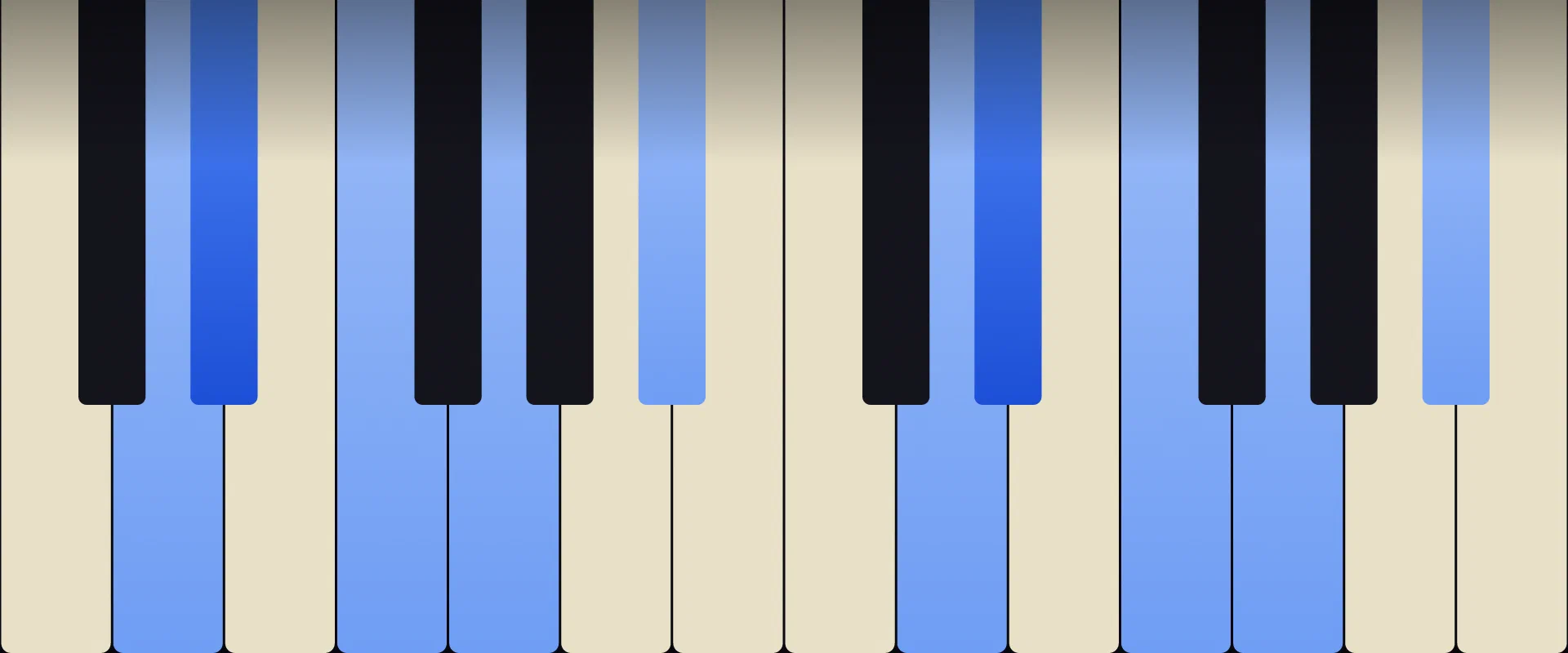
The five notes sort themselves by colour. E♭ and B♭, the root and the fifth, are the black keys, and each is the upper key of its group: E♭ at the top of the group of two, B♭ at the top of the group of three. G, D and F, the third, the seventh and the ninth, are white. Of the twelve major ninth chords this is the only one that divides that way, root and fifth raised and every other degree natural.
Play it along that line. Left hand takes E♭ and B♭, a perfect fifth, fingers 5 and 1, sitting back among the raised keys. Right hand takes G, D and F with 1, 4 and 5, all of it at the front of the keyboard. Neither hand changes level in the middle of the chord.
That split puts F on top, which is where it wants to be. Bring it down an octave, into the gap between E♭ and G, and the widest chord in the key becomes a smudge.
From that position, single notes lead out in opposite directions. Lower the D to D♭ and you have E♭9, which now wants A♭. Lower the G to G♭ instead and you get E♭m(maj9), the chord film composers use when something is about to go wrong. Lower both and you land on E♭m9.
E♭maj9 on the Guitar
Two of the six open strings belong to this chord, and they are next to each other. Open D is the major seventh, open G is the major third, and those are the two degrees that carry the chord’s identity, handed over for nothing.
The catch is register. Open D sits a semitone below the E♭ you would fret at the 6th fret of the 5th string, so the free notes and the obvious root cannot both be used without a minor second at the bottom of the chord. Drop the root instead. x x 0 0 6 6 rings D and G open and lays the index finger across the top two strings at the 6th fret for F and B♭: one finger, four notes, and over an E♭ bass it is the whole chord.
With a root of its own, the working shape sits at the 6th fret: x 6 5 7 6 x, sounding E♭, G, D and F. Middle finger on the 5th string at the 6th, index on the 4th at the 5th, little finger on the 3rd at the 7th, ring finger on the 2nd at the 6th. Four strings, no barre, and the degree left out is the fifth.
It is also one fret from its own dominant. Move the little finger back to the 6th, D becomes D♭, and x 6 5 6 6 x is the 9th shape described on the E♭9 page. One string, one fret, and the chord stops resting and starts pointing.
For a low root, take the E form up to the 11th: 11 13 12 12 x 13, sounding E♭, B♭, D, G and F, all five notes with nothing doubled. Index at the 11th on the 6th string, ring at the 13th on the 5th, middle flattened across the 4th and 3rd at the 12th, little finger at the 13th on the 1st, 2nd string muted. The six string version needs a full barre up where the frets have crowded together, and buys you a second B♭.
Inversions
| Inversion | Notes | Lowest note |
|---|---|---|
| Root position | E♭ G B♭ D F | E♭ |
| 1st inversion | G B♭ D F E♭ | G |
| 2nd inversion | B♭ D F E♭ G | B♭ |
| 3rd inversion | D F E♭ G B♭ | D |
| 4th inversion | F E♭ G B♭ D | F |
Nobody inverts a five note chord for its own sake, so read the table as a list of things a bass player can do to you. G underneath is harmless.
Fourth inversion is the row worth knowing. F under these five notes gives a root, a flat seventh, a ninth, a fourth and a thirteenth, with no third anywhere: F13sus4 missing only its fifth. It has somewhere to go, and where it goes is B♭. Arrangers write E♭maj9/F for exactly that, a suspension over the second degree that costs the pianist no change of shape.
Second inversion is the one to avoid. With B♭ at the bottom the ear hears a B♭ chord carrying an eleventh, and an eleventh over a major third is the pairing the extended chords guide tells you to keep apart.
Voicings
Drop B♭ first if you need to shed a note. E♭, G, D and F is the complete statement, which is why the fret 6 guitar grip above contains exactly those four.
Leave the root out and what remains, G B♭ D F, is a G minor seventh chord: the same four notes the E♭maj7 page recommends for comping. A rootless E♭maj7 voicing with the ninth in it is not a version of E♭maj7, it is this chord, which means pianists play E♭maj9 whenever they see E♭maj7 and leave the root to the bass.
For solo piano, spread it: E♭ low, G a tenth above it, then D and F over that. The tenth is what makes the chord sound like a whole room on a keyboard and like four cramped strings on a guitar.
Which Keys Contain E♭maj9
- I of E♭ major
- IV of B♭ major
- III of C natural minor
- VI of G natural minor
- VII of F dorian
- IV of B♭ mixolydian
Four of the six are one key signature read from different degrees. E♭ major, C natural minor, F dorian and B♭ mixolydian are the same seven pitches, so learning the chord in one hands you the other three. B♭ major and G natural minor make up the other pair.
One absence is instructive. E♭maj7 belongs to G harmonic minor as its sixth degree chord. E♭maj9 does not, because that scale’s seventh degree is F♯ and this chord needs F natural. Adding the ninth costs the chord a key.
Where E♭maj9 Shows Up
E♭maj9, B♭m7, E♭7, A♭maj9. The opening two bars of “Misty”. Watch individual notes going into B♭m7: B♭ and F stay exactly where they are and D falls a semitone to D♭. One voice moves. The tune’s whole first phrase is built out of changes that small.
Gm7, E♭maj9. Play Gm7 in the right hand and put E♭ underneath it with the left. The third degree chord of E♭ major becomes the first degree chord without a finger moving above the bass, and songwriters reach this chord that way far more often than they build it up from its root.
Gm9, E♭maj9. In G minor the tonic ninth and the sixth degree ninth are one note apart. Gm9 is G, B♭, D, F and A; take the A away, add an E♭ below, and everything else stays put. That is why so many minor key songs in flat keys wander into E♭ without announcing it.
Related Chords
Learn More
Practice Chords
Drill chord recognition with a metronome, MIDI support, and score tracking.
Start PracticingRelated Articles

A Major 9th Chord: Notes, Voicings, and How to Play It
Sep 4, 2026 · 9 min
A♭ Major 9th Chord: Notes, Voicings, and How to Play It
Sep 4, 2026 · 8 min
B Major 9th Chord: Notes, Voicings, and How to Play It
Sep 4, 2026 · 8 min