Five notes, four strings. Below the fifth fret the third string of a guitar offers G, A♭, A, B♭, B and C, and exactly one of those belongs to Dmaj9. So that string is committed to the A at the second fret, the fourth string stays open for the root, and F♯, C♯ and E all have to fit on the two thinnest strings. Three notes, two slots. The open D box does not miss this chord by a semitone or an awkward stretch. It runs out of strings.
The repair is smaller than it sounds. Give up the open fourth string, take the F♯ from its fourth fret instead, and pick the root back up on the fifth string at the fifth fret, which is the same D at the same pitch on a thicker string. The chord does not move register. It just stops being free.
Try It: Dmaj9 in the Chord Finder
The Notes of Dmaj9
Dmaj9 is five notes: D, F♯, A, C♯ and E.
| Degree | Note | Interval from Root | Semitones |
|---|---|---|---|
| 1 (Root) | D | Perfect unison | 0 |
| 3 | F♯ | Major 3rd | 4 |
| 5 | A | Perfect 5th | 7 |
| 7 | C♯ | Major 7th | 11 |
| 9 | E | Major 9th | 14 |
How Dmaj9 Is Built
Take Dmaj7, D F♯ A C♯, and put an E fourteen semitones above the root. The E is the second degree of D major carried up an octave, and it arrives without argument: reduce it to the same octave as the third and it sits a whole tone under F♯, which is a step, not a scrape.
Push the stack one third further and the picture changes. The next note would be G, and G against F♯ is a semitone. That is why Dmaj9 is where most players stop on this root, and why the useful eleventh here is G♯ rather than G. The extended chords guide sets out that rule and the difference between this chord and Dadd9, which takes the same E and leaves the C♯ out.
The four notes above the root spell F♯ minor 7th complete, which is the iii chord of this key standing on the tonic’s shoulders. A bassist on D and a guitarist on F♯m7 produce Dmaj9 between them without either choosing it.
Dmaj9 on the Piano
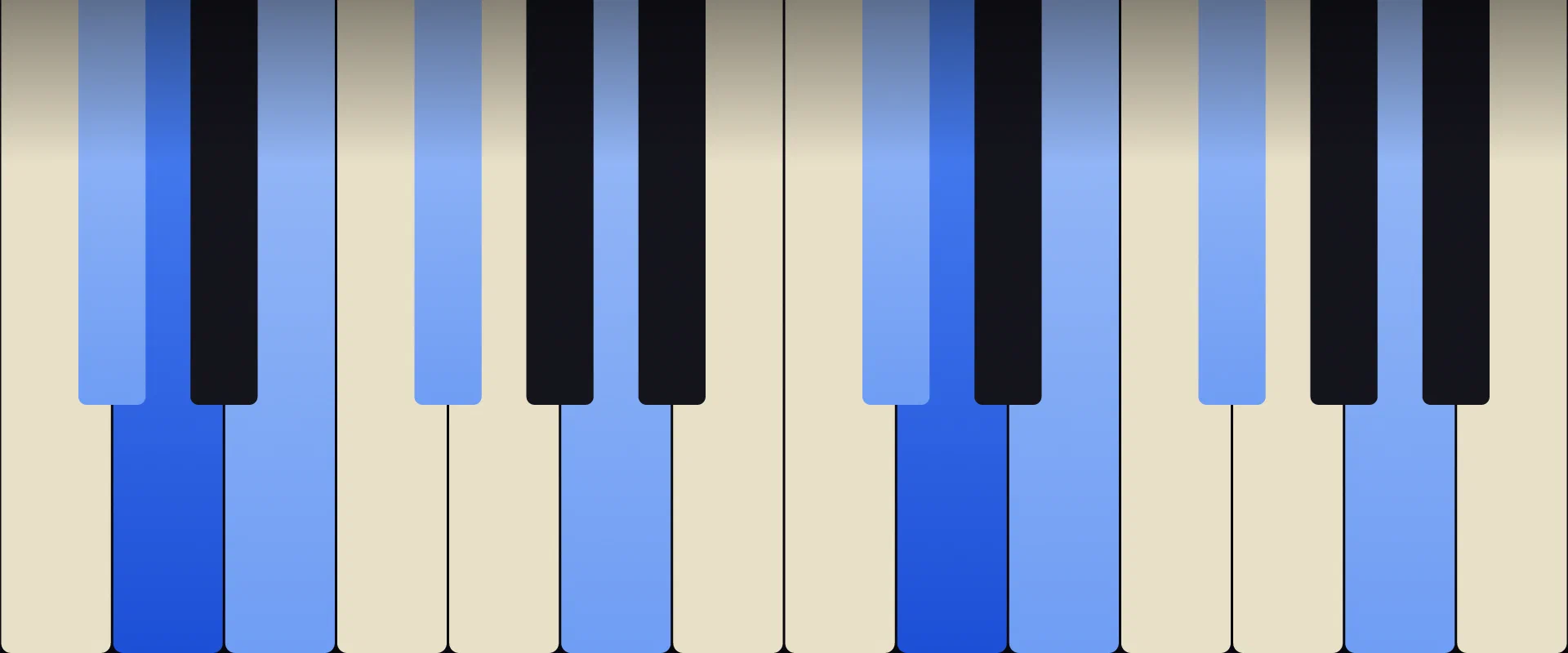
Two black keys and three white, and the split is not arbitrary: F♯ and C♯ are the third and the seventh, so both notes that decide the quality of this chord sit back off the front of the keyboard, while D, A and E, the root, fifth and ninth, are the plain white frame around them.
That has a practical consequence. Miss the C♯ and what sounds is D F♯ A E, which is Dadd9 and will pass unnoticed in a band. Miss the F♯ and you get D A C♯ E, which has no third at all. A slipped finger here does not produce a wrong note so much as a different chord.
Root position spans a ninth, so give the D to the left hand and take the rest in the right. Resist the obvious F♯ A C♯ E, which puts the thumb on a black key at the back of the keys. Roll it up one step to A, C♯, E, F♯: thumb on white, and the top note is then the third, the brightest thing in the chord. That stack is also A6, so most hands already own it.
Keep the E up there with it. E and D are a whole tone apart, and a whole tone in the bass thickens everything above it.
Dmaj9 on the Guitar
Work outwards from x x 0 2 2 2, the one finger Dmaj7. Every four string attempt in that position drops one of the five notes, and it is worth seeing which:
| Shape | Notes low to high | What is missing |
|---|---|---|
| x x 0 2 2 2 | D, A, C♯, F♯ | the 9th |
| x x 0 2 2 0 | D, A, C♯, E | the 3rd |
| x x 0 2 5 2 | D, A, E, F♯ | the 7th |
| x 5 4 2 2 0 | D, F♯, A, C♯, E | nothing |
x 5 4 2 2 0 is the complete chord and it is a reasonable grip: little finger at the fifth fret of the fifth string, ring finger at the fourth on the fourth, index flat across the third and second strings at the second, first string open. Four frets from end to end, one tiny barre, and the notes come out in textbook order, root through ninth, none doubled.
There is an easier one. x 5 2 2 2 2 keeps the little finger where it was and barres the index straight across the second fret, and it also contains all five notes. What it does with them is worse: the E lands directly above the bass D, a whole tone at the bottom of the chord rather than the top, and the result is dense where this chord wants to be transparent. Play both and the argument makes itself.
Drop the root and the shape becomes friendly. x x 4 2 2 0 is F♯ A C♯ E on the top four strings, which is the whole chord minus the note a bass player is already covering.
Higher up, the A shape at the fifth fret gives x 5 4 6 5 5, five strings across three fret numbers with nothing to barre. The E shape at the tenth fret wants all six strings across frets 10, 11 and 12, which four fingers cannot hold, so mute the fifth and play 10 x 11 11 10 12: still the complete chord, now with a low D underneath it.
Inversions
| Inversion | Bass Note | Notes | Symbol |
|---|---|---|---|
| Root position | D | D, F♯, A, C♯, E | Dmaj9 |
| 1st inversion | F♯ | F♯, A, C♯, E, D | Dmaj9/F♯ |
| 2nd inversion | A | A, C♯, E, D, F♯ | Dmaj9/A |
| 3rd inversion | C♯ | C♯, E, D, F♯, A | Dmaj9/C♯ |
| 4th inversion | E | E, D, F♯, A, C♯ | Dmaj9/E |
Five note chords are thinned far more often than inverted, and two of these show why. With F♯ in the bass the ear hears F♯ minor 7th with a stray D in it. With C♯ in the bass the root sits a semitone above it, the one arrangement of these notes that genuinely grinds.
The fourth inversion is the useful oddity. Read E, D, F♯, A, C♯ from its own bass and the four notes above E are its seventh, ninth, eleventh and thirteenth, so Dmaj9/E is how a great many charts get an E chord with no third in it. Slash notation and inversion labelling are the same subject seen from two ends, which the guide to chord inversions takes further.
Voicings
Guitar, complete (x 5 4 2 2 0). All five notes in order, root on the fifth string.
Guitar, barre at the second fret (x 5 2 2 2 2). Easier to hold, bottom heavy.
Guitar, rootless (x x 4 2 2 0). F♯ minor 7th on the top four strings, for playing with a bass.
Guitar, A shape at fret 5 (x 5 4 6 5 5). Movable, awkward, full.
Piano, spread (D low, A C♯ E F♯ above). The working voicing, thumb on a white key.
Piano, guide tones (D and C♯ left, F♯ and E right). Third, seventh and ninth, nothing else.
Which Keys Contain Dmaj9
A five note chord leaves only two notes of a seven note scale unaccounted for, and here they are B, which never varies, and the fourth degree, which is either G or G♯. That single question is the only thing the scales holding Dmaj9 disagree about. Fourteen on this site contain it, and all fourteen are rotations of two collections, the one with two sharps and the one with three.
- I of D major
- IV of A major
- III of B natural minor
- VI of F♯ natural minor
- I of D lydian
- III of B dorian
Whether you write G or G♯ over this chord is the ♯11 decision, which the extended chords guide handles in full.
Where Dmaj9 Shows Up
Two, five, one in D major: Em9, A13, Dmaj9. Em9 is E G B D F♯. A13, voiced as players actually voice it, is A C♯ E G B F♯. Dmaj9 is D F♯ A C♯ E. Two notes belong to all three chords, E and F♯. A pianist can hold that pair in the right hand for the whole cadence while the left hand walks E, A, D underneath, and the top of the texture never moves. A two, five, one that does not visibly change on top is most of what separates ninth chord comping from block chords.
The fourth degree in A major. Dmaj9 contains A and E, the tonic and the dominant of that key, which no other extension of the IV chord manages to hold at once. Go from A to Dmaj9 and the two most stable notes in the key are still sounding underneath the change, so the subdominant never really departs. Gospel and soul arrangements lean on that: it lets a chorus sit on IV for four bars without sounding as if it is waiting for something.
The Lydian vamp. Alternate Dmaj9 with an E major triad over a held D bass and you have the sound that scores an aerial shot. The E chord supplies G♯, the note Dmaj9 leaves open, so the vamp answers the chord’s one unresolved question every second bar while the bass never moves.
Related Chords
- D Major 7th Chord, the four notes this one is built on.
- D Add9 Chord, the same ninth without the seventh.
- D Dominant 9th Chord, one semitone away at the seventh, and a completely different job.
- F♯ Minor 7th Chord, which is this chord with the root removed.
- The D Lydian Scale, the mode that answers the fourth degree question the other way.
Learn More
Practice Chords
Drill chord recognition with a metronome, MIDI support, and score tracking.
Start PracticingRelated Articles
A Major 9th Chord: Notes, Voicings, and How to Play It
Sep 4, 2026 · 9 min
A♭ Major 9th Chord: Notes, Voicings, and How to Play It
Sep 4, 2026 · 8 min
B Major 9th Chord: Notes, Voicings, and How to Play It
Sep 4, 2026 · 8 min