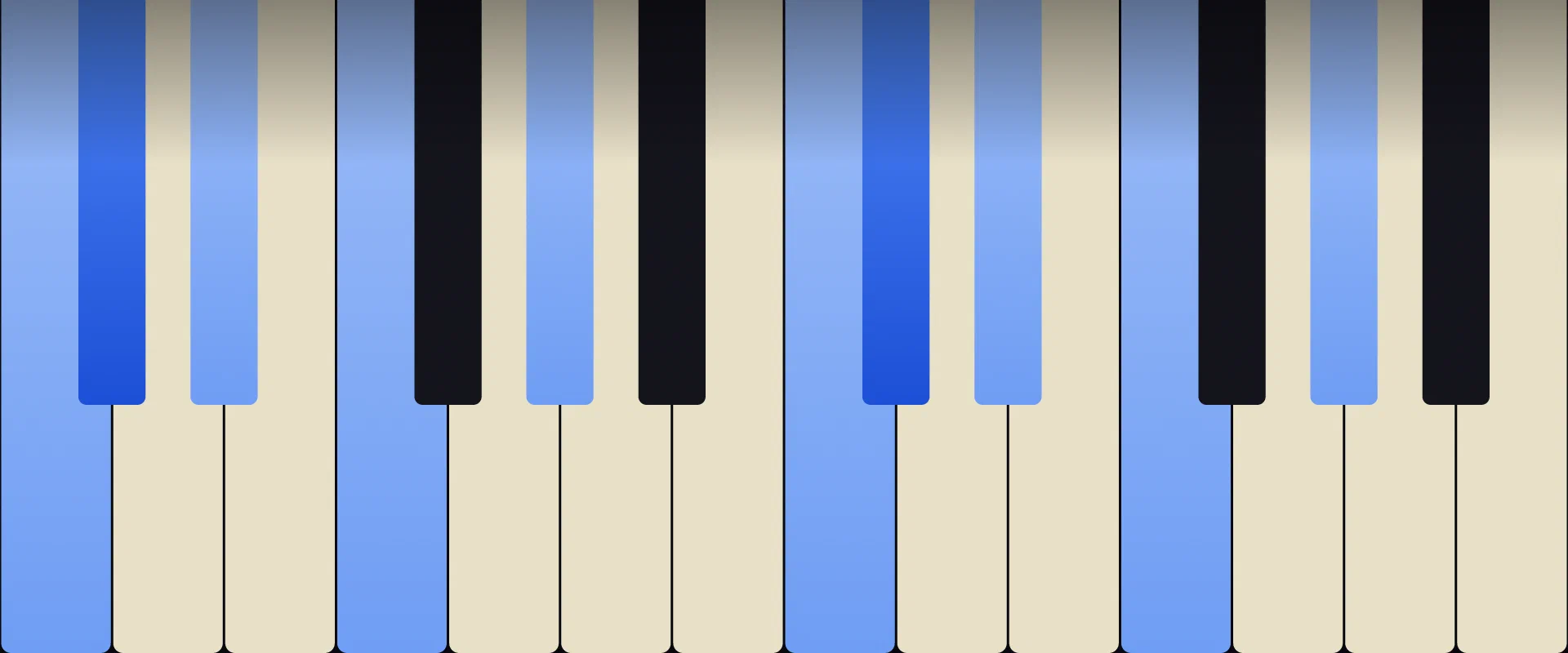
A horn section plays this chord constantly and never sees a sharp while doing it. Written as C♯maj9 it takes five accidentals, two of them on notes played on white keys. At concert pitch it is D♭maj9, five flats. But a trumpet or tenor saxophone reads a tone above concert, so the part on the stand says E♭ major, three flats, and an alto reads a major sixth above, so its part says B♭ major, two flats. The chord that looks worst on this page is, for most of a horn section, one of the easiest in the book.
Try It: C♯maj9 in the Chord Finder
The Notes of C♯maj9
| Degree | Note | Interval from root | Semitones |
|---|---|---|---|
| 1 | C♯ | Root | 0 |
| 3 | E♯ | Major 3rd | 4 |
| 5 | G♯ | Perfect 5th | 7 |
| 7 | B♯ | Major 7th | 11 |
| 9 | D♯ | Major 9th | 14 |
Two of those five, E♯ and B♯, carry a sharp and are played on the white keys F and C. The letter rule behind both is worked through on the C♯ major and C♯maj7 pages. The ninth gives no such trouble: a ninth above any kind of C is some kind of D, and D♯ is a black key exactly where the eye expects one.
How C♯maj9 Is Built
Stack a third above the B♯ of C♯maj7 and you land on D♯, a minor third higher. So the seventh and the ninth are not neighbours: three semitones apart, they sit side by side in a voicing without complaint.
The tight spot is elsewhere. B♯ is the white key immediately below C♯ and D♯ is the black key two above it, so root, seventh and ninth occupy three keys inside four semitones. Squash them into one octave and the bottom of the chord becomes a cluster, which is why this chord is always spread.
Now take the top three notes alone. G♯, B♯ and D♯ are a plain G♯ major triad, sounding A♭, C and E♭. G♯ is the fifth of C♯, so that triad is the one built on the fifth degree, and laying it over the root delivers four of the five notes in a single grip. This chord is a G♯ major triad with C♯ underneath and E♯ tucked in somewhere, and that fact runs through both instruments below.
C♯maj9 on the Piano
Three black keys and two white ones, and the black keys are not a random selection: C♯ and D♯ are the complete group of two, while G♯ is the middle key of the group of three. Root, fifth and ninth can all be found by feel.
Play D♭ in the left hand and A♭, C and E♭ in the right and the chord is nearly complete. That right hand is an A♭ major triad, black, white, black, among the first shapes anyone learns, and it is why gospel and soul pianists reach for this chord without thinking about its spelling. As a slash chord it is A♭/D♭, which is what plenty of charts print.
The missing note is the third, F. Drop it in below the triad, with 1 on F, 2 on A♭, 4 on C and 5 on E♭, and the right hand becomes an F minor seventh, ten semitones wide and easy. Put F above E♭ instead and the chord thins out, because the third then crowns the voicing and the ninth stops being the highest thing you hear.
Keep the ninth away from the bass too. D♭ and E♭ are adjacent black keys, so an E♭ down beside the root is buried rather than heard.
C♯maj9 on the Guitar
The shape that matters is four strings wide and needs no barre: x 4 3 5 4 x. Middle finger on the fifth string at the 4th fret for C♯, index reaching back to the fourth at the 3rd for E♯, little finger on the third at the 5th for B♯, ring finger on the second at the 4th for D♯. Three frets, four fingers, root, third, seventh and ninth in order, no fifth anywhere. Set it beside the C♯9 grip at the same fret and only the third string differs, one fret higher here, which is the whole distance between a dominant and a major seventh.
For a fuller chord, barre the 4th fret and play x 4 6 5 4 4: index across the barre, ring finger on the fourth string at the 6th, middle on the third at the 5th, giving C♯, G♯, B♯, D♯ and G♯. Strings four, three and two hold G♯, B♯ and D♯, the G♯ major triad from above sitting straight on the root. There is no third in it, which leaves the chord open and slightly weightless, and under a vocal that is often the better sound.
The six string form at the 9th fret does not work, and it is worth knowing why. Root, fifth, seventh and third fall at frets 9, 11, 10 and 10 on the bottom four strings, but between the 9th and 13th frets the second string offers no chord tone except G♯, and the ninth then wants the first string at the 11th. Two fingers end up demanding the same fret on opposite sides of a barre. Play 9 x 10 10 x 11 instead: index on the sixth string, middle flattened across the fourth and third at the 10th, little finger on the top string at the 11th. Wide spacing, and D♯ ringing above everything.
No open string belongs to this chord, so every voicing here is fretted and every one of them moves.
Inversions
| Inversion | Notes | Lowest note |
|---|---|---|
| Root position | C♯ E♯ G♯ B♯ D♯ | C♯ |
| 1st inversion | E♯ G♯ B♯ D♯ C♯ | E♯ |
| 2nd inversion | G♯ B♯ D♯ C♯ E♯ | G♯ |
| 3rd inversion | B♯ D♯ C♯ E♯ G♯ | B♯ |
| 4th inversion | D♯ C♯ E♯ G♯ B♯ | D♯ |
Second inversion is the friendly one. With G♯ underneath, the notes above read as G♯ major with C♯ and E♯ added, which the ear takes as a warm A♭ chord rather than as an inversion of anything.
Fourth inversion stops being a C♯ chord at all. Measured from D♯ the other notes are a ninth, an eleventh, a thirteenth and a flat seventh, with no third and no fifth above the bass, so what you hear is a suspended chord on E♭ that never resolves.
Voicings
Drop G♯ before anything else: C♯, E♯, B♯ and D♯ loses nothing, and the extended chords guide gives the order the rest go in.
Drop the root too, if a bass has it, and the remaining E♯, G♯, B♯ and D♯ sound as F, A♭, C and E♭, an F minor seventh. The rootless voicing for this chord is one most players already own.
For two hands, put C♯ low and alone, then F, C and E♭ above it across a tenth. Third and seventh identify the chord, the ninth crowns it.
Which Keys Contain C♯maj9
- I of D♭ major
- IV of A♭ major
- III of B♭ natural minor
- VI of F natural minor
- VII of E♭ dorian
- I of D♭ lydian
Every one of those pages writes this chord D♭, F, A♭, C and E♭. Fourteen scales here contain it and all fourteen sit on the flat side of the circle, so the sharp spelling has no diatonic home in the collection at all.
Function splits the list. In D♭ major and D♭ lydian the chord is home and goes nowhere, which is what a ninth on a tonic is for. In A♭ major it is the fourth degree, leaning back. In B♭ minor and F minor it is a bright chord inside a dark key. In E♭ Dorian it sits a whole tone below the tonic.
Where C♯maj9 Shows Up
| Progression | Chords | Turns up in |
|---|---|---|
| Imaj9 held | D♭maj9 | Gospel, soul, big band ballads |
| ii9 V13 Imaj9 in D♭ major | E♭m9, A♭13, D♭maj9 | Vocal charts, standards |
| IVmaj9 to I in A♭ major | D♭maj9, A♭ | Church piano, wind band |
| i9 IIImaj9 in B♭ minor | B♭m9, D♭maj9, G♭maj7 | Minor key pop, film cues |
| i9 ♭VIImaj9 loop in E♭ Dorian | E♭m9, D♭maj9 | Neo soul, house, two chord vamps |
Row three hides the best voice leading on this chord. A♭, C and E♭ are the tonic triad of A♭ major and all three sit inside D♭maj9. D♭maj7 holds only two of them, so it is the ninth that completes the set: resolve IV to I in that key and the top of the chord stays absolutely still while the bass drops from D♭ to A♭.
Row four does the same from the other side. B♭m9 is B♭, D♭, F, A♭ and C, four of them already in D♭maj9. Only B♭ leaves and only E♭ arrives, so the move from tonic to relative major barely counts as a change of chord.
Row one usually has no progression attached. A final D♭maj9, held while a singer decorates it, is how a soul ballad ends, and D♭ is the key those charts sit in because it suits the horns and a low vocal range at once.
Related Chords
- C♯ Major 7th Chord, the four note chord underneath, and the page that argues out the B♯ spelling
- C♯ Add9 Chord, the same D♯ with the seventh taken away, a much harder chord on the guitar
- C♯ Dominant 9th Chord, one fret away on the third string and a completely different function
- C♯ Major 6th Chord, the older way of colouring this triad
- Chord Inversions and Voice Leading for keeping D♯ out of the bass
Learn More
- Extended Chords and Jazz Harmony, for guide tones, rootless voicings and which tensions each chord quality will take
- Seventh Chords: The Complete Guide
- Diatonic Chords: A Beginner’s Guide
- The Circle of Fifths Explained
- D♭ Major Scale, the key that prints this chord
- E♭ Dorian Scale
Practice Chords
Drill chord recognition with a metronome, MIDI support, and score tracking.
Start PracticingRelated Articles

A Major 9th Chord: Notes, Voicings, and How to Play It
Sep 4, 2026 · 9 min
A♭ Major 9th Chord: Notes, Voicings, and How to Play It
Sep 4, 2026 · 8 min
B Major 9th Chord: Notes, Voicings, and How to Play It
Sep 4, 2026 · 8 min