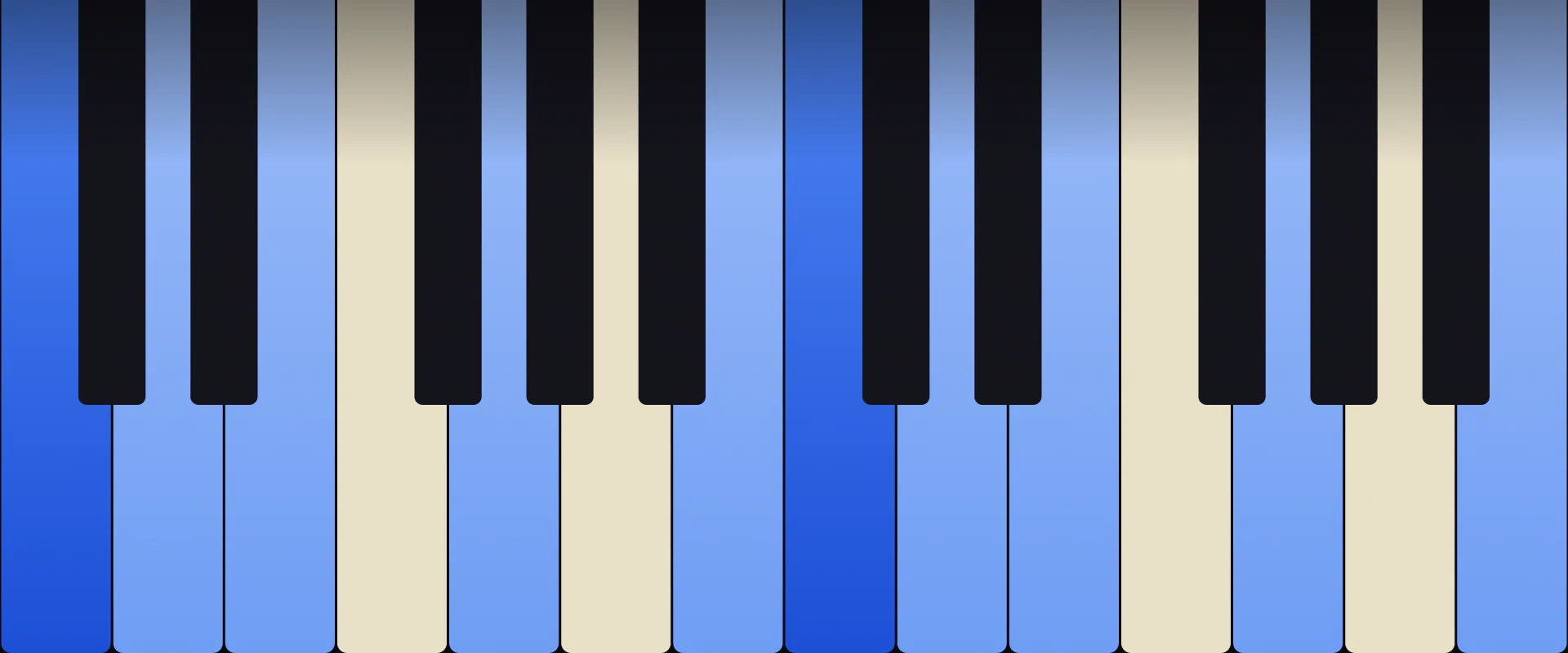
Play an E minor 7th chord and ask somebody to sound a C underneath it. That is this chord, complete and already well voiced. E, G, B and D are Em7 note for note, and they are also the third, fifth, seventh and ninth of Cmaj9, so only the bass note decides which name goes on the chart. The five notes are C, E, G, B and D, every one a white key. The two left out are F and A, precisely the notes a soloist over a C major chord has to think about: F sits a semitone above the E, and A would turn the chord into C6.
Try It: Cmaj9 in the Chord Finder
Set the root to C and switch the Ninth toggle on. Compare the chord on the first degree with the one on the third, Em9: they share four notes.
The Notes of Cmaj9
| Degree | Note | Interval from root | Semitones |
|---|---|---|---|
| 1 (root) | C | Perfect unison | 0 |
| 3 | E | Major 3rd | 4 |
| 5 | G | Perfect 5th | 7 |
| 7 | B | Major 7th | 11 |
| 9 | D | Major 9th | 14 |
Written out: C, E, G, B, D. No accidental appears anywhere, so there is no enharmonic decision to make. The 14 in the last row is a placement instruction rather than an interval name: the D is a whole tone above the root and belongs an octave above that.
How Cmaj9 Is Built
Take Cmaj7, C, E, G and B, and put one more third on top: B up to D. Nothing below moves and the seventh stays major, so the chord does not slide into being a dominant.
Read the stack from the third rather than the root and something more useful appears. Above the E stand two further thirds, G and B, so a complete E minor triad is sitting on the chord’s own third; add the D and those four notes are Em7 in root position. That is how the chord is voiced on both instruments, and how it is often written on a chart, as Em7/C.
Three of the ten intervals here are perfect fifths, C to G, G to D and E to B, which is why the chord still sounds open at a size where most chords thicken. Change one note and the family changes. B to B♭ gives C9 and an obligation with it; remove the B and you have Cadd9; flatten the E as well as the B and the five notes become Cm9. Extended Chords and Jazz Harmony covers the add9 against 9 distinction.
Cmaj9 on the Piano
One hand cannot hold this properly. C up to D is fourteen semitones with three notes standing inside it, so thumb and little finger are at full stretch before the middle fingers have anywhere to go. Give the C to the left hand alone and the right hand is left with E, G, B and D, which spans a minor 7th and sits under thumb, index, middle and little finger.
That right hand is Em7 in root position. Most players already have it from working in G major or E minor, so learning this chord at the keyboard means putting a familiar shape over an unfamiliar bass note.
Inverting the right hand changes the character without changing the name. G, B, D, E lifts the third to the top and sounds like plain C major with a rumour attached. B, D, E, G is the darkest of the four. E, G, B, D, with the ninth on top, is what anybody writing the symbol means.
Cmaj9 on the Guitar
Start from open Cmaj7, x 3 2 0 0 0, and watch what the ninth costs. D lives on the second string at the 3rd fret, but that string was supplying the open B, so the seventh has to be found again and the nearest B is the third string at the 4th fret. The open G that was ringing there is gone. The result, x 3 2 4 3 0, sounds C, E, B, D and E: two more fingers than Cmaj7, and no fifth left in the chord. The fifth is the first note any extended chord gives up, so little is lost.
All five notes are available at the nut if you insist. x 3 2 4 3 3 puts a G back on the first string, and it asks the ring finger to lie flat across the top two strings at the 3rd fret while the little finger stands over it on the third string at the 4th. Most players concede that one after a single attempt.
Up the neck the shape gives ground rather than gains it. The E form at the 8th fret has to drop the fifth string entirely: 8 x 9 9 8 10 sounds C, B, E, G and D, index barred at the 8th fret, little finger out at the 10th. The A form at the 3rd fret loses the third instead: x 3 5 4 3 x gives C, G, B and D, hollow and not really the chord a listener expects. Between the two, guitarists take the open form.
Inversions
| Inversion | Notes | Bass | Symbol |
|---|---|---|---|
| Root position | C E G B D | C | Cmaj9 |
| 1st inversion | E G B D C | E | Cmaj9/E |
| 2nd inversion | G B D C E | G | Cmaj9/G |
| 3rd inversion | B D C E G | B | Cmaj9/B |
| 4th inversion | D C E G B | D | Cmaj9/D |
A voice usually leaves before a bass note moves, so treat this as description. Two rows are worth hearing anyway. Cmaj9/E is an open Em7 with a keyboard supplying the C above it, which happens in bands by accident more often than by arrangement. Cmaj9/D is a different chord in practice: from that D the notes read as a root, seventh, ninth, eleventh and thirteenth, a suspended dominant with no third, so walking a bass down to D under a held Cmaj9 converts the harmony without a hand moving. See Chord Inversions and Voice Leading.
Voicings
Keep the D on top. It is the only note a listener has not already heard in the Cmaj7 they were expecting, so burying it in the middle wastes it.
| Shape | Frets | Result |
|---|---|---|
| Cmaj9 | x 3 2 4 3 0 | Open form, no 5th |
| Cmaj9 | x 3 2 4 3 3 | All five notes, awkward |
| Cmaj9 | x 3 2 4 3 x | Four notes: root, 3rd, 7th, 9th |
| Cmaj9 | 8 x 9 9 8 10 | E form at the 8th fret |
| Cmaj9 | x 3 5 4 3 x | Wide, no 3rd |
| Cmaj7 | x 3 2 0 0 0 | The chord it grows from |
Which Keys Contain Cmaj9
- I of C major
- IV of G major
- I of C lydian
- III of A natural minor
- VII of D dorian
- IV of G mixolydian
Rows one, five and six are the same seven notes read from three starting points, so a soloist who knows C major knows what to play over all three. C lydian changes the chord’s options rather than its notes: the F♯ there is available as a tension, and Cmaj9♯11 is the result.
What is absent matters as much. No harmonic minor appears on the list. E harmonic minor holds Cmaj7 on its sixth degree quite happily, but it raises D to D♯, so adding the ninth takes the chord out of a scale its four note version lives in.
Where Cmaj9 Shows Up
| Progression | Chords | Context |
|---|---|---|
| ii V I (C major) | Dm7, G7, Cmaj9 | The D never moves |
| I vi (C major) | Cmaj9, Am11 | Bass drops, hands do not |
| i VII vamp (D dorian) | Dm9, Cmaj9 | Modal jazz, neo soul |
| IV in G major | G, Cmaj9, D | Costs the open G string |
Follow the D through the first row. It is the root of Dm7, the fifth of G7 and the ninth of Cmaj9, so a top voice can hold that one note across the whole cadence while everything beneath it changes function. The arrival still sounds like an arrival, but nothing on top announces it, which is part of why this chord ends phrases where a plain triad would sound abrupt.
The second row is worth stealing. Hold C, E, G, B and D and move the bass from C down to A. The upper notes are untouched and the chord is now Am11, since C is its third, E its fifth, G its seventh, B its ninth and D its eleventh. One hand covers a major tonic and its relative minor, and a keyboard player in a soul band changes chord by telling the bass player rather than by moving.
The last row is where the guitar loses out. In G major this is the IV chord, and the open shapes on either side of it, G and Em7, both let the third string ring as an open G. Cmaj9 frets that string at the 4th fret, so the drone holding a fingerpicked part in G together stops dead in the middle of the bar. Guitarists there take x 3 2 4 3 x for a moment of colour and go back to Cmaj7 for anything sustained. Keyboards have no such problem, which is why bossa nova, gospel and lo fi hip hop treat this chord as an ordinary resting place while guitar led rock almost never does.
Related Chords
- C Major 7th Chord, the four notes underneath the ninth
- E Minor 7th Chord, what the top four notes spell on their own
- C Add9 Chord, the same D with no seventh below it
- C Dominant 9th Chord, B♭ in place of B, and an obligation with it
- C Major 6th Chord, the other way to colour a C major triad
- Extended Chords and Jazz Harmony for which tensions a major 7th will take
Learn More
Practice Chords
Drill chord recognition with a metronome, MIDI support, and score tracking.
Start PracticingRelated Articles

A Major 9th Chord: Notes, Voicings, and How to Play It
Sep 4, 2026 · 9 min
A♭ Major 9th Chord: Notes, Voicings, and How to Play It
Sep 4, 2026 · 8 min
B Major 9th Chord: Notes, Voicings, and How to Play It
Sep 4, 2026 · 8 min