B7 is the one chord this root gives away, and it does it with an open string. Add the ninth and the shape does not break. It stops being open. B9 is B, D♯, F♯, A and C♯, and the only C♯ within reach of first position sits on the second string at fret 2, the very string the open B7 was letting ring.
What comes out is x21222: five notes, one of each, every finger inside frets 1 and 2, and nothing sounding that is not stopped. The address survives and the free lunch does not, which turns out to be a fair trade for reasons that have more to do with funk than harmony.
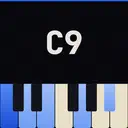
Try It: B9 in the Chord Finder
The Notes of B9
| Degree | Note | Interval from Root | Semitones |
|---|---|---|---|
| 1 (Root) | B | Perfect unison | 0 |
| 3 | D♯ | Major 3rd | 4 |
| 5 | F♯ | Perfect 5th | 7 |
| ♭7 | A | Minor 7th | 10 |
| 9 | C♯ | Major 9th | 14 |
Three accidentals, and neither the root nor the seventh is one of them. Write this chord into a piece in E major and you never reach for an accidental: B, D♯, F♯, A and C♯ are all inside that key signature. An extension importing nothing from outside the key is rarer than it sounds.
How B9 Is Built
Stack C♯ on top of B7 and stop. The tritone between D♯ and A is untouched, so the chord keeps every bit of the pull that made B7 a dominant and the ninth simply colours it.
The four notes above the root are worth naming on their own. D♯, F♯, A and C♯ is a complete D♯ half-diminished chord in root position, so B9 is a B with that chord sitting on it, which is why a pianist can play the whole thing with one note in the left hand and a familiar shape in the right.
The ninth itself forks. Lower C♯ a semitone to C natural and you have B7♭9, which belongs to a different scale. Which of the two you want is decided by the key rather than by taste, and the scale list below says how.
B9 on the Piano
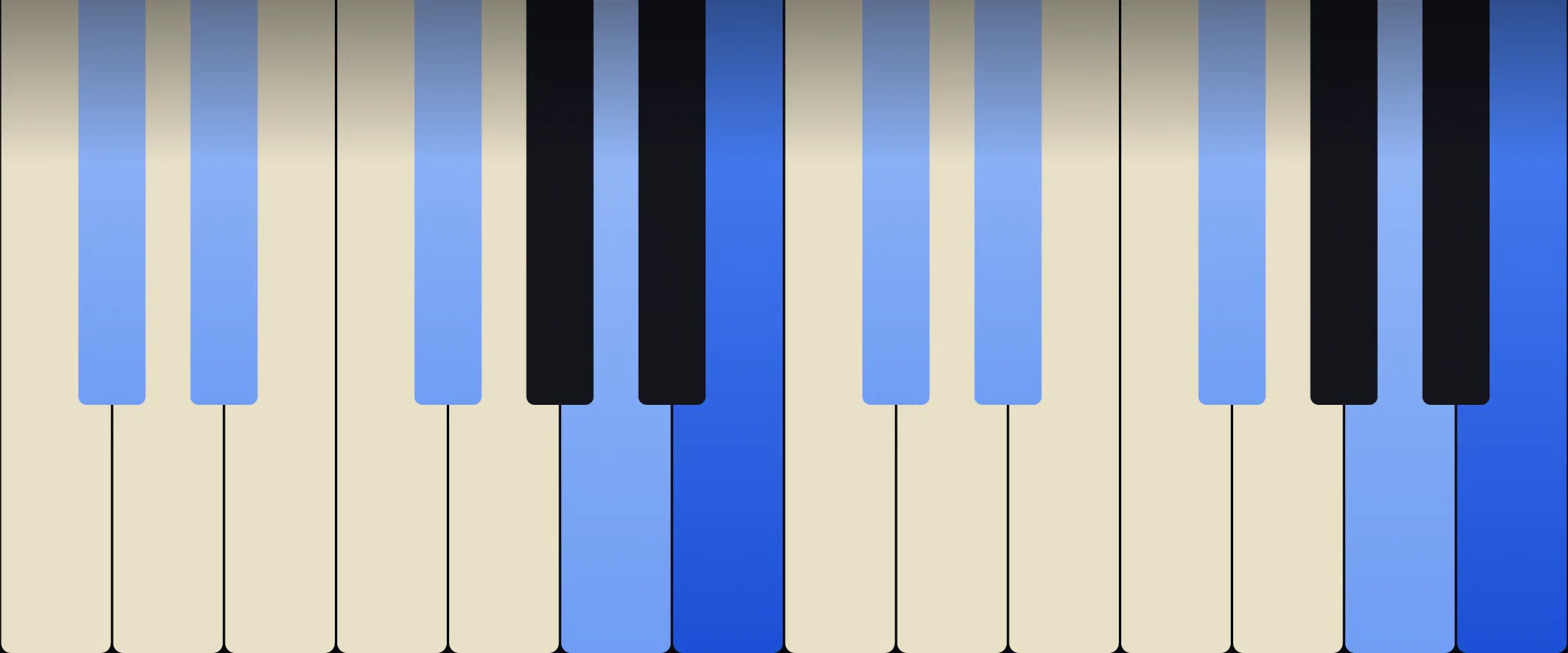
This is the chord where B outgrows a hand. Fourteen semitones from B to C♯ with five notes inside them cannot be stretched and fingered at once, so root position in one hand was never an option. Left hand takes B alone instead. Right hand takes D♯, F♯, A and C♯, with 1 on D♯, 2 on F♯, 3 on A and 5 on C♯: ten semitones, comfortable throughout, and a half diminished seventh under the fingers.
That right hand has a kink in it. D♯, F♯ and C♯ are black and A is white, and the white one sits in the middle, so the third finger comes forward to the front of the keyboard while the fingers either side stay back on the raised keys. The note that steps forward is the seventh, which is also the note with somewhere to go.
For something lighter, drop the fifth and play A, C♯ and D♯ over B in the left hand. Seventh, ninth, third: the identity of the chord in three notes inside a perfect fourth, one white key under two black ones. Keep C♯ above D♯ whatever you build, or the ninth starts sounding like a suspension that forgot to resolve.
B9 on the Guitar
x21222, string by string: fret 2 on the fifth string gives the root B, fret 1 on the fourth gives D♯, then fret 2 on the third, second and first gives A, C♯ and F♯. Middle finger on the fifth string, index on the fourth, ring finger laid flat across the top three. Three fingers, five notes, none doubled and none missing.
Set that beside x21202 and one string has changed. The second string comes off the nut and joins the fret 2 group, B becoming C♯, and that is the whole difference between the dominant seventh and the dominant ninth here. The cost is not difficulty but resonance: after the change no open string is left in the chord.
Keeping one is possible and not worth it. The only other C♯ down here is on the fifth string at fret 4, which puts the ninth in the bass: x41202 sounds C♯, D♯, A, B, F♯, and the chord loses its footing.
Trim instead. x2122x drops the first string and with it F♯, leaving root, third, seventh and ninth on four adjacent strings. That is the comfortable version and the one most records use: middle, index, then the ring finger over two strings. Cut further to xx122x for D♯, A and C♯ with no root, ready for a bass player to complete.
Higher up, the E shape at the seventh fret is 797879. Set it beside B7 in the same position, 797877, and again the top string alone moves from fret 7 to fret 9, B up to C♯. One fret on one string, in two places on the neck, and both times it is the ninth arriving.
Inversions
| Inversion | Notes | Bass Note |
|---|---|---|
| Root position | B D♯ F♯ A C♯ | B |
| 1st inversion | D♯ F♯ A C♯ B | D♯ |
| 2nd inversion | F♯ A C♯ B D♯ | F♯ |
| 3rd inversion | A C♯ B D♯ F♯ | A |
| 4th inversion | C♯ B D♯ F♯ A | C♯ |
Five note chords are not really inverted in practice, since the choice a player makes is which notes to leave out. Only the first inversion has a life of its own: D♯, F♯, A and C♯ read from the bottom is that half diminished chord in root position, so B9 with its third in the bass is a D♯m7♭5 with a B on top. The rootless voicing and the first inversion are one fact from opposite ends.
Voicings
The fifth goes first, and F♯ is what x2122x leaves out, following the order of omission the extended chords guide sets out.
The seventh never goes. Take A away and the remaining B, D♯, F♯ and C♯ are Badd9, a bright chord with no tritone that will not resolve to anything. Here you can make that substitution by accident: in x21222 the A and the C♯ sit on adjacent strings at the same fret, both under the flat of the ring finger, so a lazy third string turns the grip into x21x22, which is Badd9 exactly.
At the keyboard, give C♯ the top voice. It is the note anybody hears and the only member of the chord that is pure colour, and burying it wastes the reason you played a ninth instead of a seventh.
Which Keys Contain B9
- degree 5 (V) of E major
- degree 5 (V) of E melodic minor
- degree 4 (IV) of F♯ melodic minor
- degree 1 (I) of B mixolydian
- degree 7 (VII) of C♯ natural minor
- degree 4 (IV) of F♯ dorian
The absentee explains the fork. E harmonic minor is missing from this list even though B7 is the dominant of that scale. Its sixth degree is C natural, so the ninth above its fifth degree is C and the chord it supports is B7♭9. Raise that sixth degree, which is what melodic minor does, and C♯ arrives with B9 behind it. Choosing between C and C♯ on this root is choosing which minor you are writing in.
The C♯ minor entry has a nice property. B9 is the ♭VII there, and its ninth is C♯, the tonic of the key, so the chord furthest from home carries the home note as its brightest voice.
Where B9 Shows Up
| Progression | Numerals | Chords |
|---|---|---|
| Twelve bar in E | I9, IV9, V9 | E9, A9, B9 |
| Turnaround into E | ii7, V9, I | F♯m7, B9, E |
| Descent in C♯ minor | i, ♭VII9, ♭VI | C♯m, B9, A |
| One chord vamp | I9 | B9 |
Count the open strings across the first row and a neat series appears. E9 at 020102 has three, A9 at x02423 has one, B9 at x21222 has none. All three live in the first four frets, so a twelve bar in E can be comped entirely on ninth chords without leaving the bottom of the neck, and the V is the only one completely stopped.
That is the point of the last row and the reason losing the open string was a fair trade. A chord with nothing ringing goes dead the instant the hand relaxes, which is the whole technique behind sixteenth note funk comping, while an open second string sings on through every rest you try to place. The chord funk wants on this root is cheaper and better placed than the chord a blues wants.
Row two is the harmonic argument for the same grip. Every note of B9 belongs to E major, so F♯m7 to B9 to E moves through the key without a single accidental appearing. Soul and gospel writing in E leans on that: the dominant can be as lush as you like and the key never notices.
Row three asks the chord not to resolve at all. Against a C♯ minor tonic, B9 is a step down and a mode away, and with the tonic note ringing on top the harmony can sit there for eight bars without anybody wanting the tritone to move.
Related Chords
- B Dominant 7th Chord
- B Add9 Chord
- D♯ Half-diminished Chord
- B Mixolydian Scale
- E Melodic Minor Scale
- Guitar Chord Shapes: The CAGED System
Learn More
Practice Chords
Drill chord recognition with a metronome, MIDI support, and score tracking.
Start PracticingRelated Articles
A Dominant 9th Chord: Notes, Voicings, and How to Play It
Sep 3, 2026 · 9 min
A♭ Dominant 9th Chord: Notes, Voicings, and How to Play It
Sep 3, 2026 · 8 min
B♭ Dominant 9th Chord: Notes, Voicings, and How to Play It
Sep 3, 2026 · 8 min