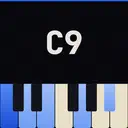
Five notes, and four is the number that gets played. Section writing is in four parts, a pianist’s right hand is comfortable with four, and the guitar grip everybody means by a 9th chord contains four different notes. So the useful question about B♭9 is which note leaves, and on this root the answer has a name of its own: take the B♭ away and what remains, D, F, A♭ and C, is a D half-diminished seventh in root position.
Both readings live in one key. Over a B♭ bass the five notes are the ♭VII of C minor and head for E♭. Under a D bass the remaining four are the ii of C minor and head for a G7 and home. Two destinations, and the bass player decides.
Try It: B♭9 in the Chord Finder
Sound B♭7 first, add the C, then take the B♭ out and listen to what is left.
The Notes of B♭9
B♭9 has five notes: B♭, D, F, A♭ and C.
| Degree | Note | Interval from B♭ | Semitones |
|---|---|---|---|
| 1 (root) | B♭ | Perfect unison | 0 |
| 3 | D | Major 3rd | 4 |
| 5 | F | Perfect 5th | 7 |
| ♭7 | A♭ | Minor 7th | 10 |
| 9 | C | Major 9th | 14 |
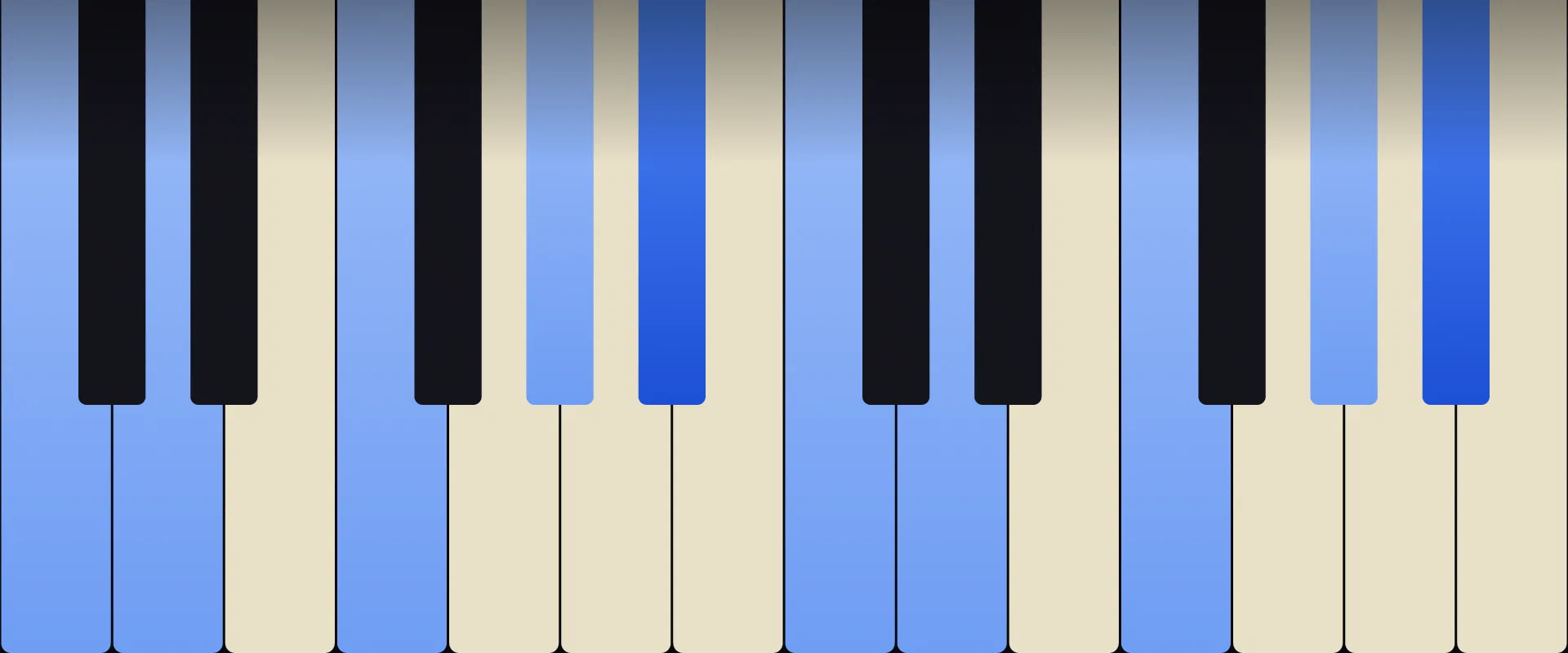
Two black keys, B♭ and A♭, and three white ones.
How B♭9 Is Built
Put C a major 9th above B♭7 and the work is done. Nothing underneath is altered, so the tritone stays, the chord keeps pulling where it was pulling already, and the C arrives purely as colour.
There is a tidier way to see it. Write out B♭ mixolydian, B♭ C D E♭ F G A♭, and take every other note from B♭: B♭, D, F, A♭, C. The two degrees skipped are E♭ and G, the chord’s 11th and 13th. E♭ is a semitone above the D, which is why nobody voices a literal eleventh chord on a major 3rd, a rule Extended Chords: Which Tensions Work sets out in full.
The neighbour to know is B♭add9, which takes the same C without the A♭ beneath it. With the ♭7 gone the chord stops being a dominant at all.
B♭9 on the Piano
With five notes and one hand there is a decision before you play anything, and the first note out is the 5th. That leaves B♭, D, A♭ and C, which reads black, white, black, white going up, so the hand alternates back and forward on every note: 1 on B♭, 2 on D, 4 on A♭, 5 on C. It spans a major 9th, a stretch for most hands, which is why the root usually goes to the left instead.
Once a bass player has the root, the rest fits one hand and two shapes are worth owning. Built up from the 3rd it is D F A♭ C: three white keys with a single black one third from the bottom, 1, 2, 3 and 5 across a minor 7th, the 9th on top where the brightest note belongs. Built up from the 7th it is A♭ C D F: the black key at the bottom, three white above it, the same fingering across a major 6th, tighter and quicker to move.
Playing solo, keep all five and split them: B♭ and F in the left hand, D, A♭ and C in the right.
B♭9 on the Guitar
The movable 9th chord shape, root on the fifth string, wants its major 3rd on the fourth string one fret below the root. Here the root is fret 1, so the 3rd is fret 0 and the open D string supplies it. B♭ is the only root that happens to: one lower and the shape runs off the end of the neck, one higher and the 3rd is a stopped note like everything else.
The result costs one finger. Play x x 0 1 1 1: the index laid across the G, B and top E strings at fret 1 gives A♭, C and F, and the open D underneath gives the 3rd. Four notes, four degrees, no root, which is the rootless voicing a pianist works to learn.
Adding the root takes one finger more. x 1 0 1 1 1 puts the middle finger on the A string at fret 1, and the index now has to cover three strings and stop, since fret 1 on the D string is E♭ and would suspend the chord. Set that against the dominant 7th here, which needs two fingers above a full barre: the ninth chord costs less than the seventh chord it extends.
Higher up, the E9 shape barred at fret 6 is 6 8 6 7 6 8 and holds all five notes, but it wants a barre plus three fingers with the little one out at fret 8. x x 6 7 6 8 is better company, giving A♭, D, F and C, the 1st fret chord reordered. Guitar Chord Shapes and the CAGED System connects the two positions.
Inversions
| Inversion | Notes | Bass note | Symbol |
|---|---|---|---|
| Root position | B♭ D F A♭ C | B♭ | B♭9 |
| 1st inversion | D F A♭ C B♭ | D | B♭9/D |
| 2nd inversion | F A♭ C B♭ D | F | B♭9/F |
| 3rd inversion | A♭ C B♭ D F | A♭ | B♭9/A♭ |
| 4th inversion | C B♭ D F A♭ | C | B♭9/C |
First inversion is the one that leads somewhere, because the moment B♭ is dropped rather than merely moved, D underneath gives Dm7♭5 outright and the chord changes allegiance.
Second inversion misleads: F, A♭ and C at the bottom is an F minor triad, and with the root that far up the ear believes it. The last row is theoretical, since a 9th in the bass has nothing above it left to be a 9th of. See Chord Inversions and Voice Leading.
Voicings
B♭ D A♭ C is the four part chord for anyone carrying their own root: 3rd, 7th and 9th kept, the 5th let go.
D F A♭ C and A♭ C D F, the two rootless shapes above, cover most of the comping this chord gets. Adding G on top gives a thirteenth chord, and moving the C a semitone either way gives the two altered ninths.
Which Keys Contain B♭9
- I of B♭ mixolydian
- V of E♭ major
- VII of C natural minor
- VI of D locrian
- IV of F dorian
- V of E♭ melodic minor
The second and fourth entries are the same seven notes read from two places, which is the chord’s double life written as scales: E♭ major names them from the key this chord resolves into, D locrian from the rootless voicing.
The F dorian entry repays a look. What makes a mode dorian rather than natural minor is its raised 6th degree, and in F that note is D, this chord’s major 3rd. F natural minor cannot produce the chord at all, so a IV of this quality is the mode announcing itself.
Run E♭ melodic minor from B♭ and you get B♭ C D E♭ F G♭ A♭, this chord with a ♭13 folded in, which is what an improviser reaches for when the target is E♭ minor.
Where B♭9 Shows Up
The most ordinary appearance is at the head of a jazz blues in this key, one note richer than the B♭7 printed on the chart. The better question is what a section plays there.
Four horns, five notes, and the answer depends on whether anyone is holding the bottom. With a bass player on B♭ the section drops the root and takes D, F, A♭ and C. Without one, the root stays and the 5th goes, giving B♭, D, A♭ and C.
That rootless version is a complete chord in its own right, so a section holding it can be pointed at either destination without changing a note.
In a cadence the 9th makes the join smoother. In E♭ major:
Fm7 | B♭9 | E♭maj7
Fm7 is F, A♭, C and E♭. B♭9 already contains F, A♭ and C, so three of those four stay exactly where they are and only E♭ moves, a semitone down to D. The plain dominant 7th shares two notes with the ii chord; the 9th makes it three, which is why the ii-V-I sounds so unhurried voiced this way.
The other place to find it is a vamp that never cadences. Sit on this chord for eight bars and the tritone stops promising E♭ and becomes colour, which is most of the harmonic content of a great deal of funk writing. On a guitar that vamp costs one finger at the 1st fret, making B♭ for once the easy key rather than the awkward one.
Related Chords
- B♭ Dominant 7th Chord, the four notes underneath, before C arrives.
- B♭ Add9 Chord, the same added C with no ♭7 beneath it, and therefore no dominant function.
- D Half-diminished Chord, what the top four notes are when the root stops sounding.
- Extended Chords: Which Tensions Work, on which notes get dropped first and why rootless voicings work.
Learn More
Practice Chords
Drill chord recognition with a metronome, MIDI support, and score tracking.
Start PracticingRelated Articles
A Dominant 9th Chord: Notes, Voicings, and How to Play It
Sep 3, 2026 · 9 min
A♭ Dominant 9th Chord: Notes, Voicings, and How to Play It
Sep 3, 2026 · 8 min
B Dominant 9th Chord: Notes, Voicings, and How to Play It
Sep 3, 2026 · 8 min