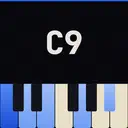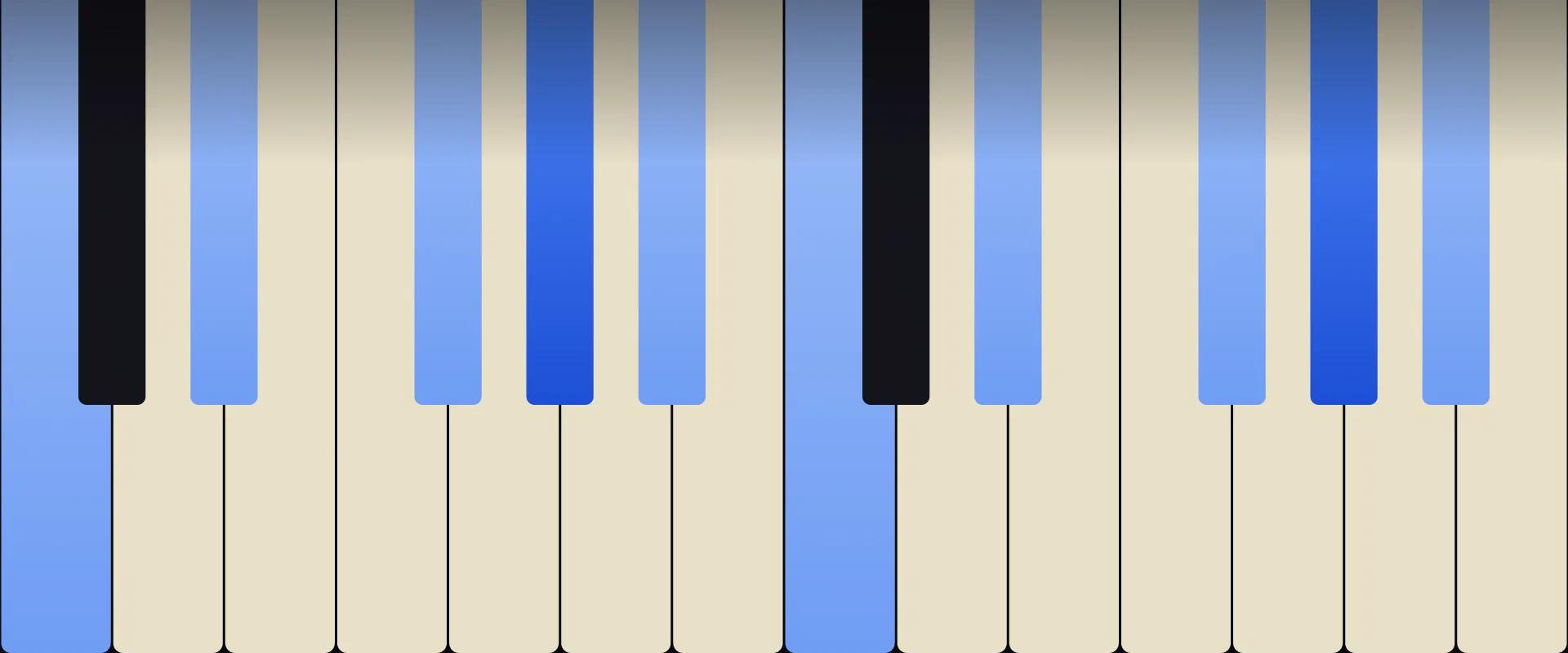
The three black keys that sit together, G♭, A♭ and B♭, are the seventh, the root and the ninth of this chord. Take them with three fingers and you are holding everything that makes A♭9 a ninth chord rather than a triad, with nothing white under the hand. A minor 7th sits a whole tone below its root and a major 9th a whole tone above, and A♭ is the only key on the instrument where both of those neighbours are black.
The chord needs one white key to finish it. C is the third, and it settles the quality that the black key group left open. E♭ comes from the group of two and is the first note to leave when the chord has to travel light.
Try It: A♭9 in the Chord Finder
The Notes of A♭9
| Degree | Note | Interval from root |
|---|---|---|
| 1 | A♭ | Perfect unison |
| 3 | C | Major 3rd, 4 semitones |
| 5 | E♭ | Perfect 5th, 7 semitones |
| ♭7 | G♭ | Minor 7th, 10 semitones |
| 9 | B♭ | Major 9th, 14 semitones |
Written low to high in root position: A♭ C E♭ G♭ B♭.
How A♭9 Is Built
A♭7 is A♭ C E♭ G♭. B♭ goes on top and nothing else changes, so the tritone between C and G♭ survives intact and the chord keeps every bit of its dominant function. That tritone is shared with D7, which is what makes the two chords substitutes for each other, and the A♭7 page works that mechanism through in full.
What the ninth does to the substitution is the part worth adding here. B♭ over a D bass is not D’s ninth. D’s ninth is E, and E is nowhere in this chord. B♭ arrives instead as D’s flattened thirteenth, E♭ as its flattened ninth and A♭ as its raised eleventh, so all five notes belong to the D altered scale and none of them is a plain extension of D7. Play A♭9 in place of D7 and you have not made the substitute richer, you have made the original chord fully altered.
It works in both directions. D9 in place of A♭7 brings in E, and E over an A♭ bass is A♭’s flattened thirteenth: each chord’s natural ninth arrives as the other one’s flattened thirteenth.
A♭9 on the Piano
Five notes, one white key, and the white key decides how the hand sits. Take the root out and what remains, C E♭ G♭ B♭, is a complete half diminished chord on C: thumb on C, 2 on E♭, 4 on G♭, 5 on B♭, an easy span of a minor 7th. Put A♭ in the left hand, or leave it to the bass player, and that grip is A♭9. The thumb is on the only white note in the chord and every other finger is forward on black, which is why the shape stays reliable at speed.
Stacking the five literally does not work. Root position runs A♭ up to B♭, fourteen semitones, and the attempt puts G♭ and A♭ side by side at the bottom, where a whole tone between two black keys sounds like a smear rather than a seventh.
The spread version fixes it by pulling the pair apart. A♭ takes the bottom with G♭ a minor 7th above it in the same hand, both black, and C E♭ B♭ goes in the right. The two notes that smeared are now a seventh apart rather than a whole tone.
A♭9 on the Guitar
The E shape at the 4th fret is 4 6 4 5 4 6 and it carries all five notes with the fifth doubled. It is the A♭7 barre with one change, the little finger reaching from the 4th fret to the 6th on the top string, so the ninth costs exactly one stretch past the barre and lands where the ear hears it, at the top of the chord.
Lift the low root and x 6 4 5 4 6 is E♭ G♭ C E♭ B♭, the same C half diminished a pianist’s right hand plays, with no A♭ in it anywhere. That is the voicing to use when a bass player is already on the root.
The other shape is the one funk was built on. With the root on the fifth string at the 11th fret, x 11 10 11 11 x gives A♭ C G♭ B♭: root, third, seventh and ninth, no fifth, four strings in the middle of the instrument with the two outer strings free to be muted by the hands holding it. The frets are cramped up there and it does not matter, because the chord is being struck and choked rather than sustained.
That same fifth string shape puts D♭9 at the 4th fret, x 4 3 4 4, right beside the A♭9 barre, so a vamp between the two never leaves the position. E♭9 is two frets further on at x 6 5 6 6.
A capo would sound this chord more cheaply and is still the wrong tool. Sixteenth note comping lives on the fretting hand choking every string between stabs, and strings ringing behind a capo cannot be choked.
Inversions
| Inversion | Notes low to high | Bass note |
|---|---|---|
| Root position | A♭ C E♭ G♭ B♭ | A♭ |
| 1st inversion | C E♭ G♭ B♭ A♭ | C |
| 2nd inversion | E♭ G♭ B♭ A♭ C | E♭ |
| 3rd inversion | G♭ B♭ A♭ C E♭ | G♭ |
| 4th inversion | B♭ A♭ C E♭ G♭ | B♭ |
Root position is not negotiable when the chord is doing a dominant’s job: the cadence depends on A♭ being the note the bass moves away from.
Third inversion changes the subject entirely. Read G♭ B♭ A♭ C E♭ from the bottom and B♭ is a major third above the bass, A♭ a ninth, C a raised eleventh and E♭ a thirteenth: a bright G♭ chord with no seventh in it at all. The site lists this chord on the second degree of G♭ lydian, and that reading is why.
Fourth inversion is the one to leave alone. With B♭ underneath, the ninth has become a root and what arrives is a suspended B♭ chord carrying a flattened thirteenth.
Voicings
Drop the fifth first. A♭ C G♭ B♭ keeps the root, the tritone and the colour, and E♭ adds nothing that anybody would miss. Drop the root as well and the rootless voicing is the C E♭ G♭ B♭ already described.
Add F on top for A♭13, A♭ C E♭ G♭ B♭ F, which is the same chord with the ninth kept and a sixth degree stacked above it. Move B♭ instead of adding to it: down a semitone gives A♭7♭9 and up a semitone gives A♭7♯9, both of which sharpen the pull into D♭ that the plain ninth deliberately softens.
Which Keys Contain A♭9
- V of D♭ major
- I of A♭ mixolydian
- VII of B♭ natural minor
- IV of E♭ dorian
- III of F phrygian
- II of G♭ lydian
Notice which keys are missing. A♭ major, E♭ major, C minor and F minor all hold the A♭ triad quite happily, and all four contain G natural where this chord needs G♭. A♭ mixolydian is where it gets to be a tonic instead.
F phrygian is the odd entry and the useful one. The chord sits on the third degree of a mode with a flattened second, so it turns up in music that never intends to cadence: a dominant with no key to resolve to.
Where A♭9 Shows Up
| Progression | In letters | Where it lives |
|---|---|---|
| I9, IV9 | A♭9, D♭9 | Funk and soul vamp in A♭ mixolydian |
| V9, I | A♭9, D♭6/9 | The cadence into D♭ |
| I9, IV9, V9 | E♭9, A♭9, B♭9 | Horn band and organ trio blues in E♭ |
Row one does not go anywhere, and that is the point of it. The seventh and the ninth are permanent residents rather than events, so the vamp runs as long as the drummer wants. Both chords live at the 4th fret in the shapes above, which is a large part of why guitarists who never choose flat keys are comfortable in this one.
Row two is the chord doing its day job, and the ninth turns out to reduce the movement rather than add to it. A♭9 is A♭ C E♭ G♭ B♭ and D♭6/9 is D♭ F A♭ B♭ E♭. Three of those five notes are the same note, A♭, B♭ and E♭, so the only voices that travel are C rising a semitone to D♭ and G♭ falling a semitone to F. The extensions on both chords behave as common tones, and what is left moving is the tritone alone.
Row three puts the chord in somebody else’s key. In a blues where every chord carries a ninth, the move from E♭9 to A♭9 changes three of the five notes, so the IV chord lands harder than it does with plain sevenths. Organ trios and horn bands work in E♭ constantly, and this is where most players meet A♭9 first: as the fourth chord of a blues rather than as a chord of its own.
Related Chords
- A♭ Dominant 7th Chord the four notes underneath, and the substitution in full
- A♭ Add9 Chord the same ninth with no seventh under it, and a chord that stays put
- A♭ Sus4 Chord for A♭9sus4, the version with the third taken out
- A♭ Mixolydian Scale the mode this chord is the tonic of
- The ii, V, I Progression where row two of the table comes from
- Secondary Dominants and Borrowed Chords for altered dominants once you have voiced one
Learn More
Practice Chords
Drill chord recognition with a metronome, MIDI support, and score tracking.
Start PracticingRelated Articles
A Dominant 9th Chord: Notes, Voicings, and How to Play It
Sep 3, 2026 · 9 min
B Dominant 9th Chord: Notes, Voicings, and How to Play It
Sep 3, 2026 · 8 min
B♭ Dominant 9th Chord: Notes, Voicings, and How to Play It
Sep 3, 2026 · 8 min