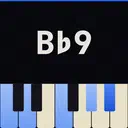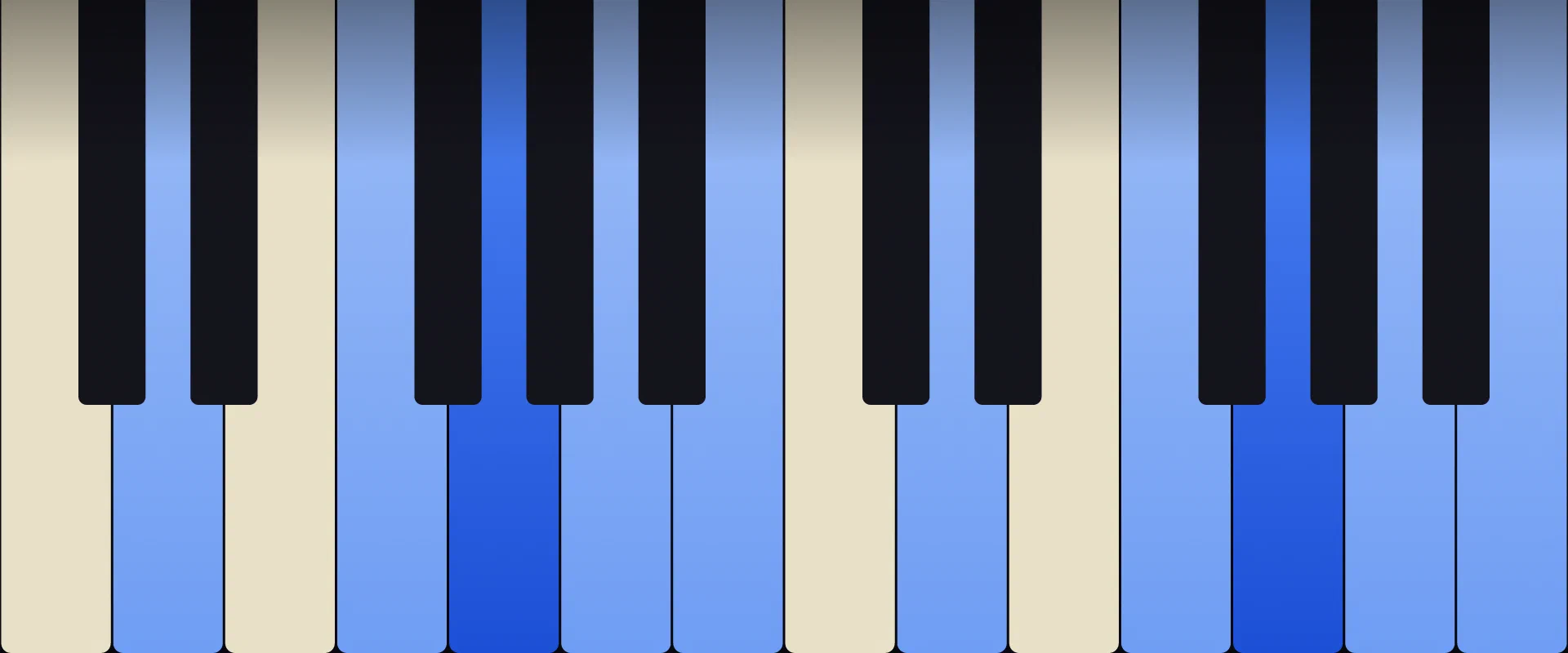
Write out the C major scale and cross off C and E. The five notes left over are G, A, B, D and F, and stacked from G they are G9. Everything the key contains apart from two thirds of its tonic triad sits in one chord, which is a fair description of what it does: it holds the whole key in suspense.
That is the theory. In practice this is a groove chord before it is a cadence chord: funk and soul guitarists play it as a four finger grip, and organ players sit on it for bars at a time without ever resolving it. All five notes are white keys, which makes it an easy chord to find and an easy one to voice badly.
Try It: G9 in the Chord Finder
The Notes of G9
| Degree | Note | Interval from Root | Semitones |
|---|---|---|---|
| 1 (Root) | G | Perfect unison | 0 |
| 3 | B | Major 3rd | 4 |
| 5 | D | Perfect 5th | 7 |
| ♭7 | F | Minor 7th | 10 |
| 9 | A | Major 9th | 14 |
A bare 9 always means dominant. The seventh is F natural rather than the F♯ of G major’s key signature, and the 9th is a plain A. Gmaj9 and Gadd9 are different chords with different jobs.
How G9 Is Built
Add A to G7, an octave and a whole step above the root. The 9th is the safest tension a dominant takes, and the grid of which extensions suit which quality lives in the extended chords guide.
The interesting structure appears once the root is gone. B, D, F and A is a complete B half-diminished chord, so the two chords that carry dominant weight in the key of C turn out to be one set of notes with and without a G underneath. A bass player supplying that G converts one into the other without the chord player moving a finger.
Take the top three notes instead and D, F and A is a D minor triad, which gives keyboard players a shortcut: a D minor triad over a G bass is already most of this chord, and adding the B completes it. The ii chord of C sitting on top of the V is no coincidence, it is what a stack of thirds produces.
G9 on the Piano
Five white keys, three of them neighbours: F, G and A. Any attempt to hold the chord inside one octave buries the root in a cluster, and lifting the A an octave clear is the entire reason the note is called a 9th rather than a 2nd.
The arrangement that always works splits the chord between the hands. Left hand takes G low and F above it, a minor 7th apart and wide enough to stay clear. Right hand takes B, D and A, so the third sits in the middle of the texture and the 9th is the top voice, where the most colourful note belongs.
Practise the ii to V move as a bass change. Hold D, F and A still in the right hand, play D in the left, then drop the left hand to G. Nothing above moves, the D minor triad becomes the top of a dominant, and adding B under the right hand fills in the third.
G9 on the Guitar
The famous grip is x 10 9 10 10 x. One finger per string on the middle four, root on the 5th string at the 10th fret, no fifth in it at all, both outer strings damped by the fretting hand. Played short and struck on the offbeat, that shape is most of what a rhythm guitarist does in funk, and the damping is not a compromise: it is what lets the chord work as a percussion part.
Chord books stop there, but the nut has something to offer. Take the open G7 at 3 2 0 0 0 1 and lift the finger off the 5th string. The B it was holding drops to the open A, and the chord keeps its third anyway, because the open 2nd string is already sounding B. The result is 3 0 0 0 0 1, six ringing strings spelling G, A, D, G, B, F, a complete G9 for the cost of one lifted finger.
It is also badly balanced, which is worth understanding rather than ignoring. The A sits at A2, a whole step above the bass G and well below the register where a second reads as harmony, so the note the chord is named for becomes the murkiest thing in it while the seventh sings on top. Mute the 6th string, play x 0 0 0 0 1, and the problem goes with it.
| Form | Frets | Notes sounded |
|---|---|---|
| Open, all six | 3 0 0 0 0 1 | G A D G B F |
| Open, no bass G | x 0 0 0 0 1 | A D G B F |
| E9 shape, fret 3 | 3 5 3 4 3 5 | G D F B D A |
| Same, five strings | 3 x 3 4 3 5 | G F B D A |
| Rootless, top four | x x 3 4 3 5 | F B D A |
| Fifth string root | x 10 9 10 10 x | G B F A |
The barred form at the 3rd fret puts every note in the right place. Compare it with the seventh chord barre at the same position, 3 5 3 4 3 3: the only difference is the top string, which climbs a whole step from a doubled root to the 9th. Most players skip the 5th string and take 3 x 3 4 3 5, which keeps the A on top and frees the hand from the barre.
Strip that to the top four strings and x x 3 4 3 5 is a rootless voicing, the half-diminished shape again, which comps behind a bass player without thickening anything.
Inversions
| Inversion | Notes | Bass | Symbol |
|---|---|---|---|
| Root position | G B D F A | G | G9 |
| 1st inversion | B D F A G | B | G9/B |
| 2nd inversion | D F A G B | D | G9/D |
| 3rd inversion | F A G B D | F | G9/F |
| 4th inversion | A G B D F | A | G9/A |
With five notes to place, which one is dropped matters far more than which one is in the bass. Two of these see regular use: the first, where the third underneath keeps the chord light beneath a melody, and the third, where the seventh in the bass commits the next chord to arriving over its own third. The last row is bookkeeping rather than a voicing, since the 9th under everything makes the ear hear A as a root.
Voicings
The 5th goes first, as always, and here that means D. Losing it costs nothing, which is why the funk grip does not contain one. What must survive is the pair of B and F and the A that gives the chord its name, so G, B, F, A is a complete statement of it on any instrument. A horn section reaches the same answer from the other end: five notes over four players means the D is written out and the 9th goes to whoever is on top. The extended chords guide sets out the order in which notes get dropped.
One resolution is worth voicing deliberately. Follow G9 with C6/9 and only two voices move: B steps up to C, F steps down to E, and G, D and A stay exactly where they were. Three common tones out of five, so the band lands on the tonic without the texture appearing to change.
Which Keys Contain G9
- V of C major
- VII of A natural minor
- I of G mixolydian
- IV of D dorian
- II of F lydian
- V of C melodic minor
Five of those six are the same seven notes read from different starting points, because C major is the only major key that holds this chord at all. It needs F natural, which rules out every sharp key, and B natural, which rules out every flat one. Rotating C major produces the modes above, each putting the chord on a different degree without changing a pitch in it.
C melodic minor is the outsider, and it explains something practical. Resolving G9 into a minor chord requires A natural, which belongs to the melodic form; C harmonic minor has A♭ instead, so classical practice reaches for a flattened 9th there. A plain natural 9th over the dominant of a minor key is a jazz sound rather than a period one.
Where G9 Shows Up
| Progression | Chords | Typical use |
|---|---|---|
| I9, IV9 in G | G9, C9 | Funk and soul vamps where both chords are dominant |
| ii7, V9, I in C | Dm7, G9, C6/9 | Jazz standards, with only two voices moving |
| III7, VI7, II7, V7 bridge in B♭ | D7, G9, C9, F9 | Swing and bebop, the middle eight of rhythm changes |
| V of V in F | F, G9, C7, F | Ragtime, trad jazz and gospel |
| Suspension into the dominant | Dm7/G, G9, C | Gospel and soul cadences |
| V9, i in C minor | G9, Cm6 | Bossa nova and film cues |
Row one is where the chord earns its living. In G mixolydian the F natural is a scale degree rather than an accidental, so the tension a dominant seventh normally carries never has to be paid off and a rhythm section can stay put for a whole verse. Nothing is unstable when nothing is asked to resolve.
The last row hides a common tone. G9 and Cm6 both contain A natural, so the 9th of the dominant becomes the 6th of the tonic without moving, which is why bossa nova writing prefers that pair to a cadence with a flattened 9th in it.
Row five is the gospel approach. Dm7 over a G bass gives the fourth degree of the key in place of the third, then G9 supplies the missing B and the cadence completes. Charts often write that first chord as G11, and the argument about sus4 against 11 is really an argument about the third.
Related Chords
- G Dominant 7th Chord, the four notes this is built on
- G Add9 Chord, the same 9th with no seventh underneath it
- B Half-diminished Chord, what remains when the root leaves
- G Major 7th Chord, whose F♯ is the note this chord refuses
- The G Mixolydian Scale
- The C Melodic Minor Scale
- Guitar Chord Shapes: The CAGED System
Learn More
Practice Chords
Drill chord recognition with a metronome, MIDI support, and score tracking.
Start PracticingRelated Articles
A Dominant 9th Chord: Notes, Voicings, and How to Play It
Sep 3, 2026 · 9 min
A♭ Dominant 9th Chord: Notes, Voicings, and How to Play It
Sep 3, 2026 · 8 min
B Dominant 9th Chord: Notes, Voicings, and How to Play It
Sep 3, 2026 · 8 min