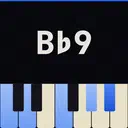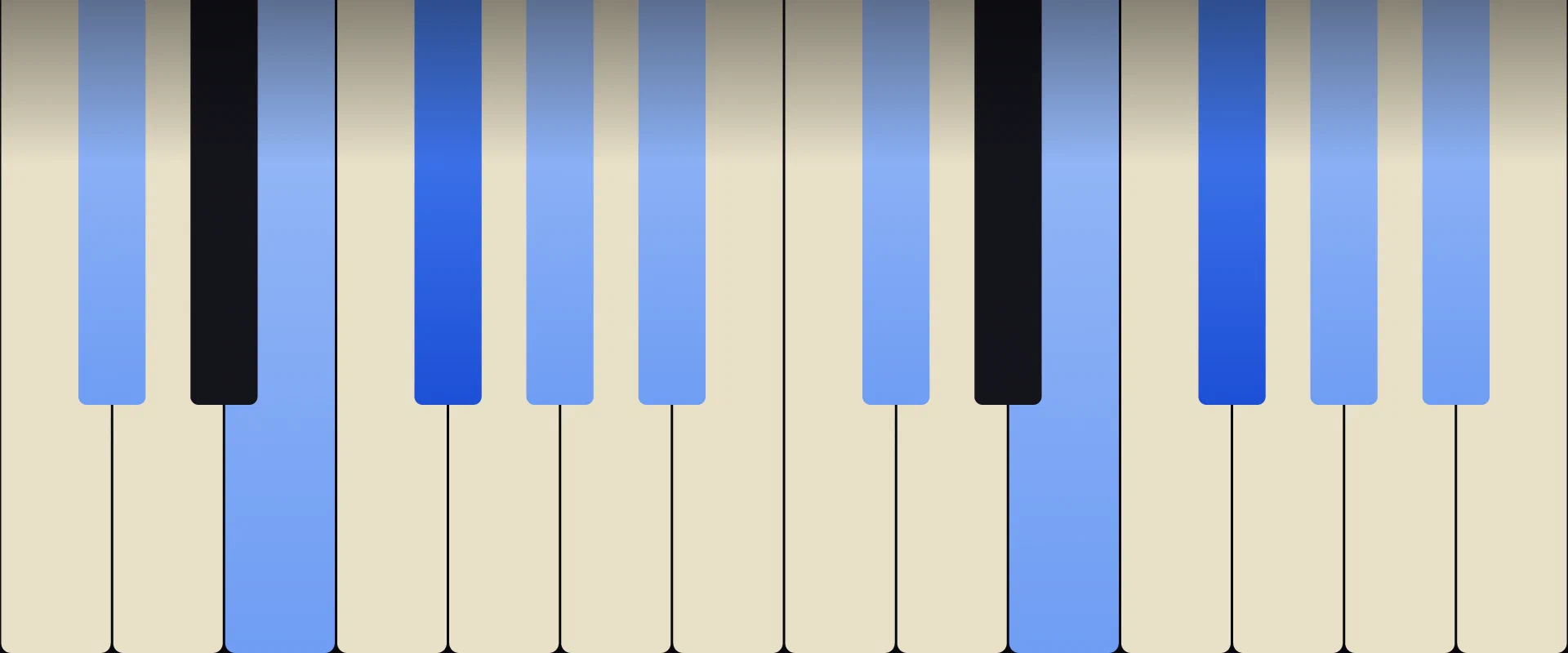
Take the root away and a complete chord is left standing. A♯, C♯, E and G♯ is a half-diminished seventh built on A♯, and it is what a pianist’s right hand actually holds when the chart says F♯9. The bass supplies the F♯, the ear hears a dominant, and the notes under the fingers spell something else entirely. That is the practical route into this chord on every instrument that has to leave notes out.
Five notes, four of them black keys, one plain E. This is where funk, soul and the ninth-fret guitar grip live.
Try It: F♯9 in the Chord Finder
The Notes of F♯9
F♯9 contains five notes.
F♯, A♯, C♯, E, G♯
| Degree | Note | Interval from root | Semitones |
|---|---|---|---|
| 1 | F♯ | Root | 0 |
| 3 | A♯ | Major 3rd | 4 |
| 5 | C♯ | Perfect 5th | 7 |
| ♭7 | E | Minor 7th | 10 |
| 9 | G♯ | Major 9th | 14 |
The G♯ arrives a whole tone above the root, so from the bottom up the chord spans more than an octave and no hand plays it as printed.
How F♯9 Is Built
Set G♯ on top of F♯7 and the job is done. Everything else follows from the two notes it inherits: A♯ and E, six semitones apart, the tritone that gives the chord its pull. Extended Chords and Jazz Harmony has the general rule for stacking a ninth and for which note gets dropped.
That tritone is shared with C7, which is why F♯7 can stand in for C7, and the F♯7 page follows the substitution through. Worth adding here is that extending both chords to ninths does not deepen the relationship at all. C9 takes D as its ninth and this chord takes G♯, and D and G♯ are themselves six semitones apart. The two ninth chords share exactly two notes, no more than the two sevenths did.
One note is deliberately absent. B, the 11th, would sit a semitone above A♯ and smother the third. On this root that has a physical consequence, described below.
F♯9 on the Piano
Learn the rootless form first, because it is the one you will use. A♯, C♯, E, G♯ under 1, 2, 4 and 5 spans a minor 7th and needs no stretching. Black, black, white, black: only finger 4 touches an unraised key. Put F♯ in the left, alone or with C♯ under it, and the chord is complete. Those same four notes over an A♯ bass are the chord A♯ locrian is built around, which is why the shape feels familiar to anyone who has practised half diminished chords.
One arrangement has to be refused. F♯ and G♯ are adjacent black keys, and putting both in the left hand turns the ninth into a growl. It belongs at the top of the right-hand voicing or nowhere.
The way in is a single finger. Hold C♯m7, which is C♯, E, G♯ and B, and let the B fall one semitone to A♯ while the left hand moves to F♯. Three of the four upper notes never move. That is the physical reason this chord follows C♯m7 so often.
F♯9 on the Guitar
The flat seventh is E natural, which is the thinnest string on the instrument, and the ninth wants that same string at the 4th fret. You cannot have both, and choosing the ninth gives the best shape on this root: 2 x 2 3 2 4. Thumb over the top for the low F♯, index flat across the 4th and 2nd strings at fret 2, middle finger on the 3rd string at fret 3, little finger on the 1st at fret 4. All five notes, none doubled, two frets from the nut.
The silent 5th string is the interesting part. At the 2nd fret it would sound B, the 11th, the one note this chord has to keep out, so the underside of the index resting on it is doing real work. Few grips are improved by a dead string. This one is.
Higher up sits the grip this chord is famous for: x 9 8 9 9 x, root on the 5th string and the third on the 4th, a fret lower but a third higher, then the seventh and the ninth on the 3rd and 2nd strings. The fifth is gone, which nobody misses, and what is left is a compact block the fretting hand can choke on every off-beat. On F♯ it lands at the 9th fret with the neck free on either side.
The rootless piano voicing has a fretboard twin, x x 8 9 9 9: A♯, E, G♯ and C♯ on the top four strings, with the F♯ left to the bass.
Inversions
| Inversion | Notes | Bass note |
|---|---|---|
| Root position | F♯ A♯ C♯ E G♯ | F♯ |
| 1st inversion | A♯ C♯ E G♯ F♯ | A♯ |
| 2nd inversion | C♯ E G♯ F♯ A♯ | C♯ |
| 3rd inversion | E G♯ F♯ A♯ C♯ | E |
| 4th inversion | G♯ F♯ A♯ C♯ E | G♯ |
The table is honest about the arithmetic and misleading about the practice. This chord is defined by having G♯ above everything else, so the rotations that push F♯ up past it barely count: the fourth row, G♯ lowest with F♯ right above it, puts the whole tone back at the bottom and the sound falls apart. The first row and the third are the ones used. E in the bass keeps the seventh where it wants to fall, down to D♯ and into B major. See Chord Inversions and Voice Leading.
Voicings
Drop C♯ first: the fifth is the note this chord can spare, and F♯, A♯, E and G♯ still says everything. Drop F♯ next and you are back to the A♯ half-diminished shape over a bass note. The thinnest version that still means F♯9 is A♯, E and G♯, guide tones plus colour, which on guitar is x x 8 9 9 x. Lose A♯ or lose E and it stops being a dominant.
Which Keys Contain F♯9
| Degree | Key |
|---|---|
| I | F♯ mixolydian |
| V | B major |
| V | B melodic minor |
| VII | G♯ natural minor |
| IV | C♯ melodic minor |
| II | E lydian |
B harmonic minor is missing, and the absence is exact rather than accidental. That scale raises its seventh to A♯, which supplies this chord’s third, but leaves its sixth as G natural, so its fifth degree yields F♯7♭9 instead. A plain ninth over B minor needs the ascending melodic form, where the sixth is raised to G♯ as well.
The C♯ melodic minor row is the jazz reading. As a IV chord the eleventh comes out as B♯ rather than B, a whole tone above the third instead of a semitone, so the note that had to be avoided everywhere else becomes available. That scale is F♯ lydian dominant.
Where F♯9 Shows Up
C♯m7, F♯9, Bmaj7. The ii, V, I of B major, and the reason to learn the one-finger move above. Soul and gospel writing in B runs on this cadence. See The ii V I Progression.
F♯9, E9, B9. A blues in B, turned around with the V dropping to the IV and then home. All three are the same grip: F♯9 at the 9th fret, E9 at the 7th, B9 at the 2nd, so the V to IV move is a literal two-fret slide with the hand shape never changing. Few guitarists choose to play blues in B, but singers put them there, and this is how the neck answers.
F♯9 held on its own. As the tonic of F♯ mixolydian the chord is not going anywhere and is not meant to. One-chord funk treats the tritone as colour rather than tension, and the 9th-fret grip is built for it: the fretting hand releases pressure between strokes and the rhythm comes from the muting, not the harmony.
The chord one step simpler on this root is F♯add9, which keeps the same G♯ and drops the E. One note is the difference between a chord that wants to move and one that is happy where it is.
Related Chords
- F♯ Dominant 7th Chord, the chord underneath this one
- F♯ Add9 Chord, the same ninth without the seventh
- B Major Chord, where this chord resolves when it resolves at all
- Guitar Chord Shapes: The CAGED System, for the shapes behind the 2nd and 9th fret grips
Learn More
- Extended Chords and Jazz Harmony, for rootless voicings and why the fifth is the first note to go
- The ii V I Progression, the cadence this chord was made for
- The F♯ Mixolydian Scale, the mode that treats it as home
Practice Chords
Drill chord recognition with a metronome, MIDI support, and score tracking.
Start PracticingRelated Articles
A Dominant 9th Chord: Notes, Voicings, and How to Play It
Sep 3, 2026 · 9 min
A♭ Dominant 9th Chord: Notes, Voicings, and How to Play It
Sep 3, 2026 · 8 min
B Dominant 9th Chord: Notes, Voicings, and How to Play It
Sep 3, 2026 · 8 min