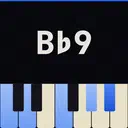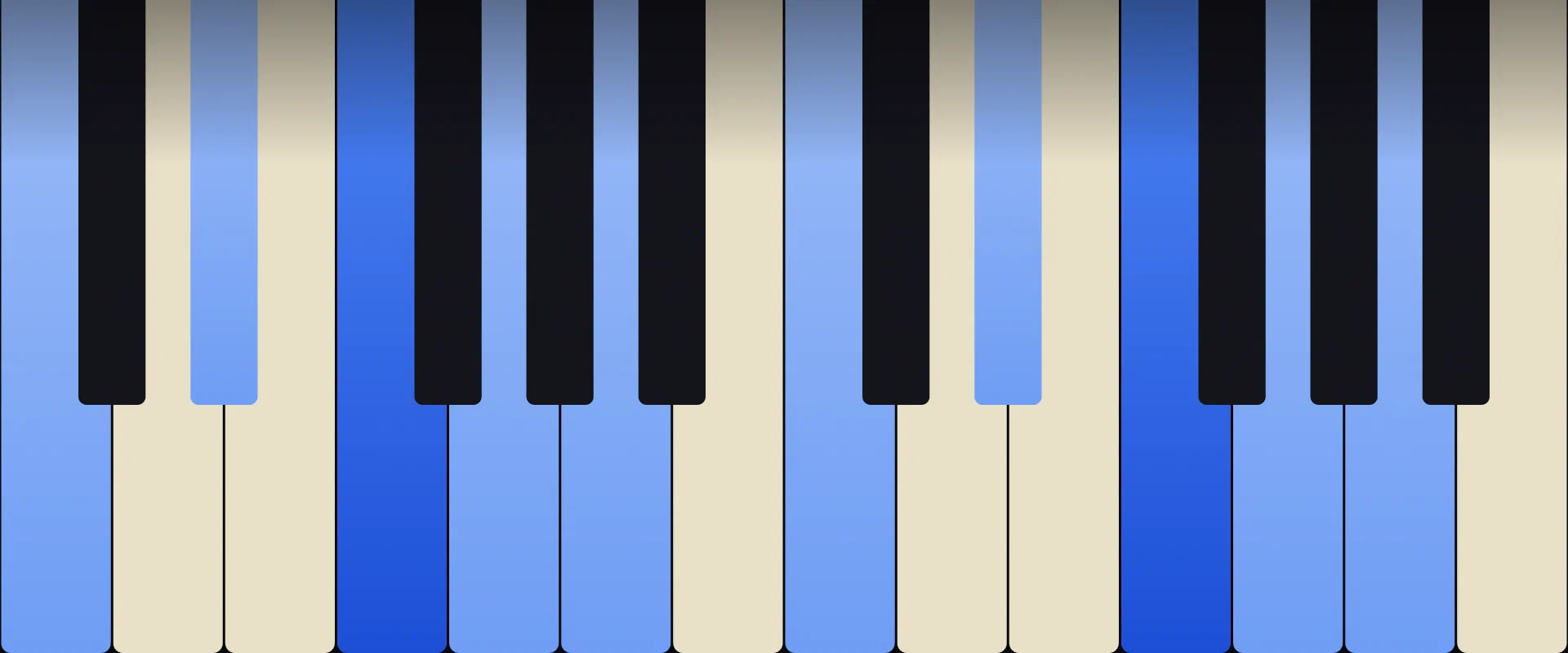
Play a C minor triad in your right hand and F in your left and four of the five notes are already down. C, E♭ and G are this chord’s 5th, its 7th and its 9th, and together they are an ordinary minor triad in odd company. What is missing is A, and A is the only thing making any of it a dominant. Everything giving F9 its lean sits under one finger. Everything giving it its colour is a triad learned in week three.
Take the F away instead and the four notes left, A, C, E♭ and G, are a chord in their own right. Read from A they are A half diminished, which that page gives as x 0 1 0 1 x, two fingers in open position. Read from C they are C minor 6th. There is one black key in the whole chord, E♭, and it is the 7th.
Try It: F9 in the Chord Finder
Set F as the root, sound the dominant 7th, then add the 9th. The chord gets wider and no more urgent.
The Notes of F9
| Degree | Note | Interval from Root | Semitones |
|---|---|---|---|
| 1 (Root) | F | Perfect unison | 0 |
| 3 | A | Major 3rd | 4 |
| 5 | C | Perfect 5th | 7 |
| ♭7 | E♭ | Minor 7th | 10 |
| 9 | G | Major 9th | 14 |
Five notes make ten pairs between them and exactly one pair is a tritone: A against E♭. That single interval is the reason the chord goes anywhere at all. G brings no new friction, being a perfect 5th above C and a major 3rd above E♭. Note also what is absent: there is no D anywhere in the chord, which the keys section returns to.
How F9 Is Built
Put G a whole tone above the octave F on top of F7, altering and dropping nothing below it. How the chain carries on above that point belongs to Extended Chords and Jazz Harmony.
Five notes hold three named chords between them. The bottom four are F7, the top four are the half diminished and minor 6th chords above, and the top three, C, E♭ and G, are C minor plain. That last one is what a player can use: a right hand that knows C minor already knows most of this chord.
Remove the 7th and keep the 9th and you have Fadd9, which settles where this one leans. E♭ is the entire difference.
F9 on the Piano
Do not put all five notes in one hand. Root position spans a 9th and stacks a major 3rd and a tritone into the octave below middle C, where they blur together.
The working split gives F to the left hand alone and A, C, E♭ and G to the right, a compact grip spanning a minor 7th, fingers 1, 2, 3 and 5, no black key under the thumb. Learn it once and the other two chords named above come with it.
There is a quicker way in for anyone who freezes at four note grips. Play C minor in the right hand with F in the left: that is F9 with no 3rd and it already sounds like the chord. Now move C down three semitones to A. One finger travels a minor 3rd, the dominant appears, and A, E♭ and G is the three note voicing pianists actually comp with.
Where G goes matters more than any other choice here. Above E♭ it is air at the top. Dropped between F and A it clusters in the bass and stops sounding like a dominant at all.
F9 on the Guitar
Start from the F7 barre, 1 3 1 2 1 1, where the index lies flat across all six strings at the 1st fret and the little finger has nothing to do. Move that finger to the 1st string at fret 3, giving 1 3 1 2 1 3, and you have F9. The note given up was a doubled F, so the 9th costs nothing harmonically and a two fret reach beyond a first fret barre physically.
Open position does better than it has any right to. The open 5th string is A, this chord’s 3rd, and the open 3rd string is G, its 9th. The three left over, E♭, C and F, all sit at the 1st fret on the 4th, 2nd and 1st strings. Middle finger on the 4th, index on the 2nd, ring on the 1st, the open strings ringing between them and the 6th muted: x 0 1 0 1 1. Five notes, three fingers, no barre, nothing doubled.
The catch is the bass. A is underneath, so on its own the grip is heard as A half diminished and wants somebody on F to finish it, which in a band is what happens.
Up the neck is where the chord earns its living. The grip is x 8 7 8 8 x: root on the 5th string at fret 8, then A, E♭ and G on the next three strings, one finger each, nothing barred. The note missing is C, which this chord can spare. Two neighbours come free of it. Move the 2nd string up a fret, x 8 7 8 9 x, and G becomes A♭ for F7♯9. Add the 1st string at fret 10, x 8 7 8 8 10, and D joins on top for F13.
If a tune has you alternating F9 and B♭9 all night, note where the second lands. B♭ sits on the 5th string at fret 1, so the same grip becomes x 1 0 1 1 x with the open 4th string supplying the 3rd, and the pair sit at opposite ends of the neck rather than side by side.
Inversions
| Inversion | Notes | Bass Note | Symbol |
|---|---|---|---|
| Root position | F, A, C, E♭, G | F | F9 |
| 1st inversion | A, C, E♭, G, F | A | F9/A |
| 2nd inversion | C, E♭, G, F, A | C | F9/C |
| 3rd inversion | E♭, G, F, A, C | E♭ | F9/E♭ |
| 4th inversion | G, F, A, C, E♭ | G | F9/G |
Five notes give four inversions and only some of them ever get written. The first row is what the open guitar shape produces and what a keyboard player gets by leaving the root to the bass. The third turns up under a descending bass line, where E♭ steps down to D and the band arrives on B♭ with its 3rd underneath.
The last row is the odd one. Nobody reading G under F, A, C and E♭ thinks of F first, so charts name it from G and treat it as a suspended sound in its own right.
Voicings
Keep G high and E♭ off the bottom. The tritone wants space, and the 9th wants to be the last thing the ear meets rather than the first.
If something has to go, it is C. The fret 8 grip below is the one shape here that has dropped it and also the shape players reach for most, which settles the question better than an argument would. What gets dropped, and in what order, is set out in the extended chords guide.
| Shape | Frets, low to high | Sounding notes |
|---|---|---|
| E9 shape, barred at fret 1 | 1 3 1 2 1 3 | F, C, E♭, A, C, G |
| Open position, no barre | x 0 1 0 1 1 | A, E♭, G, C, F |
| Fret 8, no 5th | x 8 7 8 8 x | F, A, E♭, G |
| Fret 8, 5th restored | x 8 7 8 8 8 | F, A, E♭, G, C |
| Rootless, two fingers | x 0 1 0 1 x | A, E♭, G, C |
Which Keys Contain F9
- V of B♭ major
- I of F mixolydian
- IV of C dorian
- V of B♭ melodic minor
- II of E♭ lydian
- VI of A locrian
Lines one and four are the payoff for the missing D. B♭ major and B♭ melodic minor part company at their 3rd degree, D against D♭, and this chord holds neither, so it serves both untouched. Add a 13th, D arrives, and the chord takes a side.
Line three explains why Cm7 and F9 can run for eight bars without going anywhere: both come whole out of C dorian, so the change implies no cadence. Line five is the same chord doing the opposite job. As the II of E♭ lydian its 3rd, A, is the raised 4th degree that gives the mode its character, and holding F9 over an E♭ bass is the plainest way to hear it.
Where F9 Shows Up
| Progression | Chords | Where it lives |
|---|---|---|
| ii7, V9, Imaj7 | Cm7, F9, B♭maj7 | Standards and section writing in B♭ |
| i7, IV9 | Cm7, F9 | Modal vamps in C dorian |
| I9, IV9, I9 | F9, B♭9, F9 | Funk and soul in F |
Count what the first two chords of row one share. Cm7 is C, E♭, G and B♭; F9 is F, A, C, E♭ and G. Three of Cm7’s four notes survive, so an arranger holds C, E♭ and G still, drops B♭ a semitone to A and puts F underneath. One voice moves. Plain F7 would keep only C and E♭. That is why saxophone writing in this key treats the 9th as a default rather than a decoration.
Row two is the same two chords with the resolution withheld. Sharing that much, they read less as harmony moving than as one sound opening and closing, which is what modal jazz and Latin writing want from them, and the soloist has a single scale for both bars.
Row three is the chord as home. F mixolydian hands it the tonic, and the 9th is what stops a one chord groove going stale, since the ear takes colour where it cannot have movement. In a blues in C this chord is the IV, and that bar belongs to F7. All the 9th adds there is G, the 5th degree of the key and already in the singer’s ear, which is why nobody writes it into a blues chart.
Related Chords
- F Dominant 7th Chord is the chord underneath this one.
- F Add9 Chord keeps the 9th and drops the 7th, removing the pull.
- A Half-diminished Chord is this chord with the root taken away.
- C Minor 6th Chord is those four notes read from the other end.
- B♭ Major Chord is where the tritone inside is pointing.
Learn More
Seventh Chords: The Complete Guide covers the chord this is built on, and Extended Chords and Jazz Harmony carries the stack up to 11 and 13. For Cm7 to F9 to B♭ in detail, see the ii V I progression. F and B♭ are neighbours on the circle of fifths, the shortest account of where this chord spends its time. For every scale containing it, see Scales for Piano and Guitar: The Complete Reference Guide.
Practice Chords
Drill chord recognition with a metronome, MIDI support, and score tracking.
Start PracticingRelated Articles
A Dominant 9th Chord: Notes, Voicings, and How to Play It
Sep 3, 2026 · 9 min
A♭ Dominant 9th Chord: Notes, Voicings, and How to Play It
Sep 3, 2026 · 8 min
B Dominant 9th Chord: Notes, Voicings, and How to Play It
Sep 3, 2026 · 8 min