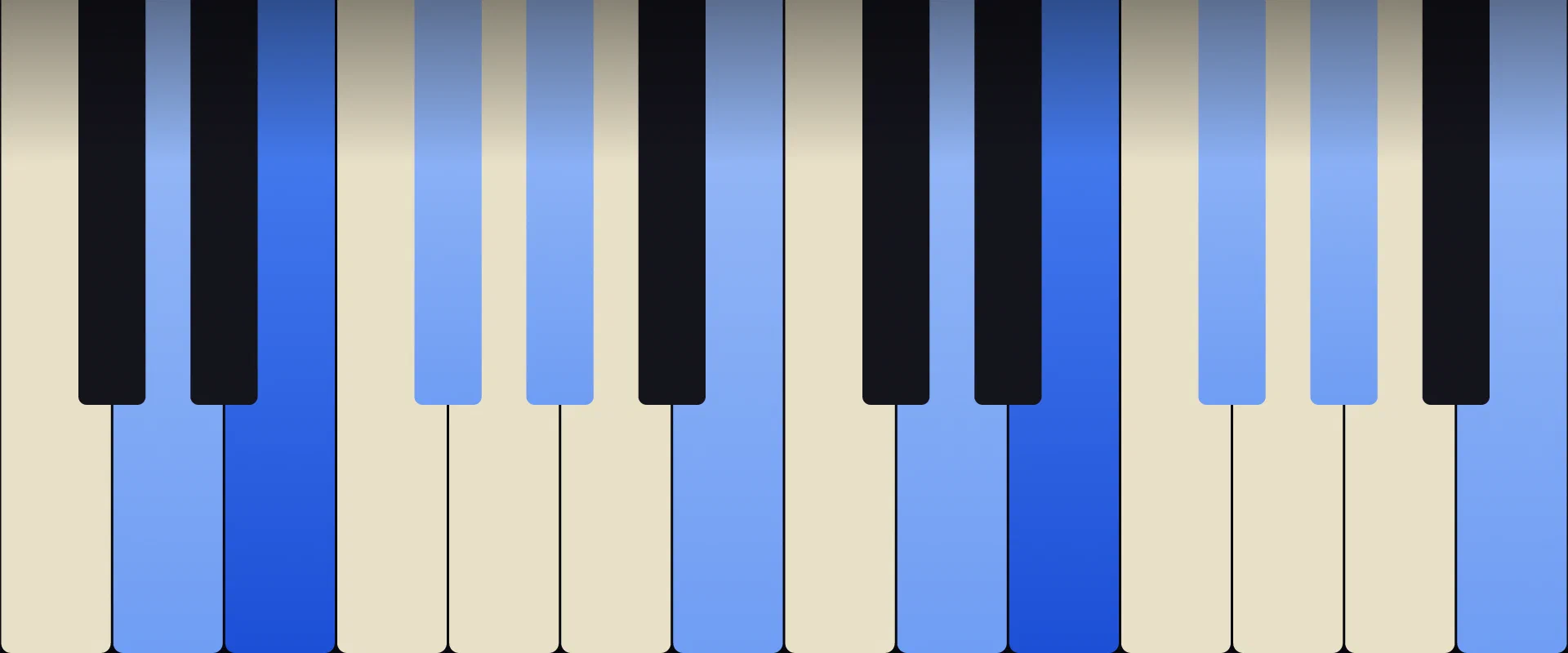
A dominant ninth needs five notes and a guitar has six strings, so something normally gets left out. Not here. Fret 0 2 0 1 0 2 and the strings sound E, B, D, G♯, B and F♯ from the bottom up: every note of the chord, one doubled fifth, three strings still open. The finger that makes it a ninth is the little finger on the first string at the 2nd fret, and what it displaces is the top E, the higher of two roots the chord can spare. No two neighbouring strings in the result are closer than a minor third, so nothing beats against anything else, and the F♯ lands as the top voice where a band cannot bury it. That arrangement, rather than any general fact about the root, is why funk and soul rhythm guitar keeps coming back to this chord.
Try It: E9 in the Chord Finder
Set the root to E and the scale to Mixolydian, then switch the Ninth toggle on and off over the first degree. Move to A major afterwards and the same five notes reappear on the fifth.
The Notes of E9
E9 is E7 with a major 9th stacked on top:
E, G♯, B, D and F♯
| Degree | Note | Interval from Root |
|---|---|---|
| 1 (Root) | E | Perfect unison |
| 3 | G♯ | Major 3rd |
| 5 | B | Perfect 5th |
| ♭7 | D | Minor 7th |
| 9 | F♯ | Major 9th |
Three white keys and two black. The seventh is D natural rather than the D♯ of the E major scale, while the ninth is F♯, which E major does supply. All five belong to E Mixolydian, so one mode covers the chord with nothing borrowed.
How E9 Is Built
Four semitones from E to G♯, three to B, three to D, four to F♯. The tritone between G♯ and D is inherited whole from E7 and does the same work, but it is no longer the outer edge of the chord, which changes what a listener notices first.
Two identities are worth carrying around. Take the E away and G♯, B, D and F♯ are a G♯ half-diminished chord in root position, complete, which is what makes a rootless E9 so easy to reach for once a bass player has the bottom covered. Take the D away instead and you have Eadd9, a chord that pulls nowhere at all. One note carries the whole difference.
The ninth being F♯ rather than F natural is also a statement about where the chord is going. In A major, E is the V and its ninth is a plain F♯ from the key. A harmonic minor has F natural on its sixth degree, so the V chord there takes a flattened ninth and becomes E7♭9. An E9 met without context is pointing at A major, and it has already ruled out the minor version.
E9 on the Piano
Five notes spanning a major ninth. Played close, E, G♯, B, D and F♯ take fingers one to five in order with no crossing, but the wide gaps land badly: a major third from thumb to second finger, two minor thirds, then another major third between the fourth and fifth, the weakest pair asked for the biggest reach.
Dropping the fifth solves it.
Left hand: fifth finger on E, thumb on B a fifth above.
Right hand: thumb on G♯, third finger on D, fifth finger on F♯.
Third, seventh and ninth in the right hand, with the tritone under thumb and middle finger where it is easy to feel. The rootless version, G♯, B, D and F♯ with fingers one, two, three and five, has black keys at both ends and white ones in the middle, so the hand sits deep at its edges and forward in its centre. Learn it as a shape in its own right, since it is also G♯m7♭5 and gets used under both names.
Whatever the arrangement, keep F♯ above D. Let the seventh become the top voice and the ear hears E7 with an extra note buried in it.
E9 on the Guitar
The open form repays a look at which notes the fretting hand actually controls. Three strings are fretted: the fifth at the 2nd fret for B, the third at the 1st for G♯, the first at the 2nd for F♯. Three ring open and supply E, D and the second B. So the notes you can choke by easing off are the third and the ninth, exactly the two that name the chord, and the notes you cannot silence are the root, the fifth and the seventh. Release and re-press while strumming and the chord flickers between a full E9 and a bare E with a D in it. Funk playing near the nut is largely that flicker.
Unlike some open shapes on this root, this one transposes: an index barre, one finger a fret above it and two more two frets above that comes to four fingers exactly, so 3 5 3 4 3 5 gives G9 in the same voicing.
The grip most associated with the sound sits higher. x 7 6 7 7 x takes the index on the fourth string at the 6th fret, the middle on the fifth at the 7th, and the ring flattened across the third and second at the 7th, sounding E, G♯, D, F♯: root, third, seventh and ninth, with the fifth dropped, which is the first note to go from any extended chord. Both outer strings are muted and nothing is open, so the chord can be cut to a percussive click by relaxing the hand a fraction. The open form cannot do that, which is why the two live in different parts of an arrangement rather than standing in for each other. To put the fifth back, add the first string at the 7th fret: x 7 6 7 7 7.
Inversions
| Voicing | Notes | Bass note |
|---|---|---|
| Root position | E G♯ B D F♯ | E |
| 1st inversion | G♯ B D F♯ E | G♯ |
| 2nd inversion | B D F♯ E G♯ | B |
| 3rd inversion | D F♯ E G♯ B | D |
| 4th inversion | F♯ E G♯ B D | F♯ |
A pianist moves between all five freely. A guitarist near the nut effectively cannot, and that is a fact about this open shape rather than about the chord. Drop the sixth string from 0 2 0 1 0 2 and the root goes with it, since the only E in the voicing was that bass string: x 2 0 1 0 2 sounds B, D, G♯, B, F♯, which is not a second inversion E9 at all but G♯m7♭5 with its own fifth underneath. What the shape offers instead of inversions is rootlessness, and the two are not the same thing.
Voicings
- Open form, 0 2 0 1 0 2, all five notes, three strings ringing.
- Barred, the same pattern moved, 3 5 3 4 3 5 at the 3rd fret for G9.
- Funk grip, x 7 6 7 7 x, no fifth, no open strings, cuts dead on release.
- Full grip, x 7 6 7 7 7, the same with the fifth restored on top.
- Piano split, E and B low with G♯, D and F♯ above middle C.
Do not double the F♯. A doubled ninth draws far more attention than a doubled root, and in a chord already carrying a tritone there is enough going on.
Which Keys Contain E9
Five notes, one of them a tritone away from another, narrow the field hard:
- degree 1 (I) of E mixolydian
- degree 5 (V) of A major
- degree 4 (IV) of B dorian
- degree 4 (IV) of B melodic minor
- degree 2 (II) of D lydian
- degree 7 (VII) of F♯ natural minor
E Mixolydian is where the chord is home rather than in transit, and it is what a funk vamp assumes without saying so. B Dorian is the useful surprise: the G♯ inside this chord is Dorian’s raised sixth, the single note that separates that mode from B natural minor, so E9 is the chord that declares it. D Lydian works the same way from another angle: the sharpened fourth that makes a Lydian scale Lydian is, in D, that same G♯.
Where E9 Shows Up
As a one chord vamp. I9 in E Mixolydian, held for as long as the groove lasts. There is no progression: a bass figure moves between E and F♯, the drums carry the form, and the guitar plays x 7 6 7 7 x on the sixteenths it wants and mutes the rest. The chord rests comfortably despite its tritone because nothing is ever set up to resolve it. Horn sections in this key voice the same five notes downwards from the F♯ so it stays in the lead trumpet.
As the V of A, in a cadence that lands. ii7, V9, I6: Bm7, E9, A6. Here the ninth pays for itself in voice leading. F♯ is the ninth of E9 and the sixth of A6, so the top voice does not move at all while everything below it resolves, and on a guitar that is literally visible: hold the first string at the 2nd fret through both chords.
As the IV of a Dorian vamp. Bm7 to E9, looped. Read as a ii and a V the pair belongs to A major and ought to resolve there. Refuse to let A arrive and it becomes B Dorian with E9 as its bright fourth degree. Modal jazz and bossa nova both run on that ambiguity, and the whole thing turns on the G♯, which is either the third of a dominant on its way somewhere or the sixth degree of a mode already at home.
The chord’s limit is register. Everything E9 offers over E7 lives in the top voice, so hand the five notes to a player who spreads them low and the ninth disappears into the texture. Put it where the F♯ can be heard, or do not write it.
Related Chords
- E Dominant 7th Chord: Notes, Voicings, and How to Play It is this chord with the first string left open.
- E Add9 Chord: Notes, Voicings, and How to Play It has the same ninth over a triad with no seventh, and consequently no pull.
- G♯ Half-diminished Chord: Notes, Voicings, and How to Play It is the top four notes of E9 read from their own root.
- E Major 6th Chord: Notes, Voicings, and How to Play It adds C♯ instead, which settles the chord rather than sharpening it.
Learn More
- Extended Chords: Which Tensions Work, and How to Voice Them covers which notes get dropped, why the fifth goes first, and how rootless voicings work.
- Seventh Chords: A Complete Guide to maj7, min7, dom7, and More covers the four note chord underneath this one.
- Chord Inversions and Voice Leading explains the held F♯ in the cadence above.
- E Mixolydian Scale: Notes, Chords, and How to Play It is the mode that contains all five notes.
Practice Chords
Drill chord recognition with a metronome, MIDI support, and score tracking.
Start PracticingRelated Articles
A Dominant 9th Chord: Notes, Voicings, and How to Play It
Sep 3, 2026 · 9 min
A♭ Dominant 9th Chord: Notes, Voicings, and How to Play It
Sep 3, 2026 · 8 min
B Dominant 9th Chord: Notes, Voicings, and How to Play It
Sep 3, 2026 · 8 min