Two familiar chords are hiding inside this one. Take the top three notes, B♭, D♭ and F, and you are holding a B♭ minor triad. Take the top four, G, B♭, D♭ and F, and you are holding G half-diminished. Neither is a curiosity. Both are how experienced players actually find E♭9 under the hand, and both explain why a chord with five notes in it almost never needs five fingers.
Try It: E♭9 in the Chord Finder
The Notes of E♭9
The chord contains five notes: E♭, G, B♭, D♭ and F.
| Degree | Note | Interval from root | Semitones |
|---|---|---|---|
| 1 | E♭ | Root | 0 |
| 3 | G | Major 3rd | 4 |
| 5 | B♭ | Perfect 5th | 7 |
| ♭7 | D♭ | Minor 7th | 10 |
| 9 | F | Major 9th | 14 |
Written E♭9. A plain 9 means the dominant seventh is underneath, so this is a dominant chord with an extra note rather than a triad with one. E♭add9 drops the D♭ and with it the chord’s reason to move, a distinction the extended chords guide covers in full.
How E♭9 Is Built
Start from E♭7, E♭ G B♭ D♭, and add F on top. The function does not change: the G against D♭ is still what makes the chord lean, and it still leans towards A♭. The surface does. That added F widens the top of the chord and takes the raw edge off the seventh without weakening it.
Notation is worth a look here. In the key of A♭ major, whose signature already carries B♭, E♭, A♭ and D♭, every note of this chord is either in the signature or a natural, so a copyist writes E♭9 without a single accidental. Move the same chord into E♭ major and the D♭ needs one every time it appears. Two keys a fourth apart, same five sounds, and one of them makes the page look twice as busy.
E♭9 on the Piano
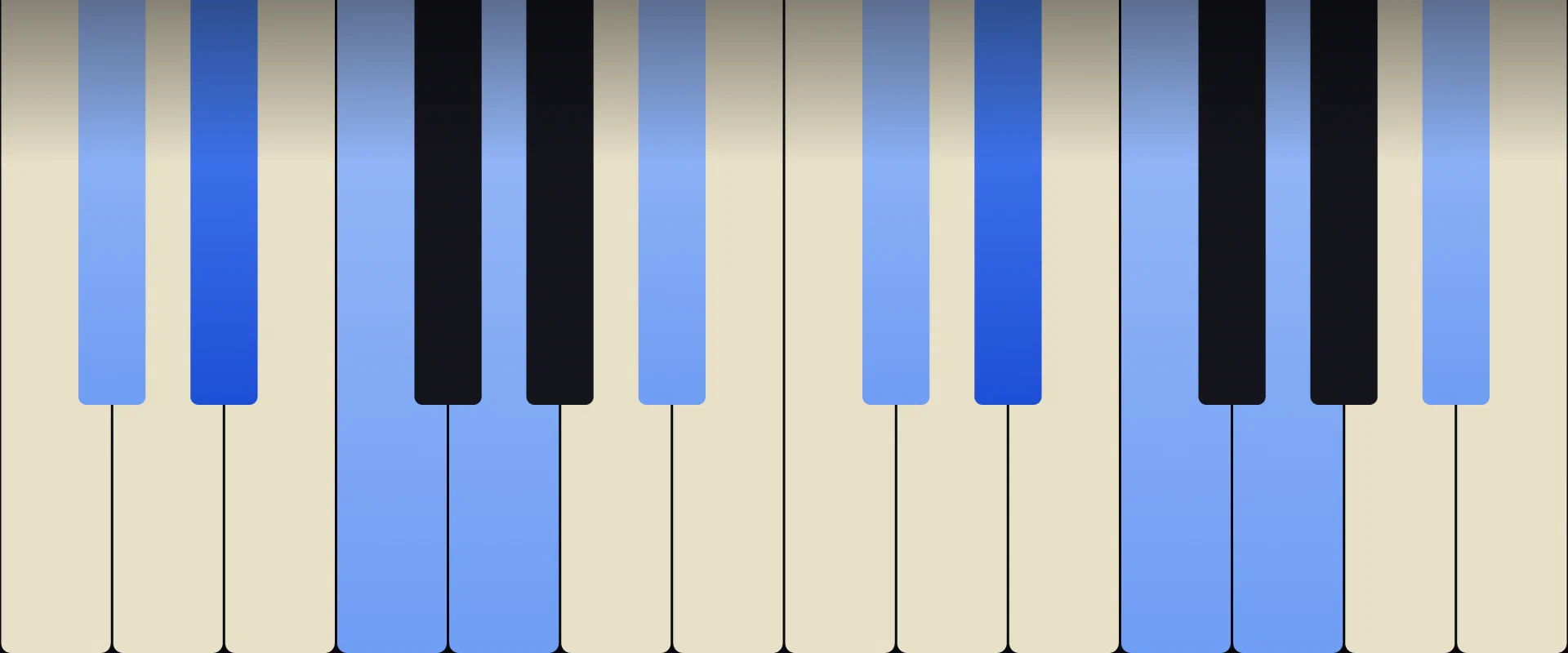
Three black keys and two white ones: E♭, B♭ and D♭ raised, G and F not. Look at the top four notes as a picture rather than a stack. D♭ and E♭ are the pair of black keys, and F and G are the next two white keys after them, with only E in between. Four of the five notes sit inside that short span, and the eye finds it without counting.
Play it in two parts. Left hand takes E♭ and G, the root and the third. Right hand takes B♭, D♭ and F, the B♭ minor triad, fingered 2, 3 and 5 so the thumb never lands on a black key and stays free for a lower note. That split gives you all five notes with no stretch beyond a fifth in either hand.
The B♭ minor shape then pays for itself. Play B♭m7, hold B♭, D♭ and F in the right hand, and move the left hand from B♭ to E♭ and G. Three of the five notes have not moved, and a minor seventh has become a dominant ninth. That is the cheapest change of harmony available on this root.
Watch the bottom of the chord. D♭ and E♭ are a whole tone apart, and voiced next to each other below middle C they growl. Keep the D♭ above the G and the F higher still.
E♭9 on the Guitar
Only one open string belongs to E♭9: the G, which is the major third. That is not enough for an open chord, but it is enough for a very small one. x x x 0 2 1 gives G, D♭ and F, the third, the seventh and the ninth, on the top three strings at the bottom of the neck. Middle finger on the 2nd string at the 2nd fret, index on the 1st at the 1st, 3rd string ringing open. Give a bass player the E♭ and that fragment is a convincing whole chord.
Four notes, still no barre: x x 5 3 2 1, sounding G, B♭, D♭ and F. Little finger at the 5th fret on the 4th string, then a diagonal down through the 3rd, 2nd and 1st. That is the whole chord minus its root, which is to say it is a G half-diminished shape, and it lives where the frets are widest on the instrument.
For a version with its own bass note, barre the E9 form at the 11th fret: 11 13 11 12 11 13, sounding E♭, B♭, D♭, G, B♭ and F. Index across the 11th, middle on the 3rd string at the 12th, ring and little finger on the 5th and 1st strings at the 13th. Six strings, the root at the bottom and the ninth on top, at the price of a full barre where the frets crowd.
The grip most players reach for first is the movable 9th shape at the 6th fret, x 6 5 6 6 x, described in full on the E♭7 page. One thing to add to it: raise the note on the 2nd string by a single fret and the ninth becomes a sharp ninth, turning the chord into E♭7♯9. The distance between smooth and snarling here is one fret on one string.
Inversions
| Inversion | Notes | Lowest note |
|---|---|---|
| Root position | E♭ G B♭ D♭ F | E♭ |
| 1st inversion | G B♭ D♭ F E♭ | G |
| 2nd inversion | B♭ D♭ F E♭ G | B♭ |
| 3rd inversion | D♭ F E♭ G B♭ | D♭ |
| 4th inversion | F E♭ G B♭ D♭ | F |
Five note chords are rarely inverted on purpose, so the table matters less for performance than for what it reveals. Third inversion is the interesting row: with D♭ underneath, these five sounds stop behaving like a dominant at all. Counted from D♭ they give a major third, a sixth, a ninth and a raised fourth, the floating sound of D♭ lydian rather than anything that wants to resolve.
First inversion is the one you will actually meet, usually because a bass player walked to G on the way somewhere.
Voicings
Drop the B♭ first. E♭, G, D♭ and F keeps the third, the seventh and the named ninth, and the missing fifth is not missed, which is the standard order of omission set out in the extended chords guide.
Keep the F away from the E♭. They are a whole tone apart, and a ninth voiced within an octave of its own root reads as a wrong note rather than a colour. F belongs an octave and a whole tone above the bass, which in practice means the ninth is the top voice or near it.
Playing alone, put E♭ in the left hand and the G half-diminished shape, G B♭ D♭ F, in the right. Root at the bottom, everything else stacked above it, nothing doubled.
Which Keys Contain E♭9
- V of A♭ major
- I of E♭ mixolydian
- VII of F natural minor
- IV of B♭ dorian
- II of D♭ lydian
- VI of G locrian
The list is short compared with a triad’s, because five notes rule out a great many scales. Two entries are the same seven notes seen from opposite ends: A♭ major and F natural minor share a key signature, so this chord is the dominant in one and the flat seventh chord in the other without a pitch changing.
Where E♭9 Shows Up
B♭9, E♭9, F9. The blues in B♭ with ninths throughout, and the commonest place a guitarist plays this chord. E♭9 is the fourth degree, the chord that arrives in bar five and again in bar ten, and B♭ is the key blues gets called in more than any other.
E♭9, A♭7, D♭maj7. A dominant resolving to another dominant. E♭ is the second degree of D♭ major, so making it dominant rather than minor points it at A♭, which then points at D♭: two dominants in a row and a long way round to the tonic.
F9, E♭9, D♭9. One grip slid down the neck in whole tones, no voice leading attempted. Funk and gospel guitar do this constantly, and it works because a 9th chord is dense enough that the ear takes the movement as one gesture rather than three chords.
B♭m7, E♭9. The two chord fragment from the piano section, with three notes held still. Where it goes next, and the full cadence into A♭, is covered on the E♭7 page.
One detail is worth carrying away from all of that. When E♭9 resolves to A♭, the F does not have to move: F is the sixth degree of A♭, so the note that made this chord a ninth becomes the note that makes A♭6 a sixth. G rises a semitone, D♭ falls a semitone, B♭ steps down, and the top voice stays exactly where it was. An arranger after a resolution nobody hears arriving puts the F in the lead and moves everything else underneath it.
Related Chords
- E♭ Dominant 7th Chord
- E♭ Add9 Chord
- G Half-diminished Chord
- B♭ Minor 7th Chord
- The ii V I Progression in Jazz
Learn More
Practice Chords
Drill chord recognition with a metronome, MIDI support, and score tracking.
Start PracticingRelated Articles
A Dominant 9th Chord: Notes, Voicings, and How to Play It
Sep 3, 2026 · 9 min
A♭ Dominant 9th Chord: Notes, Voicings, and How to Play It
Sep 3, 2026 · 8 min
B Dominant 9th Chord: Notes, Voicings, and How to Play It
Sep 3, 2026 · 8 min