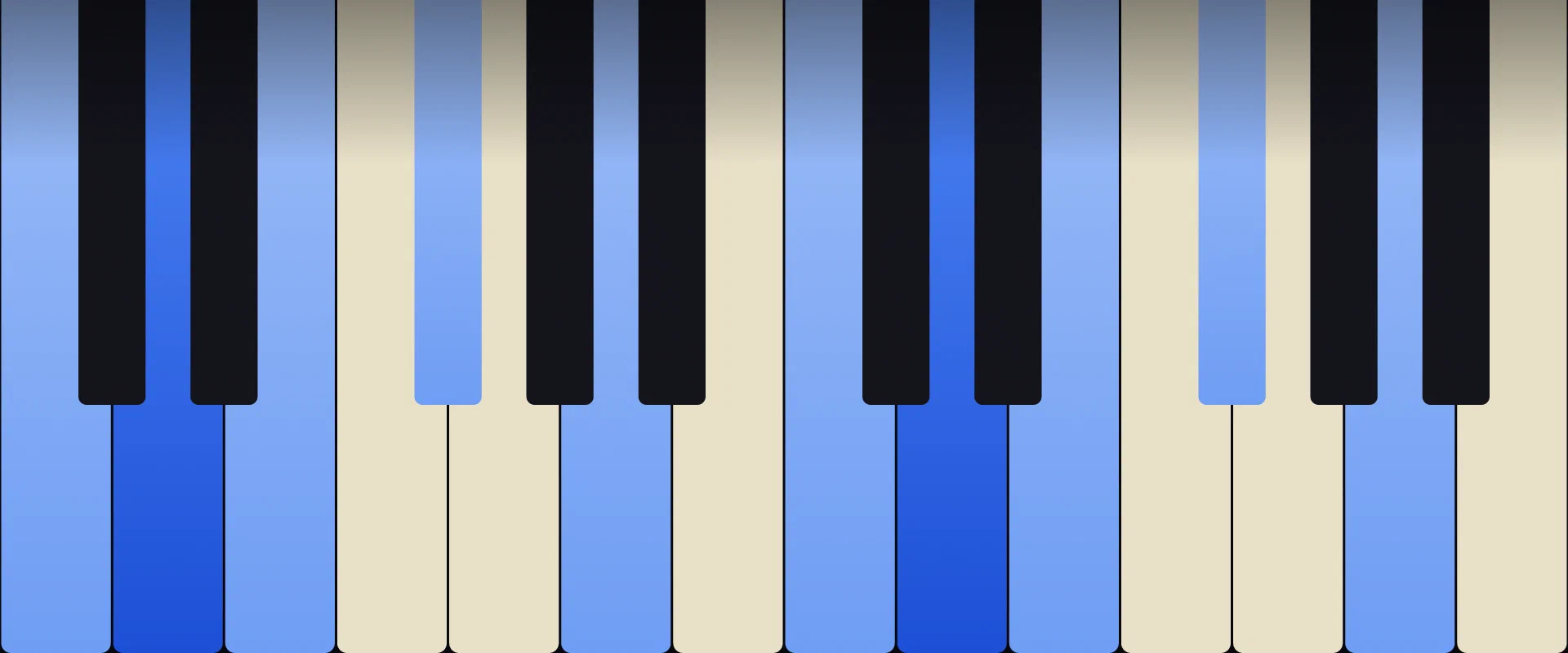
Middle finger on the fifth fret of the A string, index on the fourth fret of the D string, ring finger flat across the G and B strings at the fifth. x 5 4 5 5 x, and the two crosses are not silence you have to arrange: the middle finger leans on the sixth string and the ring finger leans on the first, so both outer strings are damped by the same hand that is making the chord. The strumming arm can then swing at all six as hard as it likes and only the middle four answer. That is D9, and the built in damping is why sixteenth note funk guitar is possible.
What sounds, low to high, is D, F♯, C and E. Root, major third, minor seventh, major ninth. The A has gone, and the fifth is the first note dropped from an extended chord, for reasons the extended chords guide gives in full.
Try It: D9 in the Chord Finder
The Notes of D9
D9 is five notes: D, F♯, A, C and E.
| Degree | Note | Interval from Root | Semitones |
|---|---|---|---|
| 1 (Root) | D | Perfect unison | 0 |
| 3 | F♯ | Major 3rd | 4 |
| 5 | A | Perfect 5th | 7 |
| ♭7 | C | Minor 7th | 10 |
| 9 | E | Major 9th | 14 |
How D9 Is Built
Take D7, D F♯ A C, and add an E a ninth above the root. Adding it changes nothing underneath. F♯ to C is still six semitones, still the interval that will not sit still, and a ninth neither sharpens nor softens it.
What the E changes is the arrival. Send this chord to G and three voices move: F♯ climbs a semitone to G, C falls a semitone to B, A drops a tone to G. The E does not move at all, because E over a G chord is its sixth. The ninth of D becomes the sixth of G by standing still, which is why this chord so often lands on a G6 rather than a plain triad.
There is a second chord hiding above the root. The top four notes, F♯ A C E, are a complete F♯ half-diminished seventh. Every dominant ninth contains one, built on its own third, and here it is a chord any guitarist in the key of G already knows.
D9 on the Piano
Root position spans fourteen semitones and asks all five fingers to cover a ninth, which almost nobody does cleanly. That is the real break between a seventh chord and a ninth: D7 spans a minor seventh and sits under one hand, while this one needs two hands, or a decision about what to leave out.
The reliable answer is D alone in the left hand, low, with F♯, C and E in the right. Thumb on the black key, middle finger on the C, little finger on the E. Those three are the third, the seventh and the ninth, and they name the chord without help. Keep the E up there: it stands a whole tone above the D, and a whole tone low in the bass turns to rumble, a point the extended chords guide makes about spacing generally.
Then hear the resolution as hand choreography. The thumb pushes forward off F♯ onto G, the middle finger slides from C down to B, and the little finger does nothing at all. Two fingers, both moving a semitone, and the chord has landed.
D9 on the Guitar
The grip at the top of this page is the A shape ninth at the fifth fret, and its geometry is worth naming. Three of the four fretted notes sit at the fifth fret, on the fifth, third and second strings. The fourth, F♯, sits one fret lower on the fourth string. The chord is a straight line with a single dent in it, and the dent is the third: the note that makes it major rather than minor is the only one out of alignment. The tritone is held by the index and the ring finger, with F♯ the lower of the pair here, the opposite order to an open D7.
The chord does have a root, on the fifth string, which is worth saying because ninth chords are often called rootless. This one is not. What it lacks is the fifth, and what it refuses is the sixth string, so it sits in a narrow band in the middle of the range and leaves the bottom free for whoever else is playing.
Getting the root onto the sixth string is possible but not with a barre. All the notes lie between the tenth and twelfth frets and no four fingers hold all six strings, so mute the fifth. 10 x 10 11 10 12 gives D, C, F♯, A and E complete: index flat across the tenth fret over the sixth, fourth and second strings, middle finger at the eleventh on the third, little finger at the twelfth on the first.
No chord book lists an open D9, but the strings argue for one. Four of the six open strings are chord tones here: both E strings give the ninth, the fifth gives A, the fourth gives D. Only the G and B need fretting, and that is where the seventh and third are waiting. x x 0 5 7 0 puts C at the fifth fret of the third string and F♯ at the seventh of the second, with open D under and open E over. Two fingers, no fifth, and it rings.
Inversions
| Inversion | Bass Note | Notes | Symbol |
|---|---|---|---|
| Root position | D | D, F♯, A, C, E | D9 |
| 1st inversion | F♯ | F♯, A, C, E, D | D9/F♯ |
| 2nd inversion | A | A, C, E, D, F♯ | D9/A |
| 3rd inversion | C | C, E, D, F♯, A | D9/C |
| 4th inversion | E | E, D, F♯, A, C | D9/E |
A five note chord is rarely inverted in practice, it is thinned. The first inversion shows why: with F♯ in the bass the chord opens as the half-diminished seventh described earlier and the root turns up in the middle of it, so the ear stops hearing D as the root. The useful form of that idea is a rootless voicing, with a bass player on the D and F♯ A C E above.
Voicings
Guitar, A shape at fret 5 (x 5 4 5 5 x). D, F♯, C, E. No fifth, both outer strings damped.
Guitar, low root (10 x 10 11 10 12). All five notes with D on the sixth string.
Guitar, open (x x 0 5 7 0). D, C, F♯, E. Two fingers, two open strings.
Piano, shell plus ninth (D low, F♯ C E above). Third, seventh and ninth. Everything that matters.
Piano, rootless (F♯ A C E over a bass D). The half-diminished shape doing the work.
Which Keys Contain D9
Six keys where all five notes are diatonic:
- V of G major
- VII of E natural minor
- V of G melodic minor
- IV of A dorian
- II of C lydian
- I of D mixolydian
Read the third entry against what is missing. D7 belongs equally to G major, G melodic minor and G harmonic minor, since it holds nothing that tells them apart. D9 does not: the sixth degree of G harmonic minor is E♭, and this chord insists on E natural. The ninth makes the chord take a side about which G is coming, which is why it turns up in bright music and hardly ever in a minor key cadence.
Where D9 Shows Up
The vamp that never moves. Jimmy Nolen’s scratch guitar on James Brown’s “Get Up (I Feel Like Being a) Sex Machine” works this chord in D and the track refuses to leave it. A dominant ninth held for four minutes is a joke at the expense of functional harmony: the most unstable chord in the system, repeated until it becomes furniture. Note the key. Funk written for horns tends to sit in E♭ or B♭, which a B♭ trumpet reads as F and C, while concert D gives that trumpet four sharps and an alto saxophone five. A D9 vamp is a guitarist’s idea, not an arranger’s.
ii, V, I in G: Am7, D9, G6. Am7 is A C E G and D9 is D F♯ A C E, so they share three notes and the whole ii to V move is one voice falling, G down a semitone to F♯. The E then stays put into the G6 as its sixth. One note is common to all three chords, and it is the note this page is about.
Twelve bars in D, all ninths. Replace every chord of a blues in D with a ninth and the shapes gather in one region of the neck. D9 takes the fifth string grip at the fifth fret. G9 takes the sixth string grip at the third, 3 x 3 4 3 5, and A9 the same grip at the fifth, 5 x 5 6 5 7. Three chords, five frets, no barre, and the I and the V share a fret number on different strings.
Related Chords
- D Dominant 7th Chord, the four notes underneath the ninth.
- F♯ Half-diminished Chord, which is this chord with the root taken away.
- G Major Chord, where the tritone is heading.
- The D Mixolydian Scale, the scale that contains every note of it.
- The G Melodic Minor Scale, the minor key this chord will actually fit.
Learn More
Practice Chords
Drill chord recognition with a metronome, MIDI support, and score tracking.
Start PracticingRelated Articles
A Dominant 9th Chord: Notes, Voicings, and How to Play It
Sep 3, 2026 · 9 min
A♭ Dominant 9th Chord: Notes, Voicings, and How to Play It
Sep 3, 2026 · 8 min
B Dominant 9th Chord: Notes, Voicings, and How to Play It
Sep 3, 2026 · 8 min