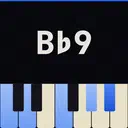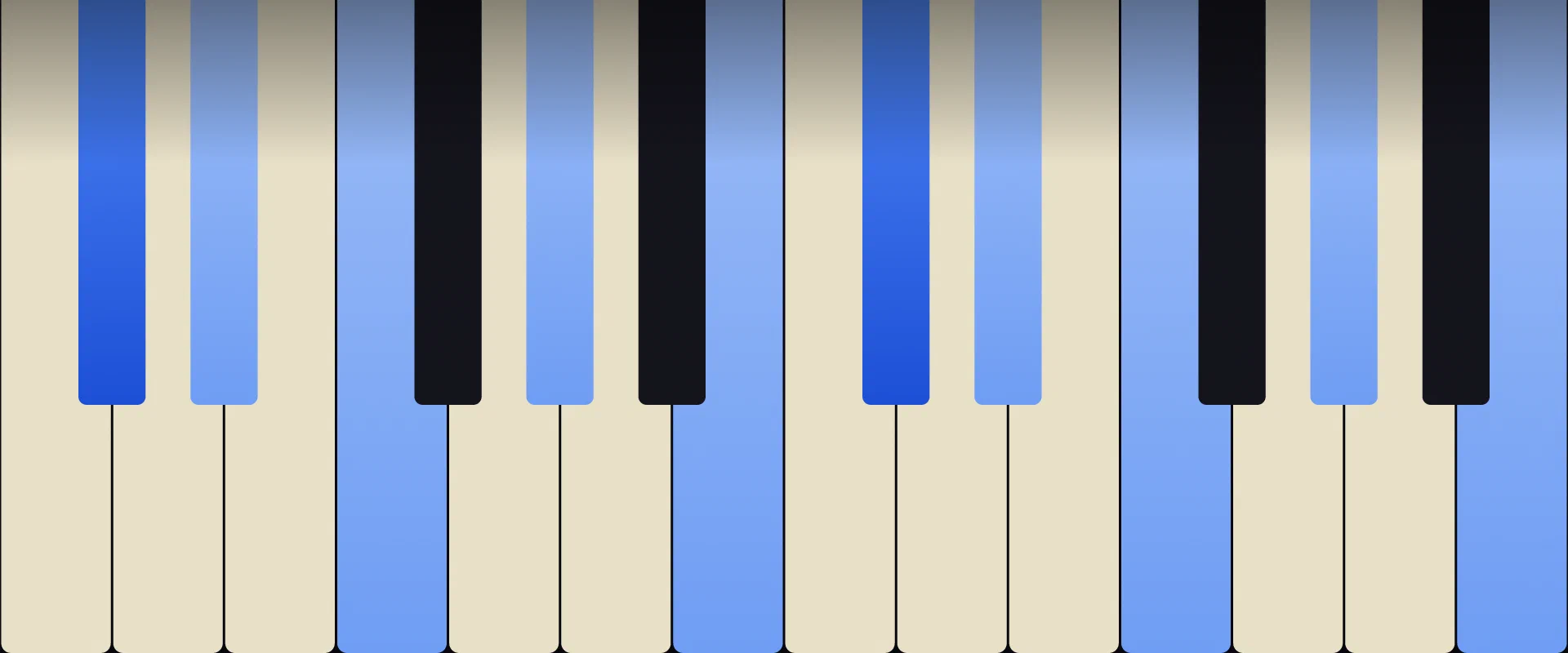
Every note of C♯9 belongs to F♯ major. C♯, E♯, G♯, B and D♯ are five of that key’s seven degrees, missing only F♯ itself and A♯, so the chord is its dominant ninth with nothing borrowed. What it is not, whatever the symbol suggests, is the dominant of F♯ minor. Harmonic minor puts D natural above this root and yields C♯7♭9. The plain ninth needs the sixth degree raised as well, which means melodic minor, so C♯9 falling to F♯m is a chosen colour rather than the textbook cadence.
Try It: C♯9 in the Chord Finder
The Notes of C♯9
| Degree | Note | Interval from root | Semitones |
|---|---|---|---|
| 1 | C♯ | Root | 0 |
| 3 | E♯ | Major 3rd | 4 |
| 5 | G♯ | Perfect 5th | 7 |
| ♭7 | B | Minor 7th | 10 |
| 9 | D♯ | Major 9th | 14 |
Five notes, and nobody plays all five. The fifth is the first to go, and the extended chords guide sets out the order the rest follow in.
How C♯9 Is Built
Start from C♯7, which is C♯, E♯, G♯ and B, and stack a third on top of the seventh. It lands on D♯, fourteen semitones above the root: an octave and a whole tone, not a whole tone. The compound distance is not decoration. Bring D♯ down beside C♯ and the two are the adjacent pair of black keys, and what you hear is a rub rather than a colour.
The ninth behaves, at least. Counting letters from C gives C, D, so a ninth on this root has to be some kind of D, and D♯ is a black key sitting where the eye expects it. The third is the troublemaker: E♯ is played on the white key F, which the C♯ major page explains at length.
Adding the ninth also gives the chord a second identity. Remove the root and what is left, E♯, G♯, B and D♯, is a stack of thirds spelling E♯ half diminished seventh, a chord symbol almost certainly never printed on a chart. In sound it is F, A♭, B and E♭, an ordinary F half diminished seventh. That is what a rootless voicing of this chord actually is.
C♯9 on the Piano
Five keys: C♯, F, G♯, B and D♯. Root position spans a ninth, so no single hand holds the chord as written and nobody tries. Left hand takes C♯, or C♯ and G♯ as a bare fifth well below. Right hand takes the other four: thumb on F, second finger on G♯, third on B, little finger on D♯, ten semitones across and comfortable.
Look at that right hand as a stack. E♯ to G♯ is a minor third, G♯ to B is a minor third, and B to D♯ is a major third. Three thirds, and only the top one is major. Flatten D♯ by a semitone to D and every interval in the hand becomes a minor third: a symmetrical diminished seventh, which is what C♯7♭9 gives you, and which is exactly the chord F♯ harmonic minor builds on this root. The whole difference between the modern sound and the classical one, on this chord, is one black key sliding down onto a white one.
Where the ninth sits matters more than usual. Put D♯ immediately above C♯ in the left hand and the bottom of the chord turns to mud, since the two are neighbouring black keys. Put it above B and it is the brightest thing in the voicing.
C♯9 on the Guitar
The grip is x 4 3 4 4 4 and it is one of the easiest chords on this root. Index finger on the D string at the 3rd fret, middle finger a fret ahead of it on the A string at the 4th, ring finger flat across the G, B and top E strings at the 4th. Two frets wide and no full barre. Low to high it sounds C♯, E♯, B, D♯, G♯: root, third, seventh, ninth, fifth. Mute the top string for the four note version, which loses only the G♯.
The third sits one fret behind the root and one string above it, so the index reaches back while the middle finger holds the root, and the two guide tones, E♯ and B, land on adjacent strings a tritone apart.
Then there is the open B string, the seventh of this chord and the only open string that belongs to it at all. It is useless here. In this grip B already sounds on the G string at the 4th fret, at B3, the identical pitch to the open second string, and the ninth needs that second string. The one sympathetic open string the instrument offers has to be fretted.
Higher up, the E form at the 9th fret is 9 11 9 10 9 11, giving C♯, G♯, B, E♯, G♯ and D♯ across all six strings. Set it beside the C♯7 shape in the same position, 9 11 9 10 9 9, and only the top string differs: the little finger moves from the 9th fret to the 11th, so the ninth costs one finger and nothing else. Both positions put the root at C♯3, the only C♯ the guitar has below middle C, so this chord never sits low on the instrument.
Inversions
| Inversion | Notes | Lowest note |
|---|---|---|
| Root position | C♯ E♯ G♯ B D♯ | C♯ |
| 1st inversion | E♯ G♯ B D♯ C♯ | E♯ |
| 2nd inversion | G♯ B D♯ C♯ E♯ | G♯ |
| 3rd inversion | B D♯ C♯ E♯ G♯ | B |
| 4th inversion | D♯ C♯ E♯ G♯ B | D♯ |
Five notes give five bass options and only some are useful. Root position, and third inversion with B underneath, both keep the dominant function intact. Fourth inversion does not: with bottom the tension supports the chord rather than crowning it, and a listener hears something else that happens to contain these notes. First inversion is the one that confuses a bass player, since E♯ in the bass is read and played as F.
Voicings
Drop G♯ first. C♯, E♯, B and D♯ is the chord complete, since the fifth adds nothing the root has not stated. Drop the root next if somebody else is covering it, which leaves the E♯ half diminished shape above.
For two hands, keep the guide tones in the middle and the ninth on top: C♯ and G♯ low in the left, F, B and D♯ in the right. The black key that gives the chord its name ends up at the very top, where it can be heard.
Which Keys Contain C♯9
- V of F♯ major
- I of C♯ mixolydian
- V of F♯ melodic minor
- IV of G♯ melodic minor
- II of B lydian
- VII of E♭ natural minor
Nine scales on this site contain this chord, against dozens for the plain triad, because every note added narrows the field and the ninth narrows it hardest: it rules out every minor scale whose sixth degree stays flat. That is why both melodic minor entries are here. F♯ melodic minor raises D to D♯ and E to E♯ at once, which is the only way F♯ minor produces this chord rather than C♯7♭9. The last entry writes the same five sounds in flats, D♭, F, A♭, C♭ and E♭, since a key with six flats has no business printing E♯.
Where C♯9 Shows Up
| Progression | Chords | Turns up in |
|---|---|---|
| V9 to I in F♯ major | C♯9, F♯maj7 | Cadences in six sharps |
| ii V I in F♯ major | G♯m7, C♯9, F♯maj7 | Jazz and bossa in the key |
| I9 vamp in C♯ mixolydian | C♯9 held | Funk, soul, disco |
| V9 to i in F♯ minor | C♯9, F♯m | Melodic minor, modern soul |
| V/vi in A major | A, C♯9, F♯m | Guitar pop, with care |
The third row is the one guitarists meet first, and they meet it as a shape rather than as a key. Six sharps is not where funk records get written, but the 4th fret grip slides, so a player working a one chord groove arrives here by moving a hand two frets rather than by reading a key signature. Held still, with no resolution coming, the seventh stops sounding unstable and the ninth does the talking.
Row four is where the opening claim bites. Aim the chord at F♯ minor and the D♯ insists that the key’s sixth degree is raised, which is a melodic minor sound and reads as neo soul rather than as a cadence. Aim it at F♯ major and every note is already in the key signature, which is why the first two rows sound settled and the fourth does not.
The A major row needs more care still. F♯ minor is the relative minor of A, so guitarists working in A meet this root constantly, but A major contains neither E♯ nor D♯, and the D♯ sits a semitone from the D natural its IV chord is built on. Hence the plain seventh does most of that work, and the ninth goes in only when nothing else is sounding a D.
Related Chords
- C♯ Add9 Chord, the same D♯ with the seventh removed, which takes the dominant function away with it
- C♯ Dominant 7th Chord, the four note chord underneath, and the page on its tritone
- C♯ Sus4 Chord, for the related C♯9sus4 sound, the same ninth over a fourth instead of a third
- The ii, V, I Progression for what this chord does between G♯m7 and F♯maj7
- Guitar Chord Shapes: The CAGED System for moving the A and E forms to any fret
Learn More
- Extended Chords and Jazz Harmony, for guide tones, rootless voicings and which tensions a dominant will take
- Seventh Chords: The Complete Guide
- Chord Inversions and Voice Leading
- Secondary Dominants and Borrowed Chords
- F♯ Melodic Minor Scale, the scale that produces this chord on F♯ minor
- C♯ Mixolydian Scale
Practice Chords
Drill chord recognition with a metronome, MIDI support, and score tracking.
Start PracticingRelated Articles
A Dominant 9th Chord: Notes, Voicings, and How to Play It
Sep 3, 2026 · 9 min
A♭ Dominant 9th Chord: Notes, Voicings, and How to Play It
Sep 3, 2026 · 8 min
B Dominant 9th Chord: Notes, Voicings, and How to Play It
Sep 3, 2026 · 8 min