Adding a fifth note to a dominant chord ought to make it edgier. This one does the opposite. The D that turns C7 into C9 makes a perfect 5th with the G and a major 3rd with the B♭, two of the mildest intervals available, and it goes nowhere near the tritone that C7 runs on. The chord picks up a voice and a good deal of body while its tension stays exactly where it was. More colour at no cost to the function is a bargain, and it is why funk and soul reach for 9th chords in the same bars where a blues is happy with a plain 7th.
Try It: C9 in the Chord Finder
Set the root to C and the scale to Mixolydian, then switch the Ninth toggle on and off over the chord on the first degree.
The Notes of C9
| Degree | Note | Interval from root | Semitones |
|---|---|---|---|
| 1 (root) | C | Perfect unison | 0 |
| 3 | E | Major 3rd | 4 |
| 5 | G | Perfect 5th | 7 |
| ♭7 | B♭ | Minor 7th | 10 |
| 9 | D | Major 9th | 14 |
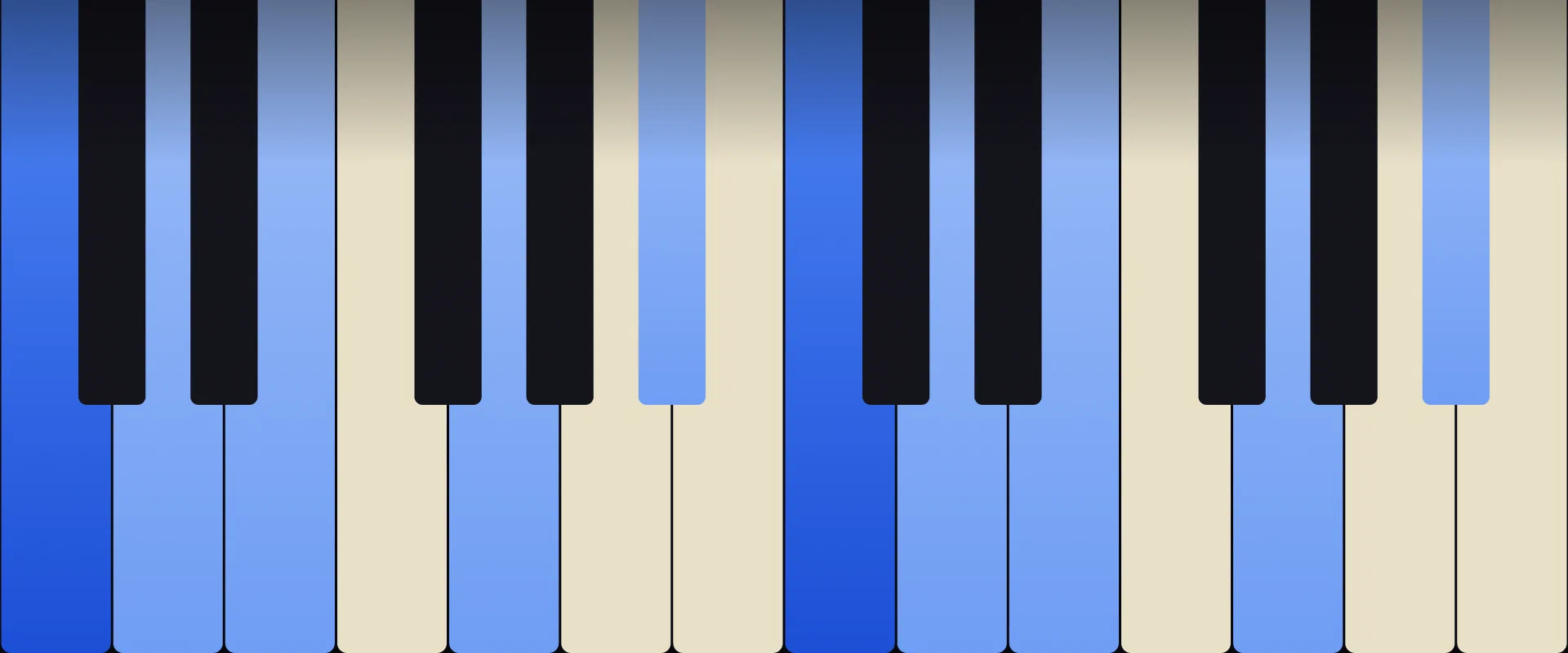
Written out: C, E, G, B♭, D. Four white keys and one black one, and the only accidental sits where a dominant chord always puts it.
How C9 Is Built
Take C7 and stack one more third: B♭ up to D. The symbol names the top of the stack and implies everything below it, so a 9 chord is a 7 chord that has grown rather than a triad with a note bolted on. Cadd9 has no B♭ in it at all, and no obligation either.
The natural 9th is the one option here that is not an alteration. A dominant tolerates D♭ or D♯ happily, because instability is its job; plain D is the version with nothing to argue about, and Extended Chords and Jazz Harmony lays out which tensions each quality accepts.
There is a useful accident in the top four notes. E, G, B♭ and D on their own are an E half-diminished chord, so a C9 is that chord sitting on a C, and a band reading Em7♭5 over a C bass plays one whether or not anybody says so.
C9 on the Piano
Five notes, but never five fingers. Left hand takes C alone, right hand takes E, G, B♭ and D, and that group turns out to be conveniently built: a minor 3rd, another minor 3rd, then a major 3rd, evenly spaced with no gaps and no stretches. Thumb, index, middle and little finger across a minor 7th. It is a more comfortable right hand than C7 with the root still in it.
Both coloured notes are findable by touch, and they use opposite landmarks. B♭ is the far side of the group of three black keys; D is the white key trapped in the middle of the group of two. The hand can assemble the chord without looking.
Register discipline is the one rule. D belongs above the E, not beside it. Drop the 9th into the octave the triad occupies and C, D and E end up adjacent, at which point the chord stops sounding like a dominant and starts sounding like a mistake.
The resolution is worth practising as a shape. Hold the five notes, then move only three: E rises a semitone to F, B♭ falls a semitone to A, and D falls a whole tone to C. F major arrives with root, third and fifth all supplied by voices a step or less away. Note what the D did. It did not hang over waiting to be dealt with; it had a destination of its own all along.
C9 on the Guitar
There is no open C9 in the chord books, and the reason is arithmetic rather than tradition. Four of the six open strings are chord tones here, the two Es, the D and the G. The one note that has to be fretted whatever happens is the B♭, and the nearest place to put it is the third string at the 3rd fret, which is exactly the string the open G was using.
So the chord is fretted, and the shape it settles into is why C9 belongs to funk guitar. x 3 2 3 3 x gives C, E, B♭ and D: index on the fifth string at the 3rd fret, middle on the fourth at the 2nd, ring and little finger on the third and second at the 3rd. One finger per string, no barre, no open strings, and no fifth, which nobody misses. With nothing ringing off an open string, the whole hand can relax a fraction of a millimetre and the chord stops dead, which is what makes it playable as a percussion part rather than a sustained one.
Add the first string at the 3rd fret for x 3 2 3 3 3 and the G comes back on top, at the cost of a small barre. Leave that string open, x 3 2 3 3 0, and the chord doubles its E instead, thinner but ringing longer. Damp the sixth string either way: open, it puts the third in the bass.
For a version with C underneath, the E9 shape at the 8th fret gives 8 10 8 9 8 10, sounding C, G, B♭, E, G and D. It is the barred C7 at that position with the top note pushed up two frets.
With a bass player in the room, drop the root: x x 2 3 3 3 sounds E, B♭, D and G, and reads as C9 the moment a low C arrives underneath.
Inversions
| Inversion | Notes | Bass | Symbol |
|---|---|---|---|
| Root position | C E G B♭ D | C | C9 |
| 1st inversion | E G B♭ D C | E | C9/E |
| 2nd inversion | G B♭ D C E | G | C9/G |
| 3rd inversion | B♭ D C E G | B♭ | C9/B♭ |
| 4th inversion | D C E G B♭ | D | C9/D |
Treat this table as a description rather than a set of instructions. A five note chord almost never appears with all five present, so what happens in practice is omission rather than inversion: the G leaves first, and once it has gone the second inversion cannot exist at all.
C9/E is the row worth hearing. With E underneath, the four notes above the bass spell that half-diminished shape again, and the chord reads as a passing sound in a bass line rather than as a dominant sitting on its root. See Chord Inversions and Voice Leading.
Voicings
Put the D on top and the guide tones under it. The 9th is the only note here a listener has not already heard in the C7 they were expecting, so burying it in the middle wastes it. Keep the group above the C an octave below middle C as well; a 9th spelled out in the bass register turns to porridge.
| Shape | Frets | Result |
|---|---|---|
| C9 | x 3 2 3 3 x | The funk grip, no 5th |
| C9 | x 3 2 3 3 3 | Full, with G on top |
| C9 | x 3 2 3 3 0 | Open first string, doubled 3rd |
| C9 | 8 10 8 9 8 10 | E shape at the 8th fret |
| C9 | x x 2 3 3 3 | Rootless, for use over a bass |
Which Keys Contain C9
- I of C mixolydian
- V of F major
- IV of G dorian
- VII of D natural minor
- II of B♭ lydian
- V of F melodic minor
Five notes leave very little room, and the first five rows are the same seven notes read from five different starting points. C9 contains five of the seven notes of F major, and the two it lacks are F and A, precisely the root and third of the chord it is trying to reach.
The last row is the instructive exception. F melodic minor differs from F major only in its sixth degree, A♭ against A, and C9 uses neither, so the chord survives into that minor key intact. F harmonic minor does not manage it: there the second degree above C is D♭, so the cadence into F minor arrives as C7♭9 instead.
Where C9 Shows Up
| Progression | Chords | Context |
|---|---|---|
| ii V I (F major) | Gm7, C9, Fmaj7 | The 9th falls onto the 5th of F |
| I9 IV9 V9 (C blues) | C9, F9, G9 | Soul and jump blues in C |
| IV vamp (G dorian) | Gm7, C9 | Two bars each, nothing resolves |
| ii V i (F melodic minor) | Gm7, C9, Fm | Natural 9th into a minor tonic |
The second and third rows explain the split in the opening paragraph. A blues is vocal music, and the third of the chord is a note somebody is going to bend anyway, so the harmony stays plain and leaves that space empty on purpose. Funk works the other way. A vamp sits on one chord for eight or sixteen bars, so the chord itself is the material, and a bare C7 held that long sounds like it is waiting for something. The 9th fills the gap between the B♭ and the octave and makes the chord sound complete while it stays put.
The grip finishes the argument. Fret 3 is the lowest point on the neck where that shape clears the nut cleanly, so C9 is often the first 9th chord a guitarist learns in position rather than as an open form.
Keyboard players arrive from the other direction. Four notes in the right hand covers the chord, leaving the left free for a root or a walking line, which is why an organ or clavinet part in a soul band defaults to 9ths rather than sevenths. Reading a chart in F, the player meets C9 before the tonic; reading one in C, as the vamp itself.
Related Chords
- C Add9 Chord, the same added D with no seventh underneath it
- C Dominant 7th Chord, the four notes this one is built on
- E Half-diminished Chord, what the top four notes spell on their own
- C Sus4 Chord, the shape behind C9sus4, where F replaces the E
- Seventh Chords: The Complete Guide for the qualities underneath the extensions
- Extended Chords and Jazz Harmony for which tensions a dominant will take
Learn More
Practice Chords
Drill chord recognition with a metronome, MIDI support, and score tracking.
Start PracticingRelated Articles
A Dominant 9th Chord: Notes, Voicings, and How to Play It
Sep 3, 2026 · 9 min
A♭ Dominant 9th Chord: Notes, Voicings, and How to Play It
Sep 3, 2026 · 8 min
B Dominant 9th Chord: Notes, Voicings, and How to Play It
Sep 3, 2026 · 8 min