Open the case and the instrument hands you E, A, D, G, B and E. Exactly one of those six is a note of Badd9, which is B, D♯, F♯ and C♯, and it is the second string. That single open B is the whole free lunch on this root, and the ninth spends it: C♯ sits on the second string at fret 2, so the string that was ringing has to be pressed down to supply it.
The bill is larger than it looks, because of a note not in the chord at all. B7 has an open shape here only because A is one of its four notes and the guitar keeps A within easy reach this low. Badd9 has no seventh, so A is foreign and the third string cannot stop at fret 2 where it usually does.
Try It: Badd9 in the Chord Finder
The Notes of Badd9
| Degree | Note | Interval from Root | Semitones |
|---|---|---|---|
| 1 (Root) | B | Perfect unison | 0 |
| 3 | D♯ | Major 3rd | 4 |
| 5 | F♯ | Perfect 5th | 7 |
| 9 | C♯ | Major 9th | 14 |
Fourteen semitones from bottom to top. Every other four note chord on this root fits inside an octave; this one does not, and that number decides most of what follows.
The new letter is the ninth, and it has to be some form of C, two letters up from B. B to C natural is one semitone, the harshest interval in the system rather than a colour, so it is raised to C♯. Spell it D♭ instead and the chord carries two kinds of D, since the third is already D♯.
How Badd9 Is Built
Take B major, B D♯ F♯, and put C♯ above it.
Nothing moves and nothing leaves, which is all
the add prefix means; the
extended chords guide
covers the family.
Worth measuring is the spacing inside. B up to C♯ is a whole step and C♯ up to D♯ is another, so three of the four notes are consecutive degrees of the B major scale and only F♯ stands clear of a neighbour. Badd9 is built from thirds but sounds like a fragment of scale, which is why it goes to porridge if those three end up side by side low down.
Two degrees are missing. There is no fourth and no seventh, and those are exactly the degrees separating B major from B lydian and B mixolydian: E against E♯, A♯ against A. The chord belongs to all three and can tell you nothing about which one you are in.
Badd9 on the Piano
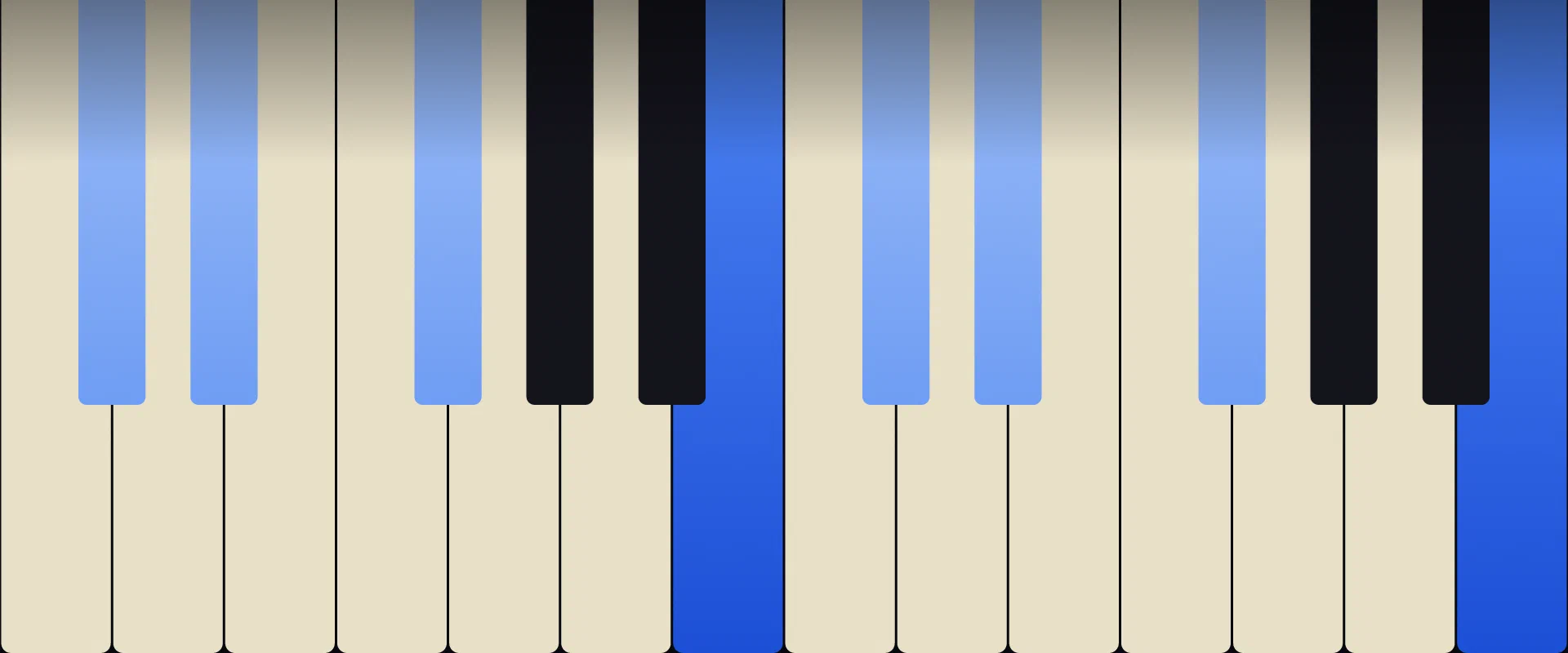
The chord divides by colour. B is the only white key in it; C♯, D♯ and F♯ are black, and they make a tidy set, the whole group of two plus the first key of the group of three. So put B alone in the left hand and play D♯, F♯ and C♯ in the right, with 2 on D♯, 3 on F♯ and 5 on C♯. The right hand then touches nothing but raised keys, and the thumb, which hates them, is never asked to stand on one.
What you must not do is close the chord up. All four notes fit inside a perfect fifth, B up to F♯, with C♯ and D♯ filling the middle, and a hand that finds them that way has made a cluster rather than a chord. Keep C♯ an octave clear of the root instead. Doing that with one hand is out of reach anyway: fourteen semitones with four fingers inside them is not a grip most players own.
Badd9 on the Guitar
Start where the hand already is. x21x22 gives the whole chord inside two frets: index on the fourth string at fret 1 for D♯, middle on the fifth at fret 2 for B, then the ring and little fingers at fret 2 on the second and first strings for C♯ and F♯. It sounds B, D♯, C♯, F♯, one of each and no barre. The third string takes no part and has to be damped by the underside of the ring finger.
Let that string sound and the price appears. B is available on it at fret 4, so x21422 fills the hole with a doubled root, but the little finger then has to reach two frets further out than its neighbours on the string sitting between them.
The barred route is no kinder. The open Aadd9 shape moved up two frets gives x24642, spanning frets 2 to 6: an index barre at the stiffest end of the neck and the little finger out at fret 6 on a string flanked by two fingers at fret 4.
At the seventh fret things settle. xx9879 is the shape to learn, with B, D♯, F♯ and C♯ on the fourth, third, second and first strings at frets 9, 8, 7 and 9. Root, third, fifth and ninth in that order, one of each, and C♯ lands an octave and a whole step above the root, which is where a ninth belongs. Barre the same region for 799879 if you want a low B, or drop to xxx879 when a bass already has it.
To make it ring, capo the seventh fret and play the open Eadd9 shape, 022102: two strings stay open, and that is the cheapest shimmer this root offers.
Inversions
| Inversion | Notes | Bass Note |
|---|---|---|
| Root position | B D♯ F♯ C♯ | B |
| 1st inversion | D♯ F♯ C♯ B | D♯ |
| 2nd inversion | F♯ C♯ B D♯ | F♯ |
| 3rd inversion | C♯ B D♯ F♯ | C♯ |
Badd9/D♯ is the useful one in E major, where D♯ is the leading note, so the chord goes on leaning towards E with no seventh to lean with. Badd9/F♯ sets the chord over its own dominant and holds an arrival in B major open for as long as the bass stays put. Put the ninth underneath everything and the ear stops hearing a B chord at all, hearing a suspension over C♯ instead.
Voicings
One decision does most of the work, and it is where C♯ goes. A ninth above the root and the chord opens out. A whole step above it, buried in the middle, and it grinds. The two guitar shapes above demonstrate both: xx9879 puts C♯ on top with clear air beneath it, x21422 sets it directly on a doubled B.
Drop the fifth when you need room, never the third. Without D♯ what remains is B, C♯ and F♯, which is Bsus2 and not a major chord at all. Do not double the C♯ either, for the reason the extended chords guide gives about doubled tensions.
Which Keys Contain Badd9
- degree 1 (I) of B major
- degree 5 (V) of E major
- degree 4 (IV) of F♯ major
- degree 3 (III) of G♯ natural minor
- degree 1 (I) of B mixolydian
- rooted on degree 2 of, and entirely contained in, G♯ minor pentatonic
The last entry is the practical one. G♯ minor pentatonic is G♯, B, C♯, D♯ and F♯: remove its root and what is left is Badd9 exactly. A guitarist in the first pentatonic box at the fourth fret is standing on the chord with no wrong note available, which is unusual generosity from this root.
Note too what the chord manages that no seventh here does. Badd9 sits inside B major and inside E major at once. B7 cannot, since its A is outside B major, and Bmaj7 cannot, since its A♯ is outside E major.
Where Badd9 Shows Up
| Progression | Numerals | Chords |
|---|---|---|
| Tonic in B | Iadd9, IV, V | Badd9, E, F♯ |
| Loop in G♯ minor | i, VI, IIIadd9, VII | G♯m, E, Badd9, F♯ |
| Subdominant in F♯ | IVadd9, I | Badd9, F♯ |
| Softened dominant in E | IV, Vadd9, I | A, Badd9, E |
The second row is where the chord and the fretboard agree. G♯ minor puts Badd9 on its third degree and its pentatonic scale sits in the same handful of frets, so the comping shape and the soloing box occupy one region of the neck.
Row three turns on a common tone. In F♯ major, B is the fourth degree and C♯ is the fifth, so the ninth of the chord is the dominant of the key. Move Badd9 to F♯ and the top voice need not move at all, since C♯ is already the fifth of the chord you land on, which is why a IVadd9 going home sounds poured rather than stepped.
Row four is the cost. A Vadd9 in E has no seventh, therefore no tritone, therefore no obligation to go anywhere. B7 does that job with its A natural. Badd9 in the same slot is a dominant that has agreed not to push: right under a fade or a held vocal note, wrong at the end of a chorus.
The first row explains the recordings. B major is a singer’s key far more than a guitarist’s, and the ringing add9 sound so common in it almost never comes from x24642. It comes from a capo with G, A or E shapes underneath, because those shapes still have open strings to spend.
Related Chords
- B Major Chord
- B Sus2 Chord
- B Major 6th Chord
- B Dominant 7th Chord
- B Major Pentatonic Scale
- Guitar Chord Shapes: The CAGED System
Learn More
Practice Chords
Drill chord recognition with a metronome, MIDI support, and score tracking.
Start Practicing