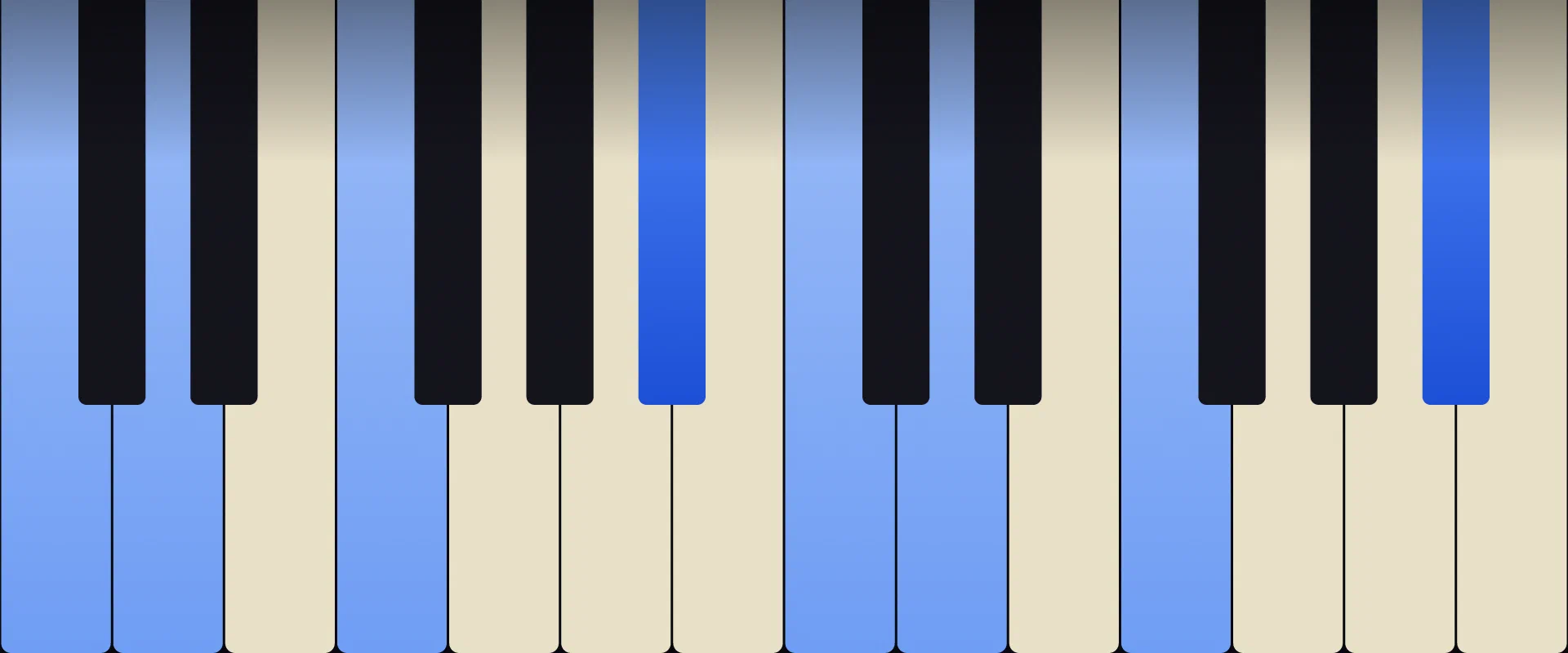
Six open strings, E A D G B E, and exactly one of them belongs to this chord. It is D, the major 3rd of B♭add9, and it turns the least popular region of the neck into the one place this chord costs almost nothing. Two fingers at the 1st fret sound all four notes with nothing doubled. B♭ major, B♭m and B♭maj7 in the same position each need a barre and double a note.
The note being added is C, and everything awkward about the chord comes from where you put it rather than from the note itself.
Try It: B♭add9 in the Chord Finder
Sound B♭ major first, then put C above it.
The Notes of B♭add9
B♭add9 has four notes: B♭, D, F and C.
| Degree | Note | Interval from B♭ | Semitones |
|---|---|---|---|
| 1 (root) | B♭ | Perfect unison | 0 |
| 3 | D | Major 3rd | 4 |
| 5 | F | Perfect 5th | 7 |
| 9 | C | Major 9th | 14 |
One black key and three white ones. The 9th is counted at 14 semitones rather than 2 on purpose: the chord expects that C played high.
How B♭add9 Is Built
Take the B♭ major triad, B♭ D F, and put C a major 9th above the root. Nothing is altered, nothing removed, and no 7th appears underneath, which is the whole content of the add prefix. That absent seventh is what separates this from B♭9, and Extended Chords: Which Tensions Work settles the distinction for every root at once.
Two comparisons on this root are more useful. B♭sus2 is B♭, C and F: the same added note, the same 5th, and no D anywhere. Put the D back and the chord stops being undecided about major or minor while keeping the openness that made the suspension worth writing. One note is the whole distance between a chord that refuses to commit and one that commits and stays bright.
B♭6 is the other four note chord on this triad with no 7th in it, and its added note is G. Neither contains a semitone or a tritone, so neither has anything to resolve. What separates them is where the added note may live. G sits a 6th above the root and is comfortable in the middle of the chord. C is not, and leaving it between B♭ and D gives a cluster, not a colour.
B♭add9 on the Piano
Squeeze the four notes into the smallest space they will occupy and you get B♭ C D F, all of it inside a perfect 5th. That is the voicing to refuse. The weight sits at the bottom, the 9th is underneath the 3rd instead of above it, and what the ear reports is a second.
Split it between the hands instead. Left hand takes B♭ on its own, the only black key here. Right hand takes D, F and C, all white, 1 on D, 2 on F and 5 on C, a minor 7th with no reach worth mentioning. The right hand never goes back among the raised keys at all, which is rare for a chord in this key.
That right hand shape has an identity of its own. D, F and C is a D minor 7th with its 5th missing, and slotting A in between F and C turns the whole thing into B♭maj9. Play the two against each other and you hear what add9 buys: B♭maj7 and everything built on it carry a leading note still leaning forward, and taking the A out leaves nothing in the chord going anywhere.
B♭add9 on the Guitar
D is the only note of this chord available open, and it is the note that makes the position work. Play x x 0 3 1 1: the open D string, the ring finger on the G string at fret 3 for B♭, the index across the B and top E strings at fret 1 for C and F. Two fingers, four notes, one of each degree, nothing doubled.
The open D is the lowest note, so this is strictly a first inversion, which stops mattering as soon as a bass supplies B♭. For the root inside the grip, add the middle finger on the A string at fret 1: x 1 0 3 1 1. Keep the index clear of the D string, since fret 1 there is E♭ and would suspend the chord instead of extending it.
Adding a note to a chord normally costs a finger. Here the extra note arrives and the barre leaves.
Further up, the Eadd9 shape barred at fret 6 is 6 8 8 7 6 8, a barre carrying three fingers at fret 8 and one at fret 7, more work than this chord is worth. Take the top four strings on their own instead. x x 8 7 6 8 gives B♭, D, F and C in that order, one note per string, no barre and no doubling, and the CAGED system places the shapes in between.
Inversions
| Inversion | Notes | Bass note | Symbol |
|---|---|---|---|
| Root position | B♭ D F C | B♭ | B♭add9 |
| 1st inversion | D F C B♭ | D | B♭add9/D |
| 2nd inversion | F C B♭ D | F | B♭add9/F |
| 3rd inversion | C B♭ D F | C | B♭add9/C |
First inversion is the everyday one: what the two finger guitar shape sounds, and what a pianist gets by leaving the root to the bass.
The last row changes the chord’s name rather than its weight. With C underneath, B♭, D and F become the ♭7, the 9th and the 11th of a C chord with no 3rd in it, which is how a 9sus4 gets voiced on a stand. See Chord Inversions and Voice Leading.
Voicings
B♭ D F C low to high is the reference shape, and the one the chord symbol describes.
B♭ D C is the three note version, the 5th discarded because F does the least work of the four and nobody misses it.
B♭ F C D is the spread version, two perfect 5ths at the bottom, B♭ to F to C, with the 3rd above them a whole tone off the 9th. It suits a low register, where those fifths keep the bottom clear.
Add G and all five notes of B♭ major pentatonic are sounding at once, which is the chord written 6/9.
Which Keys Contain B♭add9
- I of B♭ major
- IV of F major
- V of E♭ major
- III of G natural minor
- VII of C natural minor
- contained in B♭ major pentatonic
The first three are one chord doing three jobs. As a tonic it is home with a window left open. As the IV of F major it is a resting chord that happens to hold the key’s 5th degree. As the V of E♭ major it is a dominant with no 7th and so no tritone, leaning towards E♭ without forcing the issue. The two minor keys take it away from home, where it is the bright chord on III and on VII.
The pentatonic entry is the improviser’s. B♭ major pentatonic is B♭ C D F G, and removing the G leaves this chord note for note, so the scale adds one pitch to the harmony and cannot contradict it.
Where B♭add9 Shows Up
Start in the home key, where the chord solves a problem you can hear. Take the turnaround:
B♭add9 | Cm7 | F7 | B♭add9
C belongs to all three chords: the 9th of the first, the root of the second, the 5th of the third. A top voice can hold it for four bars without moving, and it is the added 9th that makes the tonic bar possible. Play a plain B♭ triad there and the same C becomes a note passing over the chord rather than part of it, which is the difference between a held vocal line sounding placed and sounding stubborn.
The second home is one key round the circle. As the IV of F major, B♭add9 shares F and C with the tonic triad, and on a guitar those two notes are the top two strings at the 1st fret, so
F | B♭add9 | F | C
happens without the index leaving where it already is. What the 9th borrows here is the key’s own 5th degree, the most settled note in F, so the IV chord widens rather than tightens. Choosing this over B♭sus2 comes down to that D, and on a guitar it is barely a choice: the open string hands you the 3rd whether you asked for it or not.
Related Chords
- B♭ Major Chord, the triad underneath, before C arrives.
- B♭ Sus2 Chord, the same C with the D taken out instead of kept.
- B♭ Major 6th Chord, the other note you can add to this triad without a 7th appearing.
- Extended Chords: Which Tensions Work, on how the 9th behaves over every chord quality, and which notes get dropped first.
Learn More
Practice Chords
Drill chord recognition with a metronome, MIDI support, and score tracking.
Start Practicing