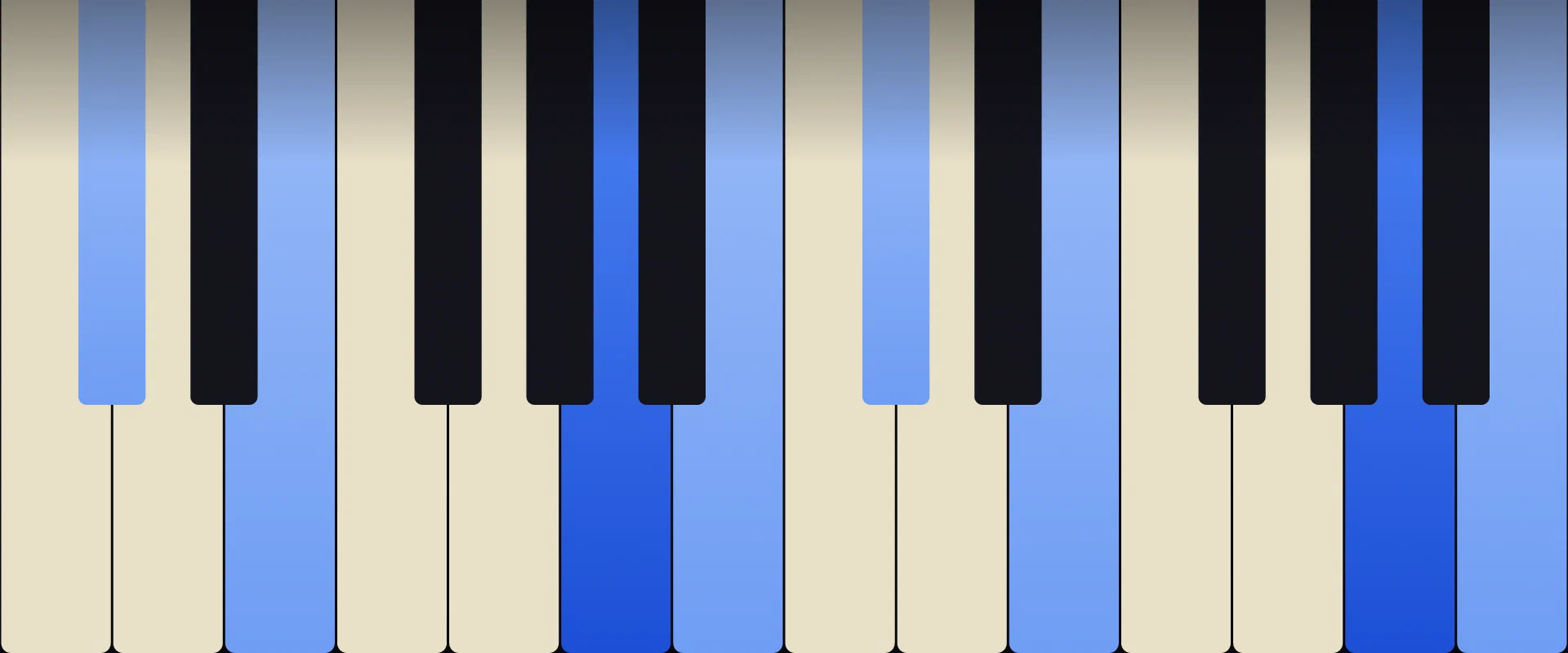
B is the one note in this chord a guitar gives away for nothing. It is the second string, open, no finger needed. It is also the string carrying the only C♯ in an open A chord, and that C♯ is the entire difference between an added ninth and a suspension. The free note and the indispensable note want the same piece of wire, and nearly everything awkward about Aadd9 on this instrument follows from that.
Try It: Aadd9 in the Chord Finder
Sound A major, then set a B on top and listen for the whole tone between that B and the C♯. It is the only friction the chord owns.
The Notes of Aadd9
| Degree | Note | Interval from root | Semitones |
|---|---|---|---|
| 1 (root) | A | Perfect unison | 0 |
| 3 | C♯ | Major 3rd | 4 |
| 5 | E | Perfect 5th | 7 |
| 9 | B | Major 9th | 14 |
Written out: A, C♯, E, B. Three white keys and one black, and the black one is the third, so the note carrying the only accidental is the note the chord cannot spare. Remove the C♯ and the A, B and E left behind are Asus2, which has no quality at all.
How Aadd9 Is Built
Nothing is taken away. A, C♯ and E stay put and a B arrives above them, fourteen semitones from the bottom of the chord. The result is not a neat pile of thirds: A to C♯ is a major 3rd, C♯ to E a minor 3rd, and then E to B is a perfect 5th, a gap wide enough that the added note reads as distance rather than thickness.
No G appears in it, natural or sharp, so there is no seventh underneath the ninth. That is what the add prefix is for, and the guide to extended chords sets out how the rest of the family stacks. A9 does carry a G, and does a different job.
Put B at the Bottom and It Is a Sus Chord
Rotate the four notes so B is lowest and B, A, C♯, E is what a chart prints as A/B: root, flattened 7th, 9th and 11th above that B, with no third anywhere. Guitarists get it by fretting the fifth to second strings at the 2nd fret and letting the top string ring, x 2 2 2 2 0. Identical pitches, and all that changed is which one the bass took.
Aadd9 on the Piano
The two notes that give the chord its edge sit either side of the C key. B is the white key immediately left of C, C♯ the black key immediately right of it, so playing them next to each other puts one finger forward on white and one back on black with an untouched key between.
Root position asks a lot of one hand. A up to B is a ninth, and filling it with C♯ and E spreads thumb to little finger across fourteen semitones. Most players stop trying: A2 alone in the left hand, C♯4, E4 and B4 in the right. That right hand spans a minor 7th, falls under 1, 2 and 5 without complaint, and leaves the ninth on top where it reads as light.
Keeping the B down among the other notes is what causes trouble. Play A3, B3, C♯4 and E4 together and the root and the ninth become neighbouring white keys in the middle of the keyboard, close enough to grind. This chord wants its A well below everything else.
One ornament is worth learning. Hold C♯4 and E4 with the thumb and index and put A4 on top with the little finger for A major, then lift that finger a whole tone to B4 for Aadd9. The two alternate under a held melody without the hand moving.
Aadd9 on the Guitar
Standard tuning offers a B in three places near the nut: the open second string, the fifth string at the 2nd fret, and the third string at the 4th fret. The first is where the C♯ has to live and the second is the root’s own string, which leaves one candidate. The open chord is x 0 2 4 2 0.
Check what the move costs. The third string of open A, x 0 2 2 2 0, supplies A3, a duplicate of the bass note. Pushing it to the 4th fret spends that duplicate, so the finished chord holds exactly one A, the open fifth string, carrying everything above it on its own.
The grip is two fingers at the 2nd fret on the fourth and second strings with a third finger two frets ahead on the string between them, a shallow arrowhead rather than a row. That reaching finger has to arrive on its tip. Let it lean towards the second string and it stops that string at the 4th fret instead of the 2nd, turning the C♯ into a D♯, and a chord holding both A and D♯ announces the mistake at once.
One consequence is unavoidable down here. The B lands at B3, a whole tone below the C♯, so the ninth sits underneath the third instead of crowning the chord, and the next B up is the 7th fret of the first string, far out of reach of a hand at the 2nd. Move the whole thing up instead: x x 7 6 5 7 gives one of each note with B on top, and x 0 7 6 5 7 keeps the open bass string ringing under it. The barred form, the Eadd9 shape at the 5th fret (5 7 7 6 5 7), adds a three-fret spread and rarely earns its keep.
For soloists the shape is a gift. A, C♯, E and B are F♯ minor pentatonic with its root taken out, and that scale’s first box starts at the 2nd fret, where the fretting hand already is.
Inversions
| Inversion | Notes | Bass | Symbol |
|---|---|---|---|
| Root position | A C♯ E B | A | Aadd9 |
| 1st inversion | C♯ E B A | C♯ | Aadd9/C♯ |
| 2nd inversion | E B A C♯ | E | Aadd9/E |
| 3rd inversion | B A C♯ E | B | A/B |
Only the last of these gets renamed, for the reason given above. The second inversion is worth knowing as a colour: with E underneath, the B becomes a perfect 5th above the bass, so the bottom of the chord turns consonant while the whole tone at the top is untouched. Guitarists reach it by letting the sixth string sound, 0 0 2 4 2 0.
First inversion is the expensive one on a fretboard, since the open shape has no spare root to move. C♯ in the bass means rebuilding from the fifth string up, x 4 2 4 2 5. A pianist just plays it.
Voicings
| Voicing | How to play it |
|---|---|
| Open Aadd9 | x 0 2 4 2 0, the ninth on the third string at the 4th fret |
| Aadd9/E | 0 0 2 4 2 0, the sixth string left open |
| Ninth on top | x x 7 6 5 7, one of each note, B highest |
| High grip, open bass | x 0 7 6 5 7, the open fifth string underneath it |
| Barre at the 5th fret | 5 7 7 6 5 7, the Eadd9 shape moved up |
| A/B | x 2 2 2 2 0, the same four notes with B in the bass |
| Piano, spread | A2 in the left hand, C♯4, E4 and B4 in the right |
Which Keys Contain Aadd9
- I of A major
- V of D major
- IV of E major
- III of F♯ natural minor
- VI of C♯ natural minor
- VII of B natural minor
Those six are three pairs: B minor is the relative minor of D major, F♯ minor of A major, C♯ minor of E major. The pairing matters because the added note changes rank as you cross between them. B is the sixth degree of D major, a passing brightness there. In B natural minor the very same B is the tonic, and this chord becomes a ♭VII with the key’s home note ringing at the top of it.
Where Aadd9 Shows Up
| Progression | In this key | Chords |
|---|---|---|
| I, IV, V | A major | Aadd9, D, E |
| V, I | D major | Aadd9, D |
| ♭VII, i | B natural minor | Aadd9, Bm |
| IV, I | E major | Aadd9, E |
As the dominant of D this chord is unusually polite, and the reason is arithmetic. A7 in the same slot contains a tritone, C♯ against G, which forces the issue. Aadd9 has the C♯ and no G at all, so the leading note is present and the tritone is not. Half the pull and none of the grit, which suits a writer who wants the dominant to hover under a vocal line.
In B minor the arrival works by common tone. Aadd9 already contains B, so moving to Bm keeps that note still while everything under it shifts and a singer sits through the change untroubled. Minor key rock has used the trick for decades, usually borrowing the ♭VII for a bar and handing it straight back.
E major puts the same B to a third use. There A is the IV chord and B is the fifth degree of the key, its dominant note, so the subdominant turns up with the note that most wants to move sitting on top of it.
In A major itself the ninth is the second degree, where singers hang about before committing to the tonic. Building the chord under a held B is how a good deal of pop writing in this key opens.
Related Chords
- A Major Chord the triad underneath, with nothing removed
- A Sus2 Chord the same B, but in place of the C♯
- A Major 6th Chord the other four-note tonic on this root, F♯ where this one has B
- Guitar Chord Shapes: The CAGED System
- Extended Chords: Which Tensions Work, and How to Voice Them
Learn More
Practice Chords
Drill chord recognition with a metronome, MIDI support, and score tracking.
Start Practicing