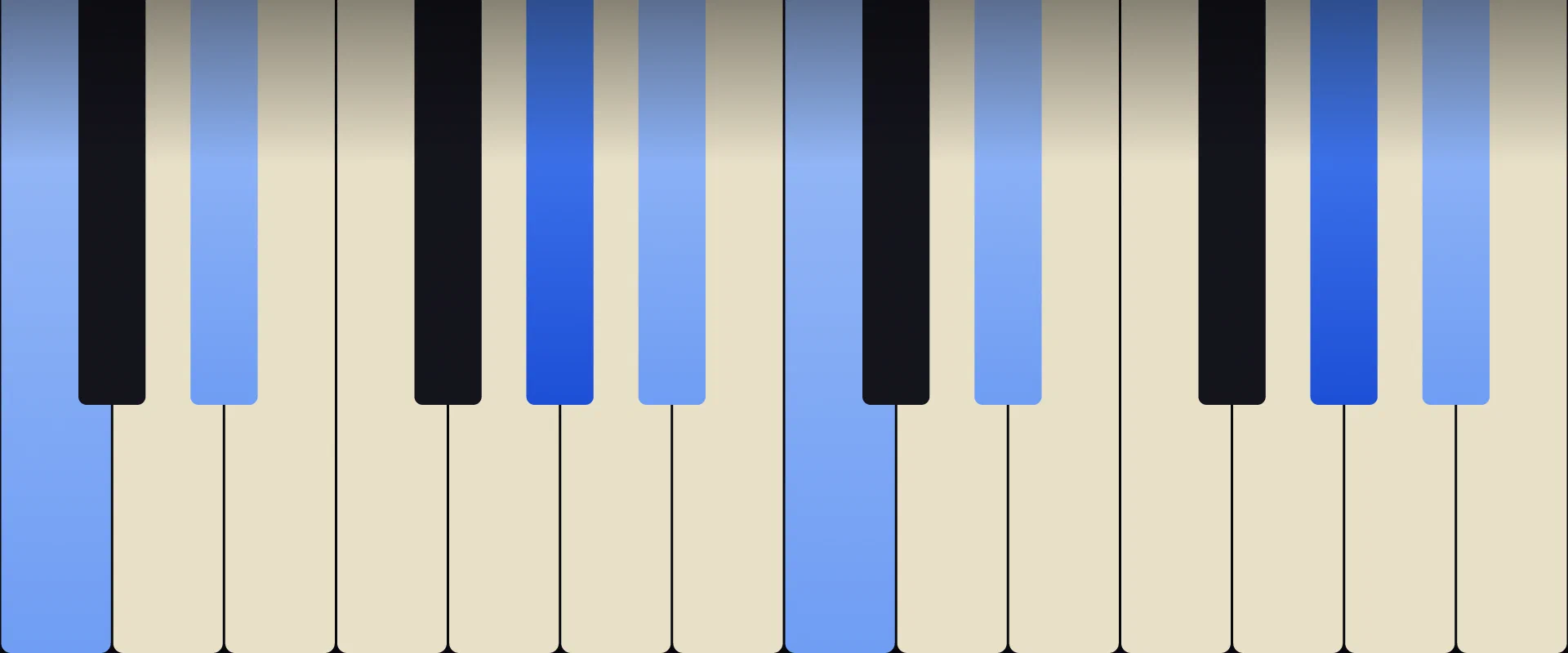
A♭7 is a chord you play instead of D7. A♭add9 is a chord you play instead of A♭. Standing in for another dominant needs the tritone between a third and a seventh, and there is no seventh anywhere in these four notes. The sharpest interval here is the minor 7th from C up to B♭, and two upper voices a minor 7th apart lean on nothing.
Function has to arrive from underneath instead. Put B♭ at the bottom and the same four notes, B♭ A♭ C E♭, are B♭9sus4 with the fifth left out: the chord keyboard players write as A♭/B♭ and use as the dominant of E♭. Nothing in the upper voices decides that. The bass note does.
Try It: A♭add9 in the Chord Finder
The Notes of A♭add9
| Degree | Note | Interval from root |
|---|---|---|
| 1 | A♭ | Perfect unison |
| 3 | C | Major 3rd, 4 semitones |
| 5 | E♭ | Perfect 5th, 7 semitones |
| 9 | B♭ | Major 9th, 14 semitones |
Written low to high in root position: A♭ C E♭ B♭.
How A♭add9 Is Built
A♭ major is A♭ C E♭. B♭ goes above it, a whole
tone above the root but an octave further up, and
nothing is displaced on the way: C is still the
third, so the chord stays plainly major. The add
prefix is the instruction to take the ninth and
leave the seventh behind, and the difference that
makes is laid out on the
extended chords
page.
That octave is not a technicality on this root. B♭ and A♭ are neighbouring black keys with only the A between them. Sound B♭ down there beside the root and the chord thickens into a cluster and the ear stops hearing a ninth at all. A♭sus2 is the version where B♭ has evicted the C rather than joined it.
Compare the other note this triad commonly takes. In A♭6 the extra note is F, a major 6th above the root and so inside the octave, sitting among the chord tones. B♭ is a major 9th above and outside it, sitting over them.
A♭add9 on the Piano
Root position will not fit under one hand, and it is the black keys that make it hurt. A♭ up to B♭ is fourteen semitones, and both ends of the reach are black, so the thumb is forward on A♭ where it has least length and the little finger is forward on B♭. A♭6 closes at F and A♭maj7 at G, both inside the octave and both one hand chords. This one is not.
Split it, then, and the split falls out neatly. Left hand takes A♭, or A♭ and E♭ together. Right hand takes C E♭ B♭: thumb on C, the single white key in the chord and the note that makes it major, 2 on E♭ and 5 on B♭. Nothing crosses, nothing stretches past a fifth, and B♭ ends up as the top voice, which is where a ninth is any use.
That right hand answers to a second name. C, E♭ and B♭ are a C minor 7th with the fifth removed, so behind a bass player you can state this chord without touching an A♭ at all.
Then the move that pays for the whole arrangement. Hold the right hand still and drop the left from A♭ to B♭. Not one of the four notes changes and the chord becomes the dominant of E♭. Gospel and soul players use it as a hinge, and everything the listener is following stays exactly where it was.
A♭add9 on the Guitar
None of the four notes is an open string, and both barre shapes are expensive. The E shape at the 4th fret is 4 6 8 5 4 4: an index barre at the 4th with the little finger out at the 8th on the D string, five frets of span with a barre already holding. The A shape at the 11th, x 11 13 15 13 11, is the same reach moved to where the frets are narrower and an acoustic’s body is in the way.
Neither is necessary, because these four notes fall on four adjacent strings inside three frets. Play x x 6 5 4 6: A♭ on the D string at the 6th, C on the G string at the 5th, E♭ on the B string at the 4th and B♭ on the top E at the 6th. That is the chord in root position, nothing doubled and nothing missing, four fingers and no barre.
Lift the little finger and x x 6 5 4 x is a plain A♭ major triad. One finger is the entire difference between the triad and the add9 here, which is not true of either barre, where the ninth costs a change of shape and a stretch.
Capo at the 1st fret and the open Gadd9 shape, 3 2 0 2 0 3, sounds A♭add9 with two strings ringing behind it. Most players in a band reach for that, and it is a fine chord, but notice where it leaves the ninth: A♭ ends up on top and B♭ is buried in the middle. The fret 6 grip is the one that keeps B♭ exposed.
Inversions
| Inversion | Notes low to high | Bass note |
|---|---|---|
| Root position | A♭ C E♭ B♭ | A♭ |
| 1st inversion | C E♭ B♭ A♭ | C |
| 2nd inversion | E♭ B♭ A♭ C | E♭ |
| 3rd inversion | B♭ A♭ C E♭ | B♭ |
Third inversion is the one with a career of its own. Once B♭ is the lowest note it stops being a ninth and becomes a root, and the chord above it reads as a suspension waiting to fall into E♭. Write A♭/B♭ on a chart and that is what you get.
First and second inversion share a fault: A♭ has climbed above B♭, and a root sitting on top of the ninth squashes the one interval the chord was chosen for. If the bass has to leave A♭, give it C and keep B♭ where it was.
Voicings
Drop the fifth. A♭, C and B♭ are the root, the third and the ninth, which is the whole identity, and on guitar the same three notes are x x 6 5 x 6. E♭ is somebody else’s job.
Leave out the root instead, as the extended chords page recommends once a bass player has it: C E♭ B♭ says everything.
Add F and the chord becomes A♭6/9, the fuller version that A♭6 covers. Add G♭ underneath the B♭ instead and it is no longer an add9 at all, it is A♭9, a dominant with somewhere to go.
Which Keys Contain A♭add9
- I of A♭ major
- IV of E♭ major
- V of D♭ major
- III of F natural minor
- VI of C natural minor
- I of A♭ lydian
The first and last entries are worth reading together. A♭ major and A♭ lydian differ by exactly one note, D♭ against D, and this chord contains neither of them. Nothing in A♭add9 can tell a listener which of the two modes is running, so it is the safe tonic chord in a passage that wants to keep the fourth degree unspoken.
As the V of D♭ major it makes a dominant with no seventh in it. B♭ is the sixth degree of D♭, a note the key is entirely at ease with, so the chord leans towards the tonic rather than dragging it. Writers use it where A♭7 would sound too eager.
Where A♭add9 Shows Up
| Progression | In letters | Where it lives |
|---|---|---|
| i, ♭IIIadd9, ♭VII, ♭VI | Fm, A♭add9, E♭, D♭ | F minor loop, house and R&B keyboards |
| IV over the V bass, I | A♭add9 with B♭ underneath, E♭ | Gospel and pop cadence in E♭ |
| Iadd9, vi7, IVmaj7 | A♭add9, Fm7, D♭maj7 | Ballad in A♭ |
Row one is the reason this chord belongs to keyboard players rather than guitarists. B♭ is the fourth degree of F minor, so the relative major chord arrives already holding the note the tune keeps circling back to, and a loop of four held chords can run for three minutes without anybody resolving anything. B♭ then carries the loop forward, since it is the ninth here and the fifth of the E♭ that follows: the most exposed note in the voicing is the one that never moves.
Row two is the hinge from the piano section written out as harmony. B♭ takes the bass, the chord above stays put, and the resolution to E♭ costs two steps: A♭ falls to G, C falls to B♭, and E♭ was in both chords all along. Gospel players treat this as the normal dominant in E♭ and the plain B♭ triad as the blunter alternative.
Row three moves one voice at a time. Going to Fm7, A♭ C E♭ belong to both chords and only the ninth shifts, B♭ down a whole tone to A♭, with the bass dropping to F underneath. The top line does the work while the middle of the texture sits still, which is what a ballad wants from a piano part.
Related Chords
- A♭ Major Chord the triad this chord puts a roof on
- A♭ Sus2 Chord the same B♭ used to replace the third instead
- A♭ Major 6th Chord the other added note, and the A♭6/9 that combines them
- A♭ Major 7th Chord what happens when the fourth note is a seventh
- A♭ Major Scale the key this chord is the tonic of
Learn More
Practice Chords
Drill chord recognition with a metronome, MIDI support, and score tracking.
Start Practicing