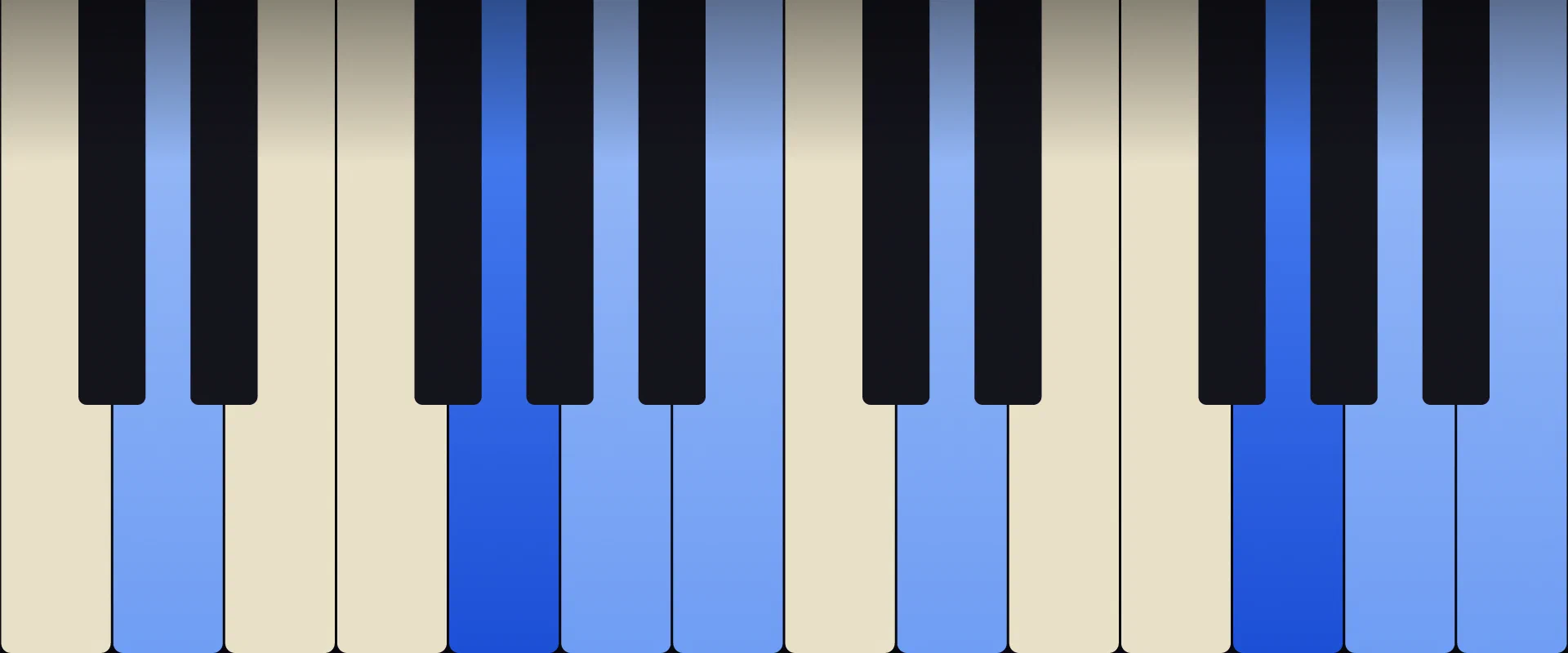
A guitarist soloing in G is working from five notes: G, A, B, D and E. Take the E away and the four that remain are Gadd9. Read the same five from the bottom of the box instead and they spell the E minor pentatonic, the first scale most players ever learn, so the chord underneath and the solo above it are cut from one piece of material.
The four notes are G, B, D and A: the G major triad with the note directly above the root added an octave higher, and nothing else. Where that A sits decides how the chord sounds, and the two instruments make the decision in opposite ways.
Try It: Gadd9 in the Chord Finder
The Notes of Gadd9
| Degree | Note | Interval from Root | Semitones |
|---|---|---|---|
| 1 (Root) | G | Perfect unison | 0 |
| 3 | B | Major 3rd | 4 |
| 5 | D | Perfect 5th | 7 |
| 9 | A | Major 9th | 14 |
The symbol is Gadd9, occasionally G(add9), and in older guitar folios G2. That last one is a poor abbreviation, since it does not say whether the third survived. Here it does.
How Gadd9 Is Built
Take G, B and D, then put A fourteen semitones above the root. The add prefix instructs you to take the 9th on its own, without the F or F♯ a continued stack of thirds would have put under it, and the difference between add9 and 9 is the extended chords guide’s to explain.
Compress the four notes into one octave and they read G, A, B, D: whole step, whole step, minor 3rd, then a fourth back to the top. No semitone anywhere, so nothing in the chord can grate however it is stacked, and that is why it works as a final chord in a way no seventh chord does.
Its nearest relative on this root is G6, which adds E to the same triad rather than A. Between them the two chords use up the whole G major pentatonic scale, and the choice tilts the harmony: E leans towards E minor, A towards D.
Gadd9 on the Piano
Root position will not fit inside an octave. G up to A is fourteen semitones, so the right hand takes 1 on G, 2 on B, 3 on D and 5 on A, with three fingers bunched at the bottom and the entire stretch left between 3 and 5. Every other chord a beginner builds on G sits inside the octave. This is the first one that does not, and a small hand finds out at once.
The sensible answer is to stop trying. Give G to the left hand alone and let the right take B, D and A under 1, 2 and 5. The A is then a ninth clear of the bass by construction, exactly what the symbol asked for, and the hand is comfortable.
Squeezed together it still works, provided it is high enough. Play G, A, B and D as neighbours above middle C and the whole step at the bottom rings like a struck bell. An octave lower the same four pitches turn opaque, because low register spacing does not forgive seconds.
One arrangement deserves separate practice. Put A alone in the left hand and a plain G major triad in the right. Same four notes, the 9th now underneath everything, and that voicing has a name of its own.
Gadd9 on the Guitar
Look at the open shapes a player already owns. G is 3 2 0 0 0 3, G6 is 3 2 0 0 0 0, G7 is 3 2 0 0 0 1, Gmaj7 is 3 2 0 0 0 2. All of them leave the 3rd string open, and that open string sounds G, the third G in the chord and the least useful note in it. Gadd9 is what happens when somebody finally frets it.
Stop the 3rd string at the 2nd fret and it gives A. The shape is 3 2 0 2 0 3, sounding G, B, D, A, B, G from bottom to top. Middle finger on the 6th string at the 3rd fret, index on the 5th at the 2nd, ring on the 3rd string at the 2nd and little finger on the top string at the 3rd. The ring finger reaching back a fret behind the middle is the awkward part, and worth taking slowly until the 4th string stays open and clean.
Two things follow from where that A lands. It sounds at A3, an octave and a whole step above the bass, so the grip spells out the interval the chord is named after. And it sits next door to the open B string, putting a whole step between two adjacent strings in the middle of the voicing. That is the shimmer listeners hear as ringing.
| Form | Frets | Notes sounded |
|---|---|---|
| Open | 3 2 0 2 0 3 | G B D A B G |
| Open G, for comparison | 3 2 0 0 0 3 | G B D G B G |
| Two finger version | 3 0 0 0 0 3 | G A D G B G |
| Compact, movable | x x 5 4 3 5 | G B D A |
| E shape barre, fret 3 | 3 5 5 4 3 5 | G D G B D A |
The two finger version reaches the same chord by a different route and voices it worse. Take open G and lift the index off the 5th string: the B it held falls to the open A, which puts the added note at A2 beside the bass G, so the brightest thing in the chord becomes the muddiest.
The compact grip travels. x x 5 4 3 5 gives one note per string, no barre and no doubling, with the 9th on top where it can be heard, and it moves to any root. The E shape barred at the 3rd fret is loud and demanding: index barre, ring finger covering two strings at the 5th fret, little finger still expected to reach the top string.
Gsus2 needs an A too and finds it somewhere else entirely, on the open 5th string at A2, paying for it by giving up the B altogether. Its 3 0 0 0 3 3 and this 3 2 0 2 0 3 agree about the bass G, the open D and the top G, and about nothing else. Keeping the third is precisely what add means, and here it costs a whole string.
Inversions
| Inversion | Notes | Bass | Symbol |
|---|---|---|---|
| Root position | G B D A | G | Gadd9 |
| 1st inversion | B D A G | B | Gadd9/B |
| 2nd inversion | D A G B | D | Gadd9/D |
| 3rd inversion | A G B D | A | Gadd9/A |
The last row is a chord in its own right. A underneath G, B and D is written G/A on nearly every chart that contains it, and measured from A the notes are the root, the minor 7th, the 9th and the 11th, which players call A9sus4 and pop charts call A11. Which label to use is a question for the extended chords guide. In the key of D this is the dominant, and it gets there without ever sounding a leading tone.
Voicings
Drop the 5th before anything else. G, B and A alone is still unmistakably this chord, and the D was only ever reinforcement. Do not double the A either: the open shape sounds two Gs and two Bs against a single ninth, and that ratio is why the note reads as colour rather than as a second chord arguing with the first. Both habits come from the extended chords guide.
Beyond that, one rule holds in every register: leave an octave between the root and the A.
Which Keys Contain Gadd9
- V of C major
- I of G major
- IV of D major
- VII of A natural minor
- III of E natural minor
- VI of B natural minor
Those six keys are only three key signatures. C major and A minor carry no sharps, G major and E minor carry one, D major and B minor carry two, and G, A, B and D belong to all three. No other major key holds the chord: A major has no G natural, F major has no B natural. Three touching stops on the circle of fifths, and the three that open strings favour, which is most of why this chord turns up more often than its eleven transpositions.
Where Gadd9 Shows Up
| Progression | Chords | Typical use |
|---|---|---|
| IV, V, I in C | F, Gadd9, C | Pop and gospel cadences with no seventh |
| I, ♭VII, IV in G mixolydian | Gadd9, F, C | Roots rock and country vamps |
| VI, VII, i in B minor | Gadd9, A, Bm | Celtic and folk rock |
| VII, i in A minor | Gadd9, Am | Modal pop, film and television cues |
| Third inversion as a dominant | G/A, D | Gospel and soul cadences into D |
| Last chord of a song in G | D, Gadd9 | Endings that stay open |
Row one is why arrangers reach for this chord instead of a dominant seventh. The A is the sixth degree of C major, a note the key already owns, so it colours the V chord without putting pressure on it, and the cadence arrives without ever having pushed.
The third inversion row is worth trying on a keyboard. Left hand on A, right hand on a G triad, then move both hands to D: the bass falls a fifth and the note on top need not move at all. Gospel and soul writing notates that chord as a slash chord, because writing A11 sends players looking for notes that are not there.
Most often nobody plays the chord at all. A guitarist strums plain open G, a keyboard or a second guitar sounds an A above it, and the band’s chord is Gadd9 without one instrument having voiced it.
Related Chords
- G Major Chord, the triad this is built on
- G Sus2 Chord, which takes the same A and gives up the third for it
- G Major 6th Chord, the other single note the pentatonic offers
- G9, the same 9th with an F underneath it, which makes the chord a dominant
- Cadd9, the shape guitarists learn beside this one, though the two grips are unrelated
- The G Major Pentatonic Scale
- The E Minor Pentatonic Scale
- Guitar Chord Shapes: The CAGED System
Learn More
Practice Chords
Drill chord recognition with a metronome, MIDI support, and score tracking.
Start Practicing