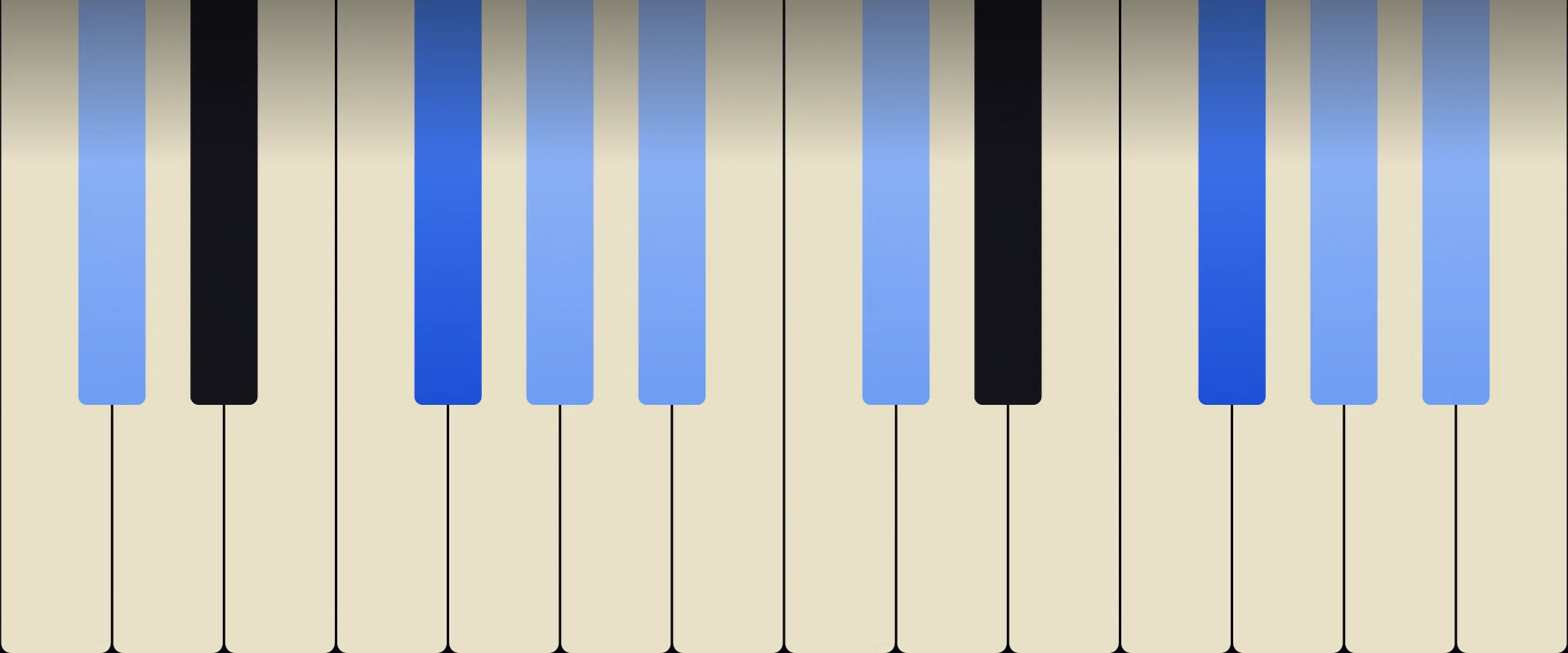
The black keys are laid out in a group of two and a group of three. Squash F♯add9 into a single octave and it reads F♯, G♯, A♯, C♯: the entire group of three, plus one key taken from the pair next door. No other add9 chord lines up with the keyboard’s own furniture that way, and it means a pianist can find this one by feel before reading a note of it.
Written out it is less friendly: a fourth sharp stacked on a triad that already has three, in a key signature of six. Every chord on this root is easier to play than to read, and this one takes that furthest.
Try It: F♯add9 in the Chord Finder
The Notes of F♯add9
F♯add9 contains four notes.
F♯, A♯, C♯, G♯
| Degree | Note | Interval from root | Semitones |
|---|---|---|---|
| 1 | F♯ | Root | 0 |
| 3 | A♯ | Major 3rd | 4 |
| 5 | C♯ | Perfect 5th | 7 |
| 9 | G♯ | Major 9th | 14 |
Four notes, four sharps, four black keys. Not one accidental in this chord has to be explained away, which makes it a rarity on a root whose own scale contains E♯.
How F♯add9 Is Built
Take F♯, A♯ and C♯ and put G♯ an octave and a
whole tone above the root. The add prefix
means the 9th arrives without the seventh under
it, and
Extended Chords and Jazz Harmony
covers what that does to the chord’s behaviour.
What the omission does on this root is settle an argument. The seventh degree of the F♯ major scale is E♯; the seventh degree of F♯ mixolydian is E natural. Leave the seventh out and neither is asked for, so the chord is degree 1 of both scales at once and a melody over it can take either E.
The near neighbour is F♯sus2, which shares G♯ and C♯ and stops there. The suspension puts G♯ where the third would go; the add9 keeps A♯ and finds room for G♯ above it. Both chords hold the same whole tone, F♯ to G♯, and the only question is whether A♯ is there to be argued with.
F♯add9 on the Piano
Close position asks for a stretch most hands will refuse: F♯ up to the G♯ above the octave is a major 9th, with A♯ and C♯ to be filled in between. Split it instead. F♯ alone in the left hand, A♯, C♯ and G♯ in the right under 1, 2 and 5.
That right hand shape is the useful part. Three black keys spanning a minor 7th, and the wrist never moves forward or back. The same holds for every rotation of the chord: turn it over as often as you like and the hand never has to come out to a white key, so the inversions all feel alike in a way mixed chords never do. Learn them by ear, since there is nothing to look at.
The one arrangement to refuse is F♯ and G♯ side by side in the left hand. Down where a bass note belongs, two adjacent black keys stop sounding like a 9th and start sounding like a mistake.
F♯add9 on the Guitar
None of the six open strings belongs to this chord, so nothing rings for free. What the fretboard offers instead is an unusually neat grip on the top four strings: x x 4 3 2 4. Ring finger on the 4th string at fret 4, middle on the 3rd at fret 3, index on the 2nd at fret 2, little finger on the 1st at fret 4. That is F♯, A♯, C♯, G♯ in order, one note per string, nothing doubled and nothing missing.
The little finger is not optional. Let the top string ring open instead and you get E natural, a flat seventh, and the chord is no longer an add9 at all. On this root, one open string is the whole distance between two chord types.
The full barres are harder than that suggests. The E shape at the 2nd fret is 2 4 6 3 2 2, which holds frets 2, 3, 4 and 6 at once, the 6 being the 9th out on the 4th string. Its saving grace is the third: A♯ falls on the 3rd string at fret 3, one fret in front of an index barre at the 2nd, so the middle finger takes it without a fight. Higher up, the A shape at the 9th fret runs x 9 11 13 11 9, five frets end to end, and most players give up and go back down the neck.
Inversions
| Inversion | Notes | Bass note |
|---|---|---|
| Root position | F♯ A♯ C♯ G♯ | F♯ |
| 1st inversion | A♯ C♯ G♯ F♯ | A♯ |
| 2nd inversion | C♯ G♯ F♯ A♯ | C♯ |
| 3rd inversion | G♯ F♯ A♯ C♯ | G♯ |
The third inversion has a life of its own. G♯ in the bass with F♯, A♯ and C♯ above it is F♯/G♯, a standard gospel and pop chord in its own right. Resolve it down to C♯ minor and the gesture belongs to C♯ dorian, because it needs the raised sixth that dorian has and natural minor does not. Chord Inversions and Voice Leading covers how a bass note rewrites a symbol.
Voicings
Spread it. F♯ and C♯ low, A♯ and G♯ above, and the 9th reads as air rather than as a second. On guitar that spacing is 2 4 x 3 2 4, the four-string grip with F♯ and C♯ underneath and the 4th string damped. Doubling F♯ costs nothing. Doubling G♯ does: two 9ths in two octaves pull the ear off the third, and the third is all that keeps this chord out of suspended territory.
Which Keys Contain F♯add9
Two rows on F♯ and two on B is what a chord with no seventh looks like: it fits wherever the triad fits and asks almost nothing extra.
The list has a flat-side half as well. All four notes live inside E♭ minor pentatonic, written there as G♭, B♭, D♭ and A♭, with the chord called G♭add9. That containment is worth more than the name: an E♭ minor pentatonic solo cannot land on a note this chord does not already own.
Where F♯add9 Shows Up
B, E, F♯add9, B in B major. The chord is the dominant, and using this version of it means there is no seventh, therefore no tritone, and nothing straining to resolve. The arrival on B is a lift rather than a release. That is why pop and worship writing in B colours the fifth degree this way instead of turning it into F♯7.
E and F♯add9 alternating. Two major chords a whole tone apart, the sound E lydian is known by. At the keyboard the move is physical as well as harmonic: E major is two white keys and a black one, F♯add9 is four black keys, and the hand travels backwards into the raised group. Film cues and dream pop use this pair and then refuse to go anywhere else.
F♯add9 as the relative major of E♭ minor. Written G♭add9, sitting on the third degree of E♭ natural minor, this is the bright chord in a dark key. Rock guitar reaches E♭ minor by tuning down a semitone from E, which puts a great deal of riff writing in exactly this territory, and the add9 is how the relative major arrives without sounding like a resolution.
Very little music is written in F♯ major by choice. This chord arrives as something else’s fifth degree, or as the bright spot in a minor key with a flat signature, which is why both of its names stay in circulation.
Related Chords
- F♯ Major Chord, the triad this one adds to
- F♯ Sus2 Chord, the same G♯ brought in by removing the third instead of keeping it
- F♯ Major 6th Chord, the other four-note chord on this root that stays on black keys, taking D♯ where this one takes G♯
- Guitar Chord Shapes: The CAGED System, for the shapes behind both barres
Learn More
- Extended Chords and Jazz Harmony, for what add9 means and how it differs from a full ninth chord
- The F♯ Major Pentatonic Scale, which contains every note of this chord
- The F♯ Mixolydian Scale, the second key that calls this chord its tonic
Practice Chords
Drill chord recognition with a metronome, MIDI support, and score tracking.
Start Practicing