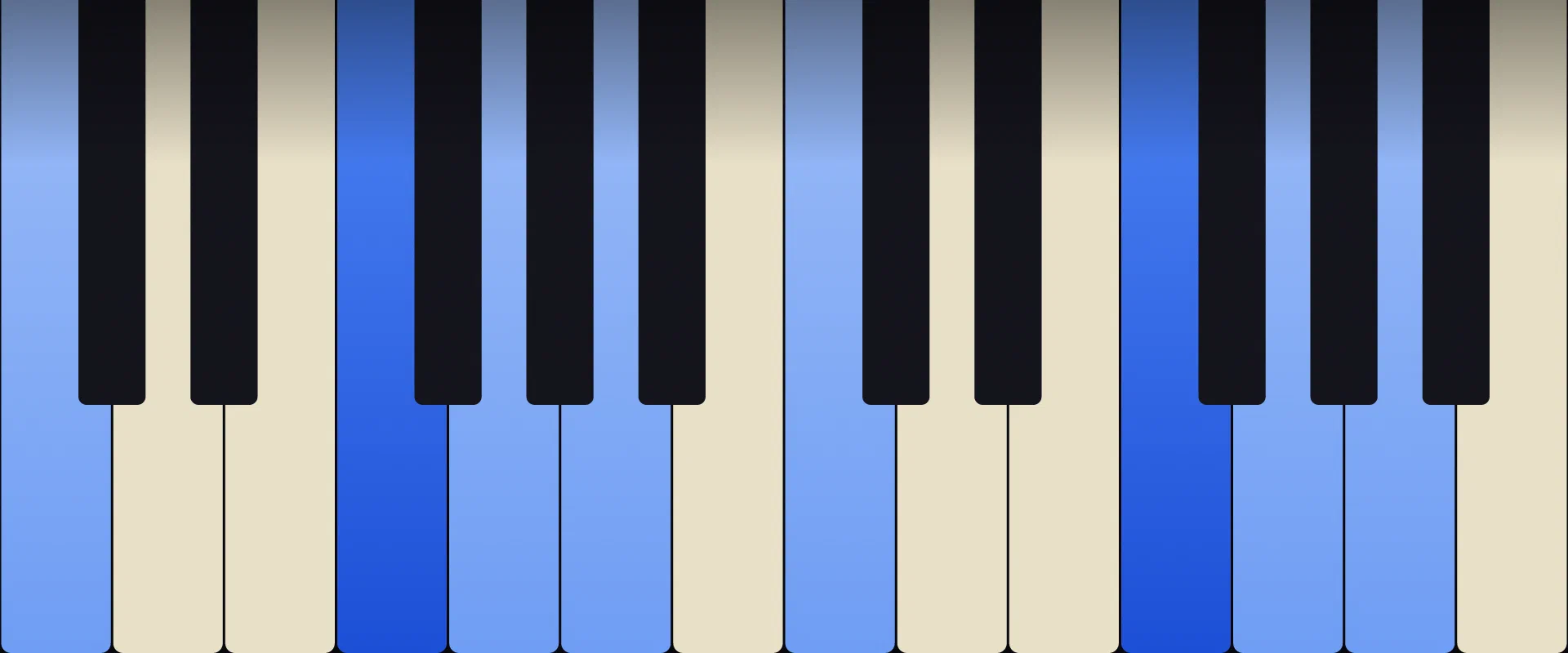
Rock guitarists were playing these four notes long before anyone wrote add9 on a chart. D minor pentatonic is D, F, G, A and C, the first scale box most players ever learn. Take the D out and what is left is F, A, C and G. Read the same five notes upwards from F instead and they are F major pentatonic. This chord is a pentatonic scale one note short, which is most of why a name with a 9 in it turns out to describe something that never bites.
It is also the first chord on this root that will not fit inside an octave. F up to G is fourteen semitones, so root position climbs F, A, C and then keeps going past the octave to land on G. Every earlier chord built on F closes inside eleven semitones.
Nothing inside it sits close together, though. The nearest pair of notes anywhere in the chord is a minor 3rd apart, which is true of neither F6 nor Fsus2, and it is why a chord with a 9th in it sounds wide rather than crowded.
Try It: Fadd9 in the Chord Finder
Set F as the root and play the plain triad first. The note that joins is G, and it arrives above the chord rather than inside it.
The Notes of Fadd9
| Degree | Note | Interval from Root | Semitones |
|---|---|---|---|
| 1 (Root) | F | Perfect unison | 0 |
| 3 | A | Major 3rd | 4 |
| 5 | C | Perfect 5th | 7 |
| 9 | G | Major 9th | 14 |
Fourteen semitones, not two. G is the 2nd degree of the F major scale, written as a 9th here because that is where it is played.
How Fadd9 Is Built
Take F major, F, A and C, and put G on top. No note is replaced and no 7th is stacked underneath, which is the entire content of the add instruction. The general case, and where the line between add9 and 9 falls, belongs to Extended Chords and Jazz Harmony.
Three chords on this root use that triad plus one note and differ only in which note. Fsus2 puts G in the place of A and so has no 3rd at all; here the 2nd and the 3rd sound together. F6 adds D rather than G. Add D and G both and you have F6/9, which is F major pentatonic entire.
Fadd9 on the Piano
Four notes, four white keys. Only three of the twelve add9 chords manage that, and they are built on C, F and G, which are already the three roots a beginner can find without looking.
Root position asks for a reach no earlier chord on F did. Thumb on F, index on A, middle on C, and then the little finger travels past the octave F to reach G. Small hands cannot hold that and should not be made to try.
So stop treating G as the top of a stack. Give F to the left hand alone and let the right take A, C and G: fingers 1, 2 and 5, a span of a minor 7th, every note present. That is the voicing you will meet in print.
The brighter arrangement is the one that makes the chord sound like a record rather than an exercise. Keep F in the left hand and in the right play G and A next to each other with C above them. That whole tone between the 9th and the 3rd is the glint people are after, and high up it reads as brightness. Put the same pair below middle C and they growl.
Fadd9 on the Guitar
The shape everyone converges on is x x 3 2 1 3: ring finger on the 4th string at fret 3, middle on the 3rd at fret 2, index on the 2nd at fret 1, little finger on the 1st at fret 3. Low to high that spells F, A, C and G, the whole chord, no note doubled and no barre involved.
What it costs is the span. Index at fret 1 and little finger at fret 3 is a three fret reach across the two widest frets on the instrument, since fret spacing shrinks steadily as you climb. The identical grip at the 8th fret covers far less ground. The shape is not hard. The position is.
Half the chord is free. The open 5th string is A, this chord’s 3rd, and the open 3rd string is G, its 9th. Ring finger on the 4th string at fret 3 for F, index on the 2nd at fret 1 for C, let those two strings ring and mute both E strings: x 0 3 0 1 x. Two fingers, four notes, nothing doubled.
That version puts A underneath. Adding the 1st string at fret 1, x 0 3 0 1 1, restores F on top without fixing the bass, and fixing it properly wants the 6th string at fret 1 too, which crowds three fingertips into one fret with two open strings running between them.
Both barre forms are demanding for the same reason as the shape above. The E shape version, 1 3 5 2 1 1, wants a first fret barre with the little finger four frets beyond it. The A shape at fret 8, x 8 10 12 10 8, asks the same reach where the frets are narrower.
Inversions
| Inversion | Notes | Bass Note | Symbol |
|---|---|---|---|
| Root position | F, A, C, G | F | Fadd9 |
| 1st inversion | A, C, G, F | A | Fadd9/A |
| 2nd inversion | C, G, F, A | C | Fadd9/C |
| 3rd inversion | G, F, A, C | G | Fadd9/G |
The first row is what both open shapes above produce, so most guitarists’ first Fadd9 has A in the bass whether they meant it or not.
The last row is barely an inversion at all. Read those four notes from G and they are the root, the ♭7, the 9th and the 11th of a G chord, so a chart writes Fadd9/G or F/G and means the dominant of C major. The category changes, not just the name: over F a subdominant with a 9th, over G a dominant with no 3rd. With C underneath a chart is as likely to write C6sus4 and drop the question.
Voicings
The one rule here concerns F and G. Fourteen semitones apart they open the chord out; side by side in the bass they turn it into a rumble. Any voicing that gives F to the left hand and leaves G to the right has already obeyed it.
Dropping the 5th costs least, since C reports nothing about either the quality or the colour here. That leaves F in the left hand with A and G in the right, and no stretch anywhere.
| Shape | Frets, low to high | Sounding notes |
|---|---|---|
| Four strings, no barre | x x 3 2 1 3 | F, A, C, G |
| Two open strings | x 0 3 0 1 x | A, F, G, C |
| Same, root restored on top | x 0 3 0 1 1 | A, F, G, C, F |
| A shape, barred at fret 8 | x 8 10 12 10 8 | F, C, G, A, C |
| E shape, barred at fret 1 | 1 3 5 2 1 1 | F, C, G, A, C, F |
Which Keys Contain Fadd9
- IV of C major
- I of F major
- V of B♭ major
- I of F lydian
- I of F mixolydian
- Contained in D minor pentatonic
Lines two, four and five say something the first three do not. F major, F lydian and F mixolydian differ only in their 4th degree and their 7th, B against B♭ and E against E♭. This chord uses the 1st, 2nd, 3rd and 5th, so it touches neither disputed note and is the tonic of all three without choosing between them.
The last line is the improviser’s licence. Taking D out of D minor pentatonic leaves this chord exactly, so a soloist working that box over Fadd9 has one note in five that is not already sounding underneath.
Where Fadd9 Shows Up
| Progression | Chords | Where it lives |
|---|---|---|
| I, IVadd9, vi7, V | C, Fadd9, Am7, G | Acoustic pop in C |
| Iadd9, IV, V | Fadd9, B♭, C | Songwriting in F |
| IV/V, I | Fadd9/G, C | The sus dominant into C |
Count the common tones in the first row and the loop explains itself. C major is C, E and G; Am7 is A, C, E and G; G major is G, B and D. G belongs to all three, and G is this chord’s 9th, so one note holds through the whole progression while everything else moves. Plain F major shares only C with the tonic, so it is the bar that breaks the thread.
In F itself the chord serves as a tonic that never quite closes, and the reason is arithmetic. G sits a whole tone above F, leaving room under a melody resting on the tonic. Fmaj7 puts E a semitone below the root instead, and that is where those two get in each other’s way.
The third row is the chord’s second career. Those same four notes over a G bass are the sus dominant of C major, one of the commonest slash chords in pop and a standard way of putting the tonic off for four bars. A bass player choosing between F and G decides whether the bar is the subdominant of C or its dominant, and the band above plays the identical grip either way.
Related Chords
- F Major Chord is the triad underneath.
- F Sus2 Chord swaps the 3rd for the 9th instead of keeping both.
- F Major 6th Chord adds D where this adds G, and stays inside an octave.
- Chord Inversions and Voice Leading goes further into what a bass note does to a name.
- Guitar Chord Shapes: The CAGED System explains why the E shape and the A shape both land on this root.
Learn More
For where add9 stops and 9 begins, and for F6/9, see Extended Chords and Jazz Harmony. For this chord as the IV of C major and the I of F major at once, see Diatonic Chords: A Beginner’s Guide and the circle of fifths, where C, F and B♭ stand in that order. For every scale containing this chord, see Scales for Piano and Guitar: The Complete Reference Guide.
Practice Chords
Drill chord recognition with a metronome, MIDI support, and score tracking.
Start Practicing