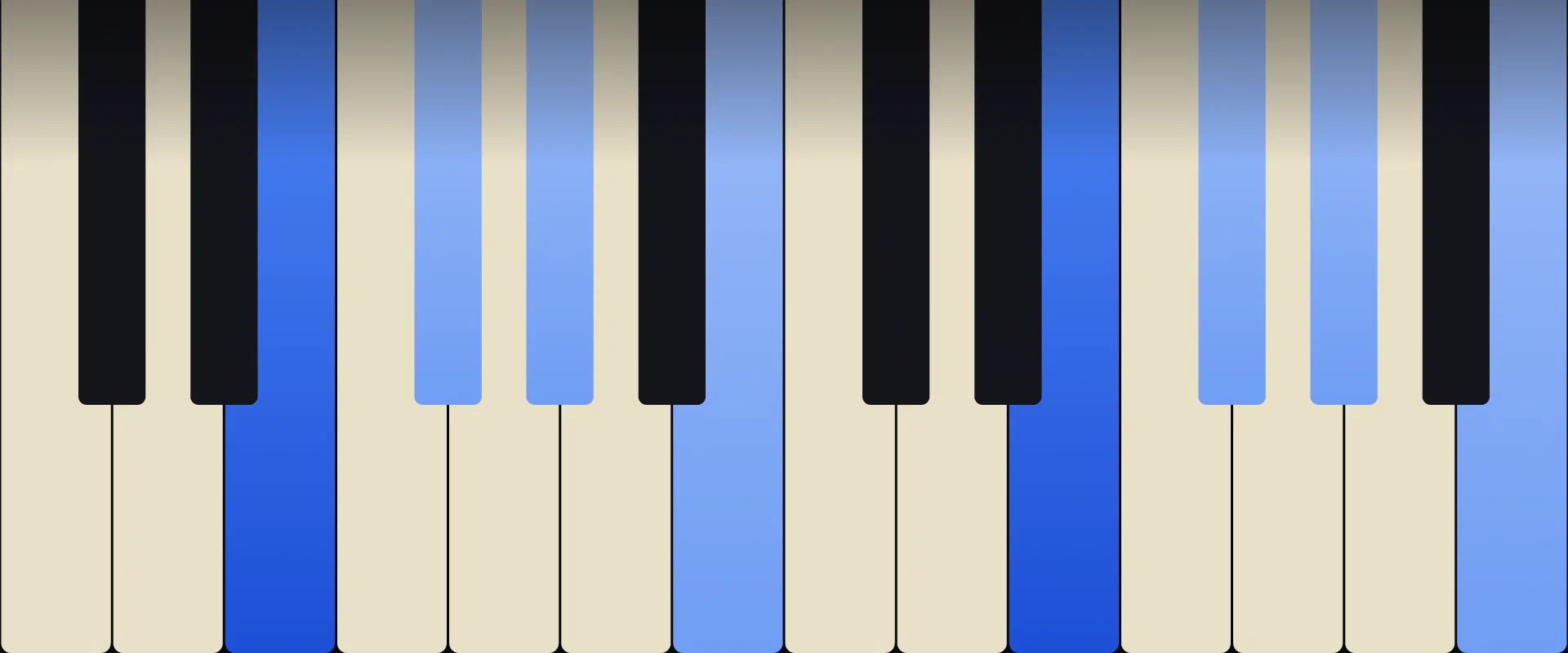
Write out E major pentatonic, E, F♯, G♯, B and C♯, then cross off the C♯. What is left is Eadd9: E, G♯, B and F♯. The chord holds four of the five notes a soloist would reach for over it, there is not one semitone anywhere inside it, and so nothing in it needs playing around. E6 takes the other four notes of that same pentatonic, keeping C♯ and dropping F♯, so between them the two chords divide one scale in half. What Eadd9 has that its neighbours on this root do not is an absence: no D, no D♯, no seventh of any kind.
Try It: Eadd9 in the Chord Finder
Set the root to E and compare E major with E Lydian and E Mixolydian. This chord sits on the first degree of all three without changing, because the notes those modes argue over are notes it does not contain.
The Notes of Eadd9
Eadd9 is the E major triad with a major 9th added and no seventh underneath it:
E, G♯, B and F♯
| Degree | Note | Interval from Root |
|---|---|---|
| 1 (Root) | E | Perfect unison |
| 3 | G♯ | Major 3rd |
| 5 | B | Perfect 5th |
| 9 | F♯ | Major 9th |
Two black keys and two white, both accidentals where the eye expects them: G♯ in the middle of the group of three, F♯ at the left edge of it. The ninth is spelled F♯ and never G♭, since E major counts in sharps.
How Eadd9 Is Built
Start from E major, E, G♯ and B, and put F♯ a whole tone above the octave E. Nothing is evicted, which is the whole difference between this chord and Esus2, where the same F♯ takes the G♯ away. Eadd9 makes exactly one commitment more than a sus2 does: it is major, and beyond that it declines to specify.
The add prefix means the ninth on its own,
without the chain of thirds that would normally
sit beneath it, and the
guide to extended chords
sets out what that buys across the family. Here
the consequence is easy to name. E7 and E9 both
pull E major’s seventh degree down from D♯ to D
natural, and it is that D that makes them lean
towards A. Eadd9 has no seventh to lower, so it
leans nowhere.
Put a C♯ underneath these four notes and they read instead as C♯m7 with an added 11th, which is why the chord turns up so readily in music sitting between E major and C♯ minor.
Eadd9 on the Piano
The problem is arithmetic rather than fingering. E up to F♯ is a major ninth, and four notes across a ninth asks the right hand for one span too many: thumb on E, second on G♯, third on B, then the fifth finger reaching a further perfect fifth to F♯. Most players stop treating it as one hand’s chord.
Left hand: fifth finger on E, thumb on B a fifth above it.
Right hand: thumb on G♯, second finger on B, fifth finger on F♯.
A minor third under thumb and index, a perfect fifth under index and little finger, and the colour note left on top where it can be heard.
The arrangement to refuse is F♯ dropped into the same octave as the E and the G♯. Voiced E, F♯, G♯, B low down the notes are still correct on paper, but the ninth has become a second, grinding against both neighbours, and some charts write that version as Eadd2 for exactly this reason.
Eadd9 on the Guitar
There are two open forms, and the gap between them is spacing rather than content.
0 2 2 1 0 2 is the open E grip with the little finger dropped onto the first string at the 2nd fret. Bottom to top the strings sound E, B, E, G♯, B, F♯. The F♯ has taken the place of what was the third and highest E in an open E major, so nothing of substance was given up to get it. It sits ten semitones clear of the G♯ below, no two adjacent strings are closer than a minor third, and the sixth and second strings still ring open.
0 2 4 1 0 0 puts the ninth in the middle instead. Leave the top string alone, stretch the little finger to the 4th fret of the fourth string, and the E that lived there becomes F♯, directly beneath the G♯ on the third string. Same four notes, but the ninth and the third are now a whole tone apart on neighbouring strings in the thick of the voicing, and the chord picks up a hard edge the first form has none of.
Neither shape travels well. Barre the first at any fret and you need the index across the neck, one finger a fret above it and three more two frets above that, which is a finger more than anybody has. The second can just about be barred, at the cost of a four fret span above the barre.
The voicing to move with instead is x 7 6 4 7 x: little finger on the second string at the 7th fret, ring on the fifth at the 7th, middle on the fourth at the 6th, index on the third at the 4th. It sounds E, G♯, B, F♯, root position with the ninth on top and nothing doubled. The same four pitches are available at the nut as x x 2 1 0 2, which is the version to use behind a singer where the full open form is too much.
Inversions
| Voicing | Notes | Bass note |
|---|---|---|
| Root position | E G♯ B F♯ | E |
| 1st inversion | G♯ B F♯ E | G♯ |
| 2nd inversion | B F♯ E G♯ | B |
| 3rd inversion | F♯ E G♯ B | F♯ |
Second inversion costs a guitarist nothing: miss the sixth string on x 2 2 1 0 2 and B is in the bass. First inversion needs the sixth string at the 4th fret with the fifth muted, 4 x 2 1 0 2, and earns its keep under a bass walking E, G♯, A. Third inversion is the one to think twice about, since with the ninth underneath everything the ear tends to rename the chord from the bottom up rather than hear an inversion at all.
Voicings
- Open form, 0 2 2 1 0 2, six strings, the ninth as the top voice.
- Crowded open form, 0 2 4 1 0 0, the ninth beside the third, harder edged.
- Compact partial, x x 2 1 0 2, four notes, no doublings, quiet.
- Movable, x 7 6 4 7 x, the same pitches with nothing open, so it stops on release.
- Piano split, E and B in the left hand with G♯, B and F♯ above middle C.
Keep F♯ above G♯ wherever you put it. Below the third it stops being a ninth in anything but name.
Which Keys Contain Eadd9
A third but no seventh lets this chord fit an unusually wide range of scales. Six that earn their place:
- degree 1 (I) of E major
- degree 1 (I) of E lydian
- degree 1 (I) of E mixolydian
- degree 5 (V) of A major
- degree 3 (III) of C♯ natural minor
- rooted on degree 1 of, and entirely contained in, E major pentatonic
The first three entries are the point. E major, E Lydian and E Mixolydian differ over the fourth degree and the seventh, and this chord holds neither, so all three keep it on the tonic unaltered. A guitarist can leave an Eadd9 ringing while a fiddle player decides which of the three the tune is in. The pentatonic entry follows from the same absence: any melody drawn from that scale is chord tones plus C♯, and C♯ is a whole tone from its nearest neighbour here, so there is no wrong note to steer round.
Where Eadd9 Shows Up
As a tonic that will not settle down. I, IV, V in E played as Eadd9, A, B. The plain triad announces itself and stops; the added ninth leaves a note hanging over the bar line that belongs equally to the A that follows, since F♯ is A’s own sixth. The giveaway in strummed rhythm guitar is the little finger tapping the first string on and off the 2nd fret while the other three stay put, which is the only ornament that string offers from this grip.
As the bright chord in a C♯ minor song. i, ♭VI, ♭III, ♭VII: C♯m, A, Eadd9, B. The F♯ is the fourth degree of C♯ minor and sits inside C♯ minor pentatonic, so a vocal resting on F♯ need not move when the chord arrives underneath it. That is the practical reason an add9 gets chosen over a plain E in this key: it removes a collision rather than adding a colour.
As a dominant with the bite taken out. V of A major: A, D, Eadd9, A. Folk and country guitar in A normally takes E or E7 here, and the seventh drags the cadence towards the blues whether the tune wants that or not. The ninth keeps the chord unmistakably the V while removing the note that was doing the pulling. Slide a D in under the F♯ and you have E9 instead, a dominant in the full sense, which behaves nothing like this.
Four notes with no semitone between any of them will not sound conclusive, so a final Eadd9 reads as a fade rather than a full stop.
Related Chords
- E Major Chord: Notes, Voicings, and How to Play It is the triad underneath, entirely intact.
- E Sus2 Chord: Notes, Voicings, and How to Play It has the same F♯ replacing the G♯ rather than joining it, and tab books mix the two up.
- E Major 6th Chord: Notes, Voicings, and How to Play It is the other four note slice of E major pentatonic, with the little finger one string lower.
- E Dominant 7th Chord: Notes, Voicings, and How to Play It is what the open grip becomes when the fourth string is left open instead.
Learn More
- Extended Chords: Which Tensions Work, and How to Voice Them explains what add9 means and why a ninth without a seventh behaves differently.
- Diatonic Chords: A Beginner’s Guide to Building Chords from Scales covers the triad this chord adds to.
- Chord Inversions and Voice Leading goes further into choosing a bass note.
- E Major Pentatonic Scale: Notes, Patterns, and How to Play It is this chord plus C♯, and the obvious scale to improvise with over it.
Practice Chords
Drill chord recognition with a metronome, MIDI support, and score tracking.
Start Practicing