Guitarists learned this sound from strings they never fret. Gadd9, fingered 3 0 0 2 0 3, takes its ninth from the open A string. Cadd9, x 3 2 0 3 3, rings the open G straight through the middle of the chord. Move the idea to E♭ and the supply runs out. Of the six open strings exactly one belongs to E♭ G B♭ F, the G, and it is the major third rather than the ninth. The note this chord is named after sits under a finger on every instrument that plays it here, which is most of the reason you meet E♭add9 written on a part rather than stumbled into.
Try It: E♭add9 in the Chord Finder
The Notes of E♭add9
The chord contains four notes: E♭, G, B♭ and F.
| Degree | Note | Interval from root | Semitones |
|---|---|---|---|
| 1 | E♭ | Root | 0 |
| 3 | G | Major 3rd | 4 |
| 5 | B♭ | Perfect 5th | 7 |
| 9 | F | Major 9th | 14 |
Written E♭add9. The add is doing real work: it says take the ninth and nothing else, so no seventh appears and the chord carries no dominant pull. E♭9 is a different chord, and the extended chords guide lays out that whole family.
How E♭add9 Is Built
Take E♭ major, E♭ G B♭, and put F above it. F is a whole tone up from E♭, but it belongs an octave higher than that, which is what turns a second into a ninth.
That octave is the whole difference between this chord and E♭sus2. Both add the same pitch, F. The suspension throws the G out to make room for it; here the G stays and the chord is still unambiguously major.
E♭6 is the near neighbour, E♭ G B♭ C: also a triad plus one note, also free of a seventh, so it can end a piece just as well. Only the position of the added note differs, and that on its own sends the two chords in opposite directions once the bass moves.
E♭add9 on the Piano
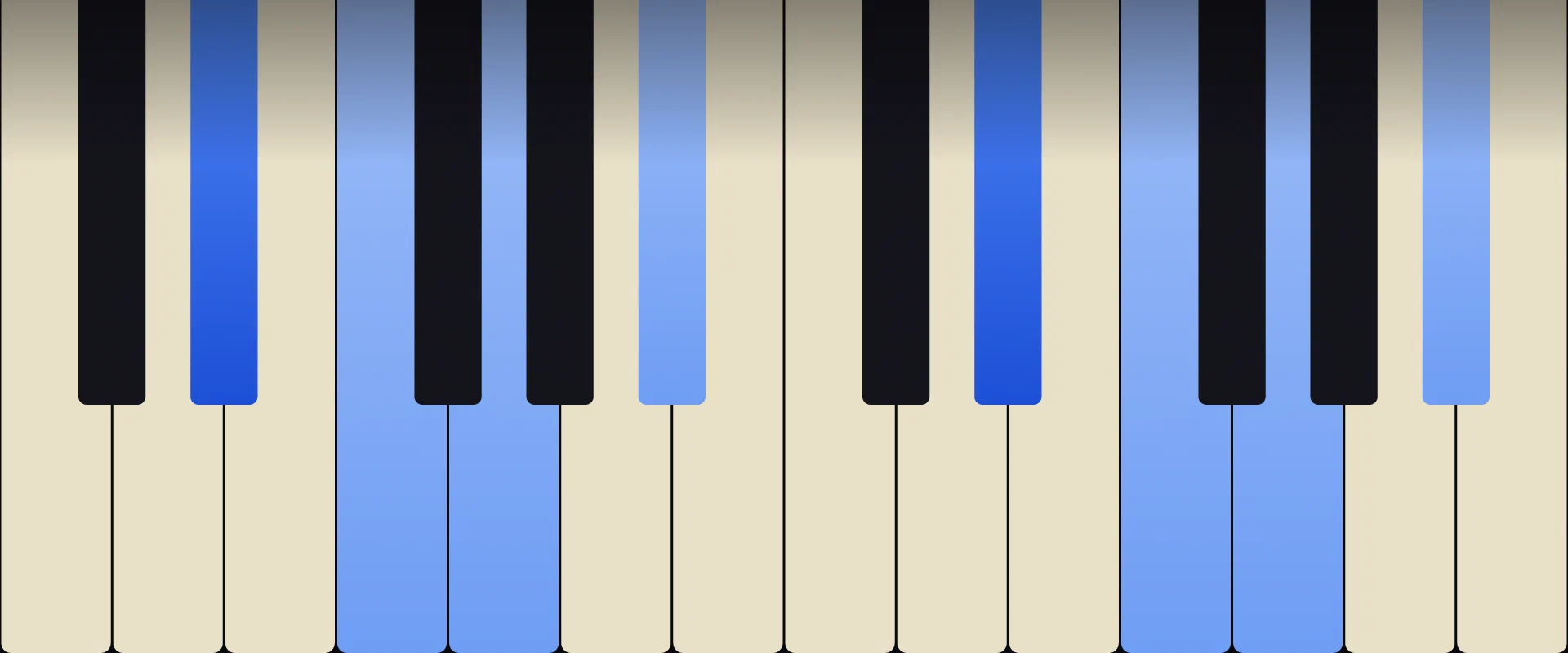
E♭ and B♭ are the black notes here, and the two white ones both belong to the group of three. F is the white key immediately before that group, G is the one wedged inside it between the first two of the three. Find the F by looking for that gap rather than by counting a whole tone down from G.
Root position is a stretch. E♭ up to F is a major ninth, an octave and a whole tone, and holding that with G and B♭ inside it defeats most hands. Split the chord instead. Left hand takes E♭ alone, right hand takes G, B♭ and F with fingers 1, 2 and 5, and the reach shrinks to a minor seventh.
The version that sounds like a record is E♭ in the left hand with B♭, F and G in the right. The bottom of that right hand is a bare fifth, B♭ up to F, then G a whole tone above the F puts the third on top where it rings clearly. The ninth ends up in the middle of the texture, colouring the chord rather than announcing itself.
One thing to keep away from: E♭ and F sitting next to each other below middle C. A whole tone down there thickens into a rumble and the F stops reading as a ninth at all. Keep the F higher than the B♭ and the problem never arises.
E♭add9 on the Guitar
No chord book prints an open E♭add9, and the shapes they do print are all barres. That is not quite the end of it, because the open G string is the major third of this chord.
Try x 6 8 0 6 6. Root E♭ on the 5th string at the 6th fret under the middle finger, B♭ on the 4th at the 8th under the little finger, the 3rd string left open, and the index across the top two strings at the 6th for F and B♭. The third rings unfretted in the middle of the chord and the only doubled note is the fifth.
The clean movable shape is the open Cadd9 grip pushed up three frets: x 6 5 3 6 x, sounding E♭, G, B♭ and F in exactly that order, one of each. Ring finger at the 6th on the 5th string, middle at the 5th on the 4th, index at the 3rd on the 3rd, little finger at the 6th on the 2nd. Four frets, four fingers, no barre anywhere.
The two curated barre shapes both cost more. The Aadd9 form at the 6th fret, x 6 8 10 8 6, needs a barre plus a reach to the 10th and buries the ninth underneath the third. The Eadd9 form at the 11th, 11 13 15 12 11 11, is a full barre with a four fret reach above it, in the region where the frets crowd and the neck meets the body.
A capo at the 3rd fret hands the problem back. The Cadd9 shape then sounds E♭add9, and the string you still leave alone, the 3rd, rings B♭ instead of G: the fifth of the chord rather than its third.
Inversions
| Inversion | Notes | Lowest note |
|---|---|---|
| Root position | E♭ G B♭ F | E♭ |
| 1st inversion | G B♭ F E♭ | G |
| 2nd inversion | B♭ F E♭ G | B♭ |
| 3rd inversion | F E♭ G B♭ | F |
Third inversion is the one with a name of its own. F, E♭, G, B♭ is what players write as E♭/F, an E♭ triad over an F bass, and counted from that F it reads root, flat seventh, ninth and eleventh. In B♭ major that is the dominant. A chord most people file under colourful tonic turns into the chord immediately before B♭, just by dropping the ninth to the bottom.
Second inversion, B♭ F E♭ G, opens with a perfect fifth and is the easiest of the four to voice low without mud. First inversion sits the third in the bass and works under a descending line.
Voicings
Drop the B♭ before anything else. E♭, G and F is the entire chord in three notes, since the third identifies it and the ninth colours it.
Spread it for width: E♭ low, B♭ well above it, then G and F over an octave clear of the root. The gap at the bottom keeps the low end readable, and the whole tone between G and F reads as brightness rather than friction because it is high up.
Do not double the F. One ninth colours a chord; two make the chord about the ninth. The guitar shape above obeys that without being asked, since it doubles only the B♭.
Which Keys Contain E♭add9
- I of E♭ major
- IV of B♭ major
- V of A♭ major
- III of C natural minor
- III of C dorian
- Rooted in E♭ major pentatonic
The pentatonic entry is the practical one. E♭ major pentatonic is E♭, F, G, B♭ and C, and this chord is four of those five notes, so a melody drawn from that scale lands on a chord tone unless it lands on C. That is an unusual amount of room for a soloist.
Where E♭add9 Shows Up
E♭add9, B♭/D, Cm7, A♭, with F on top. The ninth becomes the fifth of B♭, then the eleventh of Cm7, then the sixth of A♭, and never moves a step. One voice stays still while four chords pass underneath it, which is what makes the progression sound joined up rather than walked through. Pop piano parts and string pads in E♭ run on this.
B♭, E♭add9, B♭. The plagal move with the fourth degree coloured. F is the fifth of B♭ as well as the ninth of E♭add9, so the top voice holds across both chords and only the inner parts shift.
E♭/F, B♭. The same four notes with F at the bottom, doing the dominant’s work in B♭ major. Keyboard players write it as a slash chord rather than as F9sus4 because that is literally what the hands are doing, an E♭ chord sitting on an F.
Cm7, E♭add9. Two chords a minor third apart in C minor that share E♭, G and B♭. The single new note is F, the fourth degree of the key, so the music brightens without leaving C minor for a moment.
What those four share is placement rather than progression. F does all the work and it is never the lowest thing sounding. Hand it to a violin section, a right hand or a synth pad and the chord opens out. Bury it under the E♭ and it turns to smudge.
Related Chords
Learn More
Practice Chords
Drill chord recognition with a metronome, MIDI support, and score tracking.
Start Practicing