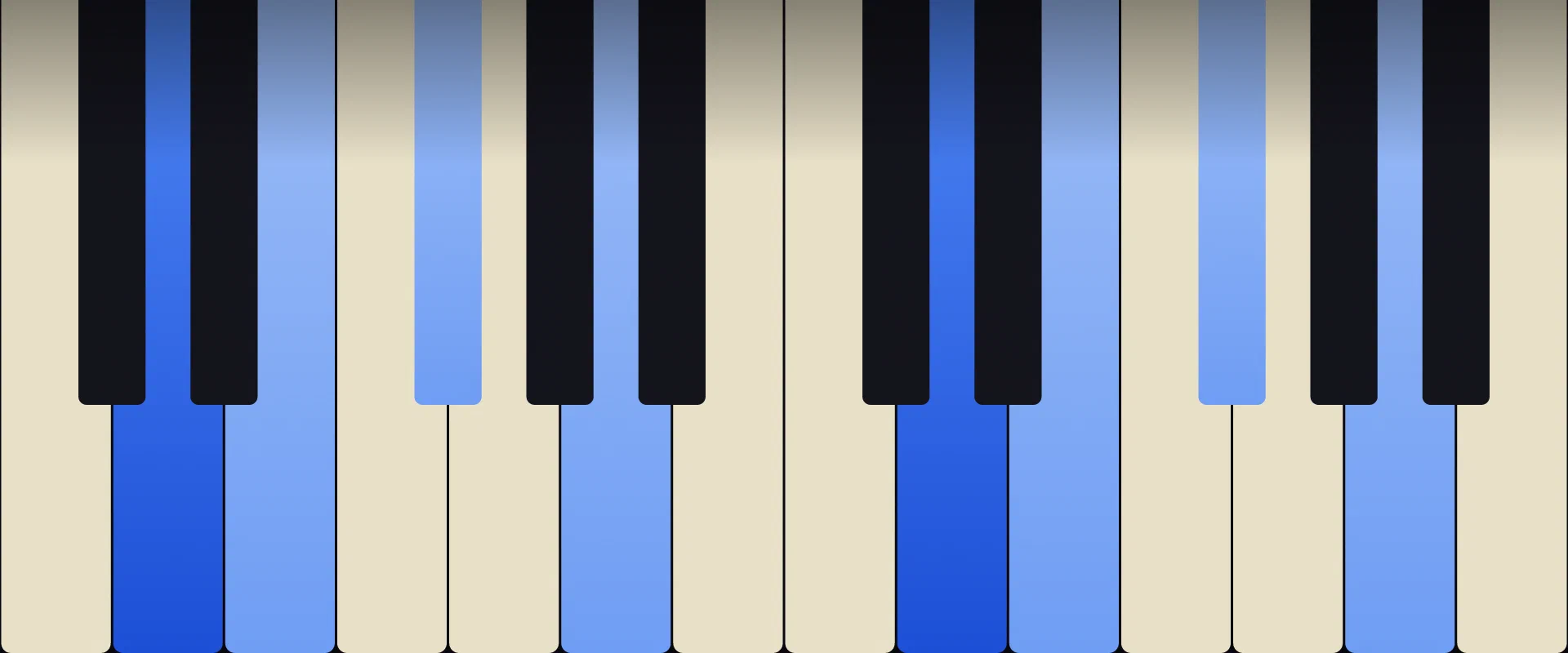
Dadd9 is D, F♯, A and E, and three of those four notes are open strings on a guitar. The sixth and first strings are both E, the fifth is A, the fourth is D. Only the F♯ has to be fretted at all. And yet the open D shape every guitarist learns in their first month cannot produce this chord, because the F♯ and the E both want the first string and only one of them can have it.
Chord books get this wrong often enough to be worth checking. x x 0 2 3 0 is printed as Dadd9 in a great many of them, and it sounds open D, A at the second fret of the third string, D at the third fret of the second, open E. D, A, D, E. No F♯, which makes it Dsus2. Removing the third and adding a ninth are opposite operations, and the printed shape does the first while claiming the second.
Try It: Dadd9 in the Chord Finder
The Notes of Dadd9
Dadd9 is four notes: D, F♯, A and E.
| Degree | Note | Interval from Root | Semitones |
|---|---|---|---|
| 1 (Root) | D | Perfect unison | 0 |
| 3 | F♯ | Major 3rd | 4 |
| 5 | A | Perfect 5th | 7 |
| 9 | E | Major 9th | 14 |
How Dadd9 Is Built
Take D major, D F♯ A, and put an E fourteen semitones above the root. Nothing is removed and no seventh is added, which is the whole meaning of the add prefix. How that differs from a plain 9 chord is set out in the guide to extended chords.
The E is the second degree of the D major scale carried up an octave, and the octave is not decoration. Next to the D it is a neighbour and a mild scrape. A ninth above it, it reads as air over the chord. Some writers reserve Dadd2 for the low version and Dadd9 for the high one, and the two do not sound alike.
Set it beside Dsus2, D E A. Both chords put an E over this root. Dsus2 spends the F♯ to get it. Dadd9 keeps the F♯ and has to find room for the E somewhere else. Everything awkward about this chord follows from that refusal to trade.
Dadd9 on the Piano
Root position runs D, F♯, A, E and spans a ninth, fourteen semitones, which is at the outer edge of what a hand reaches. In practice it is a two hand chord, and every decision about it turns out to be a decision about where the E goes.
Fold the E back inside the octave and the problem vanishes at a price. D, E, F♯, A spans seven semitones and sits under one hand: the first three notes are consecutive steps of the D major scale under thumb, index and middle finger, with the little finger out on A. It is easy, and it is thick. Two whole tones stacked at the bottom of a chord read as a cluster, and the openness that made anyone want this sound has gone.
The version worth practising gives D alone to the left hand, low, and F♯, A and E to the right, thumb on the single black key and little finger on the E. The top interval is then A up to E, a bare fifth, so the chord finishes wide rather than crowded. Keep the E out of the bass register, for the reason given under low register spacing in the extended chords guide.
One thing this chord will not do is move. It has no seventh, no tritone and no interval narrower than the whole tone from D to E, so nothing is leaning on anything. You can play Dadd9 and stop.
Dadd9 on the Guitar
Start from the open D box, x x 0 2 3 2, which sounds D, A, D, F♯ across the top four strings. Two of the four slots are committed: the fourth string gives the root open, the third gives the A at the second fret. That leaves the second and first strings to carry both the F♯ and the E, and as normally fingered they carry a doubled D and an F♯.
One of them has to travel. The cheapest fix sends the doubled D on the second string up to E at the fifth fret.
| Shape | Notes low to high | What it is |
|---|---|---|
| x x 0 2 3 2 | D, A, D, F♯ | D major |
| x x 0 2 3 0 | D, A, D, E | Dsus2 |
| x x 0 2 5 2 | D, A, E, F♯ | Dadd9 |
| x x 0 2 7 0 | D, A, F♯, E | Dadd9 |
x x 0 2 5 2 is the one most hands settle on. Lay the index across the top three strings at the second fret, reach the little finger to the fifth fret of the second string, and the third stays on top where an open D always puts it. The span goes from two frets to four, and that is the real cost: it stops being a chord you can fall into mid strum.
x x 0 2 7 0 keeps the open first string and sends the F♯ to the seventh fret of the second, which puts the ninth on top but leaves index and little finger five frets apart.
Further up, the Aadd9 shape barred at the fifth fret gives x 5 7 9 7 5, D A E F♯ A: five strings, five frets, no fingering anyone enjoys. The Eadd9 shape at the tenth fret, 10 12 12 11 10 12, holds all six strings and would need a fifth finger to do it. In drop D, though, 0 0 0 2 5 2 turns the cheap shape into six strings without any of that.
Inversions
| Inversion | Bass Note | Notes | Symbol |
|---|---|---|---|
| Root position | D | D, F♯, A, E | Dadd9 |
| 1st inversion | F♯ | F♯, A, E, D | Dadd9/F♯ |
| 2nd inversion | A | A, E, D, F♯ | Dadd9/A |
| 3rd inversion | E | E, D, F♯, A | Dadd9/E |
The third inversion is nearly free on a guitar. Press the fourth string at the second fret rather than leaving it open, x x 2 2 3 2, and the bass note becomes E, so the note the chord was named for now sits underneath everything else. Dadd9/A is cheaper still: let the fifth string ring.
Voicings
Guitar, moved second string (x x 0 2 5 2). The practical open position version, third on top.
Guitar, open ninth (x x 0 2 7 0). Wider grip, E ringing above everything.
Guitar, Aadd9 shape at fret 5 (x 5 7 9 7 5). Full and movable, hard to hold.
Guitar, drop D (0 0 0 2 5 2). Six strings, two Ds and two As under the F♯ and the E.
Piano, spread (D low, F♯ A E above). Open fifth at the top. The reference voicing.
Piano, close (D E F♯ A in one hand). Compact and dense, better as an inner voice.
Which Keys Contain Dadd9
Dadd9 is diatonic wherever D, F♯, A and E all survive:
- I of D major
- V of G major
- IV of A major
- III of B natural minor
- VII of E natural minor
- every note of it inside B minor pentatonic
That last entry is the one guitarists should read twice. B minor pentatonic is B, D, E, F♯, A, so all four notes of Dadd9 are in it and a soloist in the first position box of that scale cannot land outside this chord. Over plain D major the E has to be handled. Over Dadd9 it is already there.
Where Dadd9 Shows Up
Capo at the second fret. The Cadd9 shape, x 3 2 0 3 3, is one of the most fingered grips in acoustic music, since it shares three fingers with an open G and needs no barre. Clamp a capo at the second fret and the sounding notes are D, F♯, A, E, A: this chord, complete, with the capo doing the work the index finger would otherwise have to. A great many recordings that ring with a Dadd9 were fingered as a Cadd9 by someone who never thought about the name.
The first string left open. Jangling guitar playing in D consists largely of never lifting that string, and in this key the note it gives is unusually well behaved: E is the 9th of D, the 5th of A, the 11th of B minor and the 6th of G. Run I, V, vi, IV as D, A, Bm, G with the top string ringing and you get Dadd9, A, Bmadd11 and G6 without changing a fingering habit. Except at the tonic. Leave the first string open there and the F♯ disappears, which is exactly why the capo trick exists.
The fifth degree that refuses to push. In G major this chord lands on the fifth degree, and what it leaves out decides its behaviour. D7 puts a C six semitones from the F♯ and that pair has to resolve. Dadd9 puts an E a whole tone from the F♯ and holds no tritone at all, so C, G, Dadd9, G is a loop rather than a cadence. Accompanists use it to sit on the fifth degree for two bars without the harmony queuing.
Related Chords
- D Major Chord, the triad this is built on.
- D Sus2 Chord, the chord it is most often confused with.
- D Major 6th Chord, whose added B plus this chord’s E gives D6/9.
- D Major 7th Chord, the same triad with a seventh added instead.
- The D Major Pentatonic Scale, which is these four notes plus a B.
Learn More
Practice Chords
Drill chord recognition with a metronome, MIDI support, and score tracking.
Start Practicing