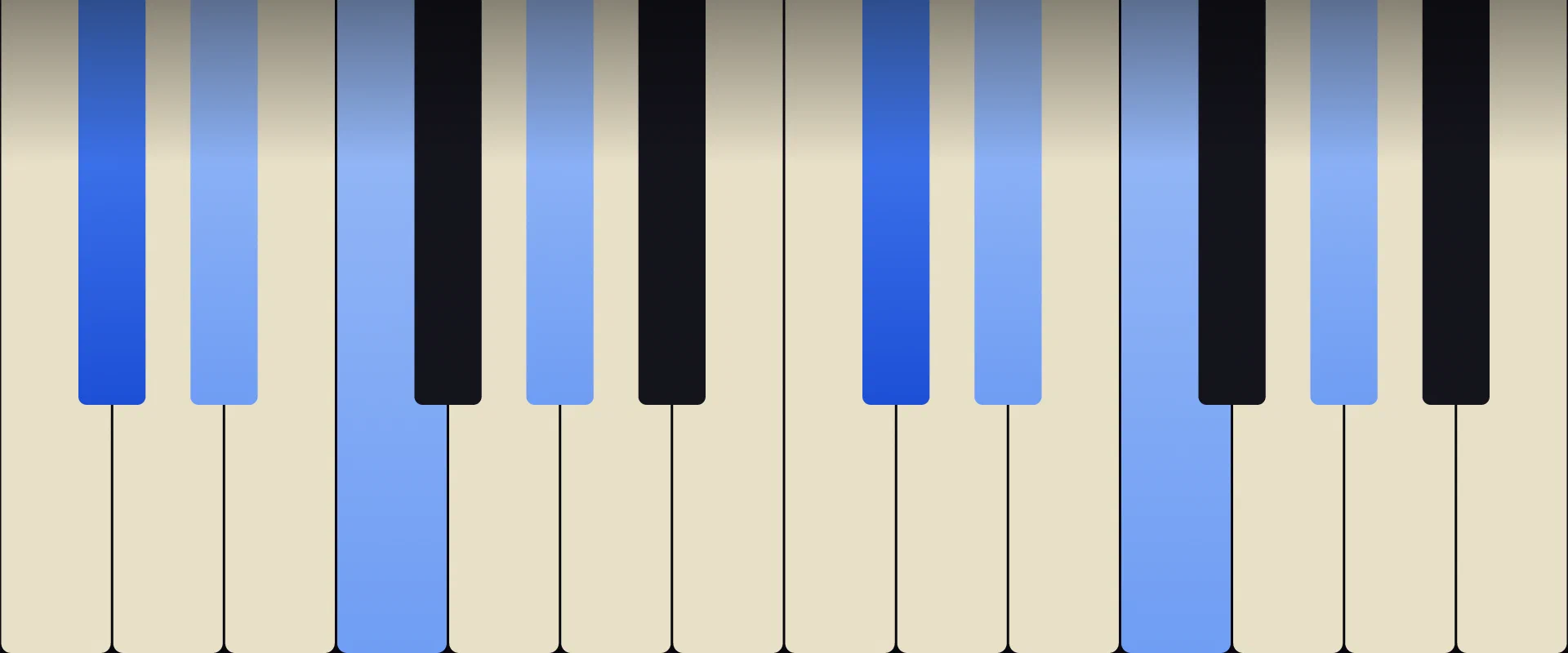
The add9 is a guitar chord by habit. Cadd9, Gadd9 and Dadd9 all take their shimmer from a string nobody has to fret. Move the idea to C♯ and that shimmer vanishes: not one of the six open strings belongs to C♯, E♯, G♯ and D♯, and five of the six sit exactly one semitone away from a note that does. The keyboard is the opposite story. Four notes, three of them black keys, and together they are most of a pentatonic scale.
Try It: C♯add9 in the Chord Finder
The Notes of C♯add9
| Degree | Note | Interval from root | Semitones |
|---|---|---|---|
| 1 | C♯ | Root | 0 |
| 3 | E♯ | Major 3rd | 4 |
| 5 | G♯ | Perfect 5th | 7 |
| 9 | D♯ | Major 9th | 14 |
Fourteen semitones, not two: the ninth is a compound interval, and that is the whole design.
How C♯add9 Is Built
Take C♯ major, C♯, E♯ and G♯, and put D♯ an octave and a whole tone above the root. Nothing goes in between. The add prefix means the ninth arrives without the seventh that would normally sit under it, a distinction the extended chords guide works through in full.
The ninth behaves itself on this root. Counting letters from C gives C, D, so a ninth here must be some kind of D, and fourteen semitones above C♯ lands on D♯: a plain sharp on a black key. The third is the note that catches people out, because E♯ is played on the white key F, and the C♯ major page explains why that spelling is not a misprint.
What the missing seventh buys is ambiguity. C♯ major and F♯ major differ by exactly one note, B♯ against B, and that note is the seventh. Leave it out and the chord belongs to both keys at once, as the I chord of one and the V chord of the other, with nothing in it to say which.
There is no tritone in these four notes either. The widest clash available is the whole tone between C♯ and D♯, so as a dominant the chord colours rather than pushes, and a piece in F♯ can sit on it for eight bars without sounding like it is waiting for anything.
C♯add9 on the Piano
Under the hands the chord is C♯, F, G♯ and D♯. Root position spans a major ninth, so one hand does not hold it as written. Left hand takes C♯, or C♯ and G♯ as a bare fifth; right hand takes F with the thumb, G♯ with the second finger and D♯ with the little finger, which puts the thumb on a white key and the little finger on a black one.
Squeeze the four notes into one octave and something useful appears: C♯, D♯, F, G♯. Those are four of the five notes of D♭ major pentatonic, which is the black key pentatonic with G♭ pulled down a semitone to F. The only member of that scale the chord leaves out is B♭, so a player improvising over these four notes can run all five and never land on a wrong one. That is why the chord sounds open rather than rich: it is not adding tension to a triad, it is filling the gap between the root and the third with the note a pentatonic would have put there anyway.
The chord is also C♯sus2 with its third restored. Hold C♯, D♯ and G♯, drop F into the middle, and the suspension stops being one, because there is now a third to suspend against.
C♯add9 on the Guitar
Start with what is not available. None of the six open strings is C♯, E♯, G♯ or D♯. Worse, five of them sit a single semitone away from one: both E strings under E♯, the A string above G♯, the G string under G♯, the D string under D♯. Close enough to be actively wrong. The one exception is B, and B is the seventh, the exact note that the word add excludes, so the only open string that could ring here without grinding is the one C♯7 leaves open and this chord has to mute.
Both movable shapes are expensive. The A form at the 4th fret is x 4 6 8 6 4, sounding C♯, G♯, D♯, E♯ and G♯. Open Aadd9 is x 0 2 4 2 0, a first week shape, but barring it turns the two open strings into the index finger, so the little finger now has to reach the 8th fret while the index holds the 4th. The E form at the 9th, 9 11 11 10 9 11, fails differently: a full barre, the ring finger flattened across the A and D strings at the 11th, the middle finger on the G at the 10th, the little finger on the top E. Two barres, high up where the frets are narrow.
There is a third option the chord books skip. Fret the low E string at the 4th and the A, D, G and B strings all at the 6th: 4 6 6 6 6 x. That gives G♯, D♯, G♯, C♯ and E♯, second inversion with the fifth underneath, for an index finger plus a small barre. The top string stays muted, because at the 6th fret it sounds A♯ and would make the chord C♯6/9. The bass interval is a fifth wide, so the low end stays clear.
Failing all that, a capo at the 1st fret turns the open Cadd9 shape into this chord. The ring comes back, on the third string sounding G♯, so it lands on the fifth rather than the ninth.
Inversions
| Inversion | Notes | Lowest note |
|---|---|---|
| Root position | C♯ E♯ G♯ D♯ | C♯ |
| 1st inversion | E♯ G♯ D♯ C♯ | E♯ |
| 2nd inversion | G♯ D♯ C♯ E♯ | G♯ |
| 3rd inversion | D♯ C♯ E♯ G♯ | D♯ |
Second inversion is the guitar voicing above, and the steadiest of the four, because the fifth underneath keeps the black key pair apart. Third inversion does the reverse, putting D♯ below C♯ so that a whole tone sits at the very bottom, which the extended chords guide warns about for good reason. First inversion is the one a bass player will query, since E♯ in the bass is read and played as F.
Voicings
Keep the ninth an octave clear of the root. On this chord that is not a preference but the definition: C♯, D♯, E♯ and G♯ packed into a single octave is heard as C♯sus2 with a third pushed in beside the second.
Drop the fifth if you need three notes. C♯, E♯ and D♯ carries everything, since G♯ only confirms what the root implies. At the piano the cleanest form is C♯ alone in the left hand with F and D♯ a minor seventh apart in the right.
Which Keys Contain C♯add9
- I of D♭ major
- V of F♯ major
- II of B lydian
- I of C♯ mixolydian
- V of F♯ melodic minor
- degree 1 of D♭ major pentatonic
The first entry and the last one both print the chord as D♭, F, A♭ and E♭. Same four keys under the fingers, different letters, chosen because five flats beats seven sharps on the page. Note which key is missing: F♯ harmonic minor has the E♯ this chord needs for its third, but its sixth degree is D natural, so the chord it builds on this root carries a flattened ninth instead. Only melodic minor, which raises that sixth degree to D♯, supplies the ninth in this chord. The pentatonic at the bottom is barely a key at all, more a scale that these four notes fill most of.
Where C♯add9 Shows Up
| Progression | Chords | Turns up in |
|---|---|---|
| Iadd9 in D♭ major | D♭add9, G♭, A♭ | Piano pop, gospel, ballads |
| Vadd9 to I in F♯ major | C♯add9, F♯ | Capo guitar, worship, indie |
| I vamp in C♯ mixolydian | C♯add9, F♯, C♯add9 | Static modal writing |
| V/V in B major | Bmaj7, C♯add9, F♯, B | Sharp key pop |
| IIIadd9 in B♭ minor | B♭m, D♭add9, G♭, A♭ | Minor key pop and film |
Rows one and five are the same four keys wearing the flat name, which covers most sightings of this chord in print. Where it appears as C♯add9 the surrounding key is sharp: F♯ major, B major or C♯ minor.
Row two is the interesting job. A dominant with no seventh has no tritone to resolve, so C♯add9 heading for F♯ is a cadence with the urgency removed. Guitarists take the whole key with a capo at the 4th fret, where F♯ reads as D shapes and this chord becomes the open Aadd9 that otherwise needs a five fret stretch.
Row four is the reason the chord needs a sharp spelling at all. B major has E natural in it, so this chord arrives there with a printed accidental on its third, and that accidental is the signal that the music is pointing at F♯ rather than sitting in B.
Related Chords
- C♯ Sus2 Chord, the same D♯ without a third to argue with
- C♯ Major Chord, the triad underneath, and the page that works through the E♯ spelling properly
- C♯ Major 6th Chord, which adds A♯ instead of D♯ and stays inside the octave
- C♯ Dominant 7th Chord, the chord that puts B where this one puts nothing
- Guitar Chord Shapes: The CAGED System for moving the A and E forms to any fret
Learn More
- Extended Chords and Jazz Harmony, for add9 against 9 and which tensions suit which quality
- Diatonic Chords: A Beginner’s Guide
- Chord Inversions and Voice Leading
- The Circle of Fifths Explained
- D♭ Major Pentatonic Scale, the scale these four notes almost complete
- C♯ Mixolydian Scale
Practice Chords
Drill chord recognition with a metronome, MIDI support, and score tracking.
Start Practicing