Stack thirds on the seventh degree of C major and you get B, D and F. The next note the scale offers is A, not A♭, so what C major hands you on its last degree is Bm7♭5. A fully diminished seventh wants A♭ on top, and A♭ is not in C major. It has to be fetched from C minor.
That matters on this root in particular, because B is the leading note of the key everything gets taught in. Bdim7 sits one semitone under the most familiar tonic in music, pulls at it harder than any diatonic chord does, and is not diatonic to it. Its notes are B, D, F and A♭: three white keys and one black, one accidental in the whole spelling. Only G♯dim7 is written that cheaply, and that is these same four pitches read from another member of the stack. Spelled from F, the identical sound costs three accidentals, one a double flat.
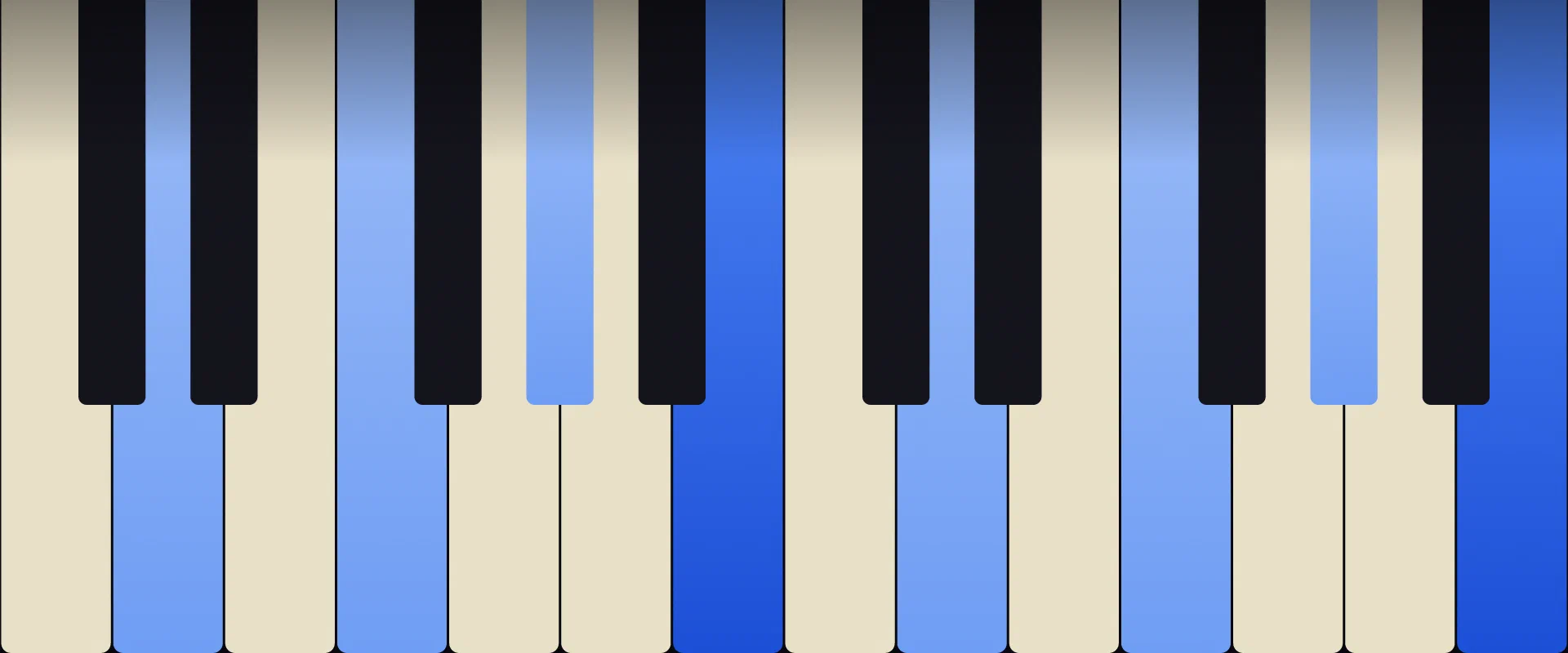
Try It: Bdim7 in the Chord Finder
The Notes of Bdim7
| Degree | Note | Interval from Root | Semitones |
|---|---|---|---|
| 1 (Root) | B | Perfect unison | 0 |
| ♭3 | D | Minor 3rd | 3 |
| ♭5 | F | Diminished 5th | 6 |
| ♭♭7 | A♭ | Diminished 7th | 9 |
Three, three and three. Every gap is a minor third, which is what “fully diminished” describes.
How Bdim7 Is Built
Follow the A♭ back to where it comes from and the chord explains itself. C natural minor is C, D, E♭, F, G, A♭ and B♭, and it has no leading note: B♭ is a whole tone below C and leans nowhere. Raise that degree to B and you have C harmonic minor, altered for the sole purpose of putting a semitone under the tonic.
Now build a seventh chord on the note you raised. B up a third to D, up a third to F, up a third to A♭, the flat sixth the minor scale kept. Bdim7 is not a colour anybody chose. It is the by-product of the alteration that defines harmonic minor.
Two tritones live inside it, B to F and D to A♭, crossing each other. A dominant seventh has one. That is the arithmetic behind it sounding like something has gone wrong.
The nearest simpler chord is Bdim, which stops at F. Add A and you get Bm7♭5, which lives in C major. Add A♭ and you get this chord, which lives in C minor. One semitone at the top of the stack picks the key.
Bdim7 on the Piano
Only one finger leaves the white keys, and in root position it is the weakest one. Right hand, 1 on B, 2 on D, 3 on F, 5 on A♭, the little finger reaching up to the black key between G and A. Left hand, 5, 3, 2, 1.
Because the four notes are evenly spaced, the hand covers the same nine semitones in every inversion; the only thing that moves is which finger draws the black key. D F A♭ B puts A♭ under the middle finger, where a black key belongs, and is the easiest of the four at speed. A♭ B D F puts it under the thumb, which is the one to avoid: the thumb sits deep between G and A and the wrist has to lift to clear the whites.
Practise the resolution rather than the chord. Hold B, D, F, A♭ and let three voices settle: B rises a semitone to C, A♭ falls a semitone to G, F falls to E♭, and D goes wherever the voicing is short. That is C minor. Let F fall only to E and it is C major, which is where you hear that A♭ was the borrowed note: it had to leave either way.
Set it against a plain C major triad and every note is a step away: B under C, F over E, A♭ over G. It surrounds the tonic on all sides at once.
Bdim7 on the Guitar
The chord books list no open form for this root, which is a shame. Two of the six open strings are chord tones, and they are the two that matter: the open B is the root, the open D is the minor third. The missing F and A♭ both sit at the first fret.
Play x20101. Middle finger on the fifth string at fret 2 for the B in the bass, index on the third string at fret 1 for A♭, ring on the first string at fret 1 for F, the fourth and second strings open, the sixth muted. Five sounding strings, three of them open, root position, no barre. Do not barre the first fret: that catches the second string and adds a C, the note this chord leans towards rather than contains.
Drop the fifth string and xx0101 is the same chord over D, two fingers. Moved into an open C it puts the resolution inside the first fret: F falls to the open E, the open B climbs to C.
Higher up, the movable form rooted on the fourth string is a pair of two string barres, index across the fourth and second strings at fret 9, ring across the third and first at fret 10, giving B, F, A♭ and D. Fret 9 is cramped and the fingers interlock, but it is what most players reach for, because it moves: the same grip three frets away holds the same four notes.
Inversions
| Inversion | Notes | Bass Note |
|---|---|---|
| Root position | B D F A♭ | B |
| 1st inversion | D F A♭ B | D |
| 2nd inversion | F A♭ B D | F |
| 3rd inversion | A♭ B D F | A♭ |
Inversion means less here than in any other seventh chord. Read D F A♭ B upwards and it is a diminished seventh built on D, note for note. Only the resolution says which name was the useful one.
Voicings
Split the two tritones at the keyboard: B and A♭ in the left hand, D and F in the right. Piled into one hand below middle C it turns to mud, because minor thirds that low beat against each other.
The voicing that earns its keep is the rootless one. Put a G in the left hand, play B, D, F, A♭ above it, and G7♭9 is complete, four of its five notes in one grip. On guitar the top four strings of x20101 do the same over a bass player’s G.
Which Keys Contain Bdim7
- degree 7 (VII) of C harmonic minor
One scale, and the shortness of that list is the point. A fully diminished seventh is diatonic to no major scale, no natural minor, no mode of either and no melodic minor: build a seventh on the leading note of any of them and the top note lands a minor seventh above the root, giving the half diminished chord instead. Only harmonic minor raises its seventh degree while keeping its sixth flat, and only that produces this chord without borrowing.
Where Bdim7 Shows Up
| Progression | Numerals | Chords |
|---|---|---|
| Minor cadence | iv, vii°7, i | Fm, Bdim7, Cm |
| Neighbour chord in C | I, vii°7, I | C, Bdim7, C |
| Rootless flat ninth | V7♭9 without its root | G7♭9 becomes Bdim7 |
| Secondary leading note in F | vii°7/V, V7, I | Bdim7, C7, F |
The third row is the one working musicians use most, and it is worth checking by hand. G7 is G, B, D and F, and its flat ninth is A♭. Write out G, B, D, F, A♭, take the G away, and B, D, F, A♭ is what is left. The A♭ that made the chord fully diminished is the same A♭, working as the ninth of a dominant rather than the sixth degree of a minor scale.
That identity multiplies. Any of the four evenly spaced notes can be read as the third of a dominant seventh, so this handful of pitches is the rootless flat ninth of G7, B♭7, D♭7 and E7 alike. A guitarist who knows x20101 holds the tense upper half of four dominants.
The last row is the chord doing borrowed work in a major key. In F major both B♮ and A♭ are foreign, but C is the dominant and B is a semitone below it, so Bdim7 tonicises C exactly as it tonicises C minor. That is how the symbol ends up in ragtime and early jazz written in keys containing none of its accidentals.
The first two rows are the chord at home and the chord decorating. In C minor it is the seventh degree. In C major, set between two statements of the tonic, it resolves nowhere and returns, giving a held chord something to do.
Related Chords
- B Diminished Chord
- B Half-diminished Chord
- G Dominant 7th Chord
- C Minor Chord
- C Harmonic Minor Scale
- Secondary Dominants and Borrowed Chords
Learn More
Practice Chords
Drill chord recognition with a metronome, MIDI support, and score tracking.
Start PracticingRelated Articles
A Diminished 7th Chord: Notes, Voicings, and How to Play It
Sep 1, 2026 · 8 min
A♯ Diminished 7th Chord: Notes, Voicings, and How to Play It
Sep 1, 2026 · 8 min
C Diminished 7th Chord: Notes, Voicings, and How to Play It
Sep 1, 2026 · 8 min