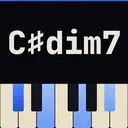
Five roots on this site are normally written with a flat: D♭, E♭, G♭, A♭ and B♭. Only one of them spells a diminished triad without a double flat, and that is B♭, which manages B♭, D♭, F♭ while E♭ needs B♭♭ and A♭ needs E♭♭. Stack one more minor 3rd on top and B♭ runs out of luck too, since the seventh letter above B♭ is A and a diminished 7th above B♭ is A♭♭. There the spelling reference gives up and names the chord A♯dim7: A♯, C♯, E and G.
It is the only chord in the 240 page set with A♯ on the front of it. Everything else standing on this key, from B♭ major through B♭m7 to B♭13, is filed under B♭. One interval flips the whole name across to the sharp side.
The sound is the least eccentric thing here: four notes, each a minor 3rd above the last, closing back on A♯ after one octave.
Try It: A♯dim7 in the Chord Finder
Set the root to A♯ and watch the gaps: three semitones, three, three, three.
The Notes of A♯dim7
A♯dim7 has four notes: A♯, C♯, E and G.
| Degree | Note | Interval from A♯ | Semitones |
|---|---|---|---|
| 1 (root) | A♯ | Perfect unison | 0 |
| ♭3 | C♯ | Minor 3rd | 3 |
| ♭5 | E | Diminished 5th | 6 |
| ♭♭7 | G | Diminished 7th | 9 |
Written A♯dim7 or A♯°7.
How A♯dim7 Is Built
Take the diminished triad on this key, add a note a minor 3rd above the top, and stop. The triad is on the site as B♭ Diminished, the same three keys under the other name.
The comparison worth making is sideways. Raise the G by one semitone and the chord becomes A♯, C♯, E, G♯, filed here as B♭m7♭5, because a minor 7th above B♭ is A♭ and a single flat is affordable. Three of the four notes never move between the two chords. The seventh alone decides whether the root is called B♭ or A♯.
Because the intervals are identical, the chord has no top and no bottom: C♯dim7, Edim7 and Gdim7 are these same four keys under other names, and of the four, only A♯dim7 is written entirely in sharps.
A♯dim7 on the Piano
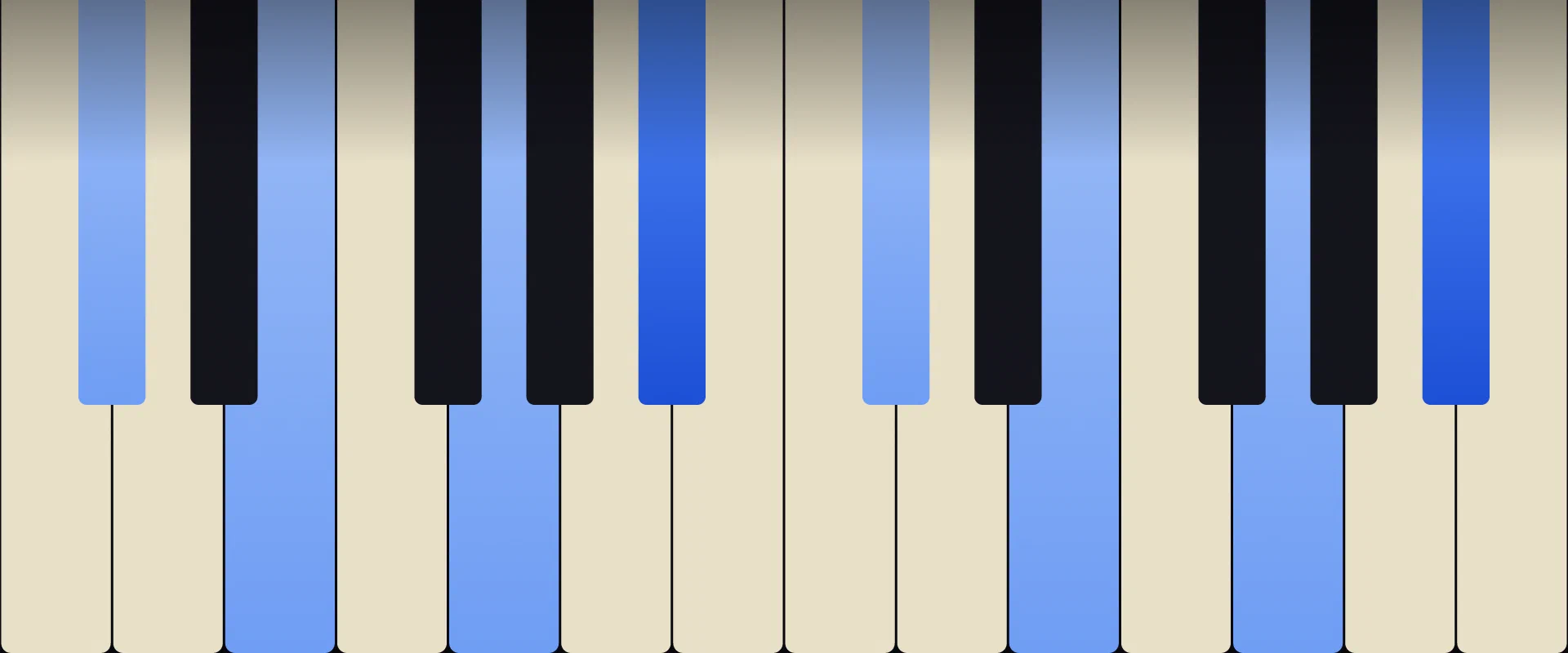
Read upwards, the chord is black, black, white, white: A♯ and C♯ on black keys, E and G on white ones. That silhouette does not survive inversion. Start on C♯ and it reads black, white, white, black; start on E and it is white, white, black, black. Four shapes under the hand, one chord, and a useful five minute drill.
The reach from A♯ to C♯ is the awkward one. The two black keys belong to different groups: A♯ is the top of the group of three, C♯ the bottom of the group of two, and between them sit B and C, the white pair with no black key wedged in. Only two black to black minor 3rds on the keyboard cross a seam like that, and this chord opens with one of them. All three gaps inside the chord measure three semitones, but only this one steps from one black key group to the other, and the hand feels the difference.
Right hand, put 1 on A♯, 2 on C♯, 3 on E and 5 on G. A thumb on a black key is normally avoided, though it works here because the hand travels outwards afterwards: 1 and 2 stay back among the black keys, 3 and 5 come forward onto the white key fronts, and the wrist sits at a diagonal. Keep the hand square instead and the third and fifth fingers have to reach backwards.
A♯dim7 on the Guitar
The chord books list no open form for this root, which undersells the position badly. The movable grip with the root on the fifth string frets one, two, nothing, two across the fifth, fourth, third and second strings, and with the root at the first fret that “nothing” is the open G string:
x 1 2 0 2 x
A♯ on the A string at fret 1, E on the D string at fret 2, G open, C♯ on the B string at fret 2. Index, middle and ring fingers, no barre, and the one string carrying real tension down here is the string you never press. The nut does a quarter of the job for free, which stops being true the moment you slide the shape to fret 4, 7 or 10, where the same four notes return reordered.
The grip with the root on the fourth string sits at fret 8:
x x 8 9 8 9
A♯, E, G and C♯ on the top four strings, fingers crossing over each other: middle on the fourth string at fret 8, little finger on the third at fret 9, index on the second at fret 8, ring on the first at fret 9. Drop it six frets to x x 2 3 2 3 and it is still these four notes, now with E in the bass. For a chord this exotic on paper, one of its cheapest voicings is two frets from the nut.
Inversions
| Inversion | Notes | Bass note | Symbol |
|---|---|---|---|
| Root position | A♯ C♯ E G | A♯ | A♯dim7 |
| 1st inversion | C♯ E G A♯ | C♯ | A♯dim7/C♯ |
| 2nd inversion | E G A♯ C♯ | E | A♯dim7/E |
| 3rd inversion | G A♯ C♯ E | G | A♯dim7/G |
Nothing in the sound distinguishes these. Every other seventh chord has an unequal gap that betrays the root, and this one has none, so the ear takes the lowest note and the chord becomes C♯dim7, Edim7 or Gdim7. The key and the chord that follows decide the analysis. See Chord Inversions and Voice Leading.
Voicings
C♯ E G over a bass F♯ is the version working players actually reach for, and the section below explains why: it is an F♯7♭9 with nobody wasting a finger on the root.
A♯ E C♯ G spreads the two tritones apart. The chord holds A♯ with E and C♯ with G, and this order keeps each pair open instead of letting both sit low and turn to mud. Below middle C, give the left hand A♯ on its own.
A♯ G C♯ E, diminished 7th jammed straight above the root, is the harsh option. See Extended Chords and Jazz Harmony.
Which Keys Contain A♯dim7
- degree 7 (VII) of B harmonic minor
One entry, and that is not a hole in the data. Of the scale families with pages here, only the raised seventh of harmonic minor yields a fully diminished seventh chord. Major, natural minor and melodic minor stop at a half-diminished seventh, and the modes are rotations of major, so they inherit that ceiling. B harmonic minor, B C♯ D E F♯ G A♯, is this chord’s single diatonic address. The chord finder will also show the four notes inside B harmonic major and the octatonic scales, neither of which has an article yet.
Where A♯dim7 Shows Up
Its permanent job is leading to B minor. Sound A♯dim7 then Bm and no voice moves further than a whole tone: A♯ rises a semitone to B, G falls a semitone to F♯, and the tritone between A♯ and E contracts to the B and D of the target chord.
Bm | Em | A♯dim7 | Bm
The useful thing about B minor is its relative major. D major is the friendliest key on a guitar, all open D, G, A and Bm, so this chord turns up in folk and country writing far more often than a symbol with a sharp in it suggests. Its commonest habitat there is the approach to the relative minor:
D | G | A♯dim7 | Bm
Bass G, A♯, B, climbing a semitone into the target, and the G that was the previous chord’s root stays put as the diminished 7th of this one.
The third use throws the root away. Put F♯ underneath these four notes and the chord is F♯7♭9, F♯ A♯ C♯ E G, the dominant of B minor with its ♭9 in place:
C♯m7♭5 | F♯7♭9 | Bm
A guitarist holding x x 2 3 2 3 over a bass player’s F♯ is playing the V of a minor ii-V-i without touching its root. See F♯7 for the plain version. Even spacing also makes that grip a rootless A7♭9, C7♭9 and E♭7♭9.
One correction worth making: this chord is not diatonic to B major. The seventh degree of B major carries A♯, C♯, E and G♯, a half-diminished chord. Getting the fully diminished version into a B major song means borrowing G natural from the parallel minor, a borrowed chord rather than a native one, and that sudden minor shading is the point of using it.
Related Chords
- B♭ Diminished Chord, the triad underneath, under the other root name.
- B♭ Half-diminished Chord, one semitone away at the top.
- B Minor Chord, where this chord is trying to go.
- Seventh Chords: The Complete Guide, where the fully diminished seventh sits beside the other four types.
Learn More
Practice Chords
Drill chord recognition with a metronome, MIDI support, and score tracking.
Start PracticingRelated Articles
A Diminished 7th Chord: Notes, Voicings, and How to Play It
Sep 1, 2026 · 8 min
B Diminished 7th Chord: Notes, Voicings, and How to Play It
Sep 1, 2026 · 8 min
C Diminished 7th Chord: Notes, Voicings, and How to Play It
Sep 1, 2026 · 8 min