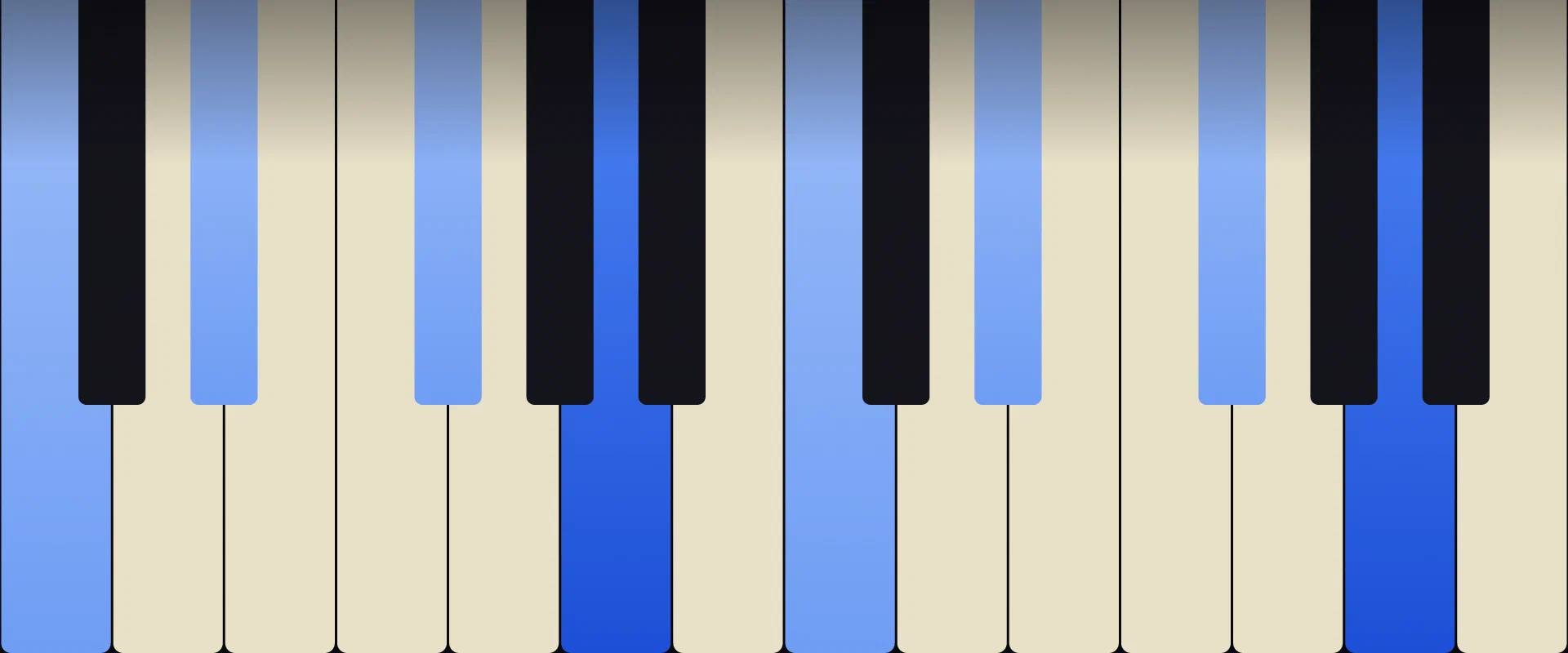
Adim7 is A, C, E♭ and G♭. So is Cdim7. So is D♯dim7, and so is F♯dim7. Not similar chords: the same four keys under the hand, four names for one sound. Twelve possible roots collapse into three chords, and A is one of the four names of the first of them. That single fact decides nearly everything below, from how many grips you have to learn to why a composer reaches for this chord at all.
Try It: Adim7 in the Chord Finder
Sound A, C, E♭ and G♭, then rebuild the same four notes starting from C, from E♭ and from G♭. The keyboard lights up identically every time.
The Notes of Adim7
| Degree | Note | Interval from root | Semitones |
|---|---|---|---|
| 1 (root) | A | Perfect unison | 0 |
| ♭3 | C | Minor 3rd | 3 |
| ♭5 | E♭ | Diminished 5th | 6 |
| ♭♭7 | G♭ | Diminished 7th | 9 |
Written out: A, C, E♭, G♭. Two flats, both on black keys, and no double accidental, which makes A one of the easier spellings in this family to read.
Count semitones. A to C is 3, C to E♭ is 3, E♭ to G♭ is 3, and G♭ back up to A is 3 again. Four steps of three make an exact octave with nothing left over, so no long interval marks where the chord begins. Two tritones sit inside it, A against E♭ and C against G♭, a minor 3rd apart.
How Adim7 Is Built
Take A diminished, which is A, C and E♭, and add one more minor 3rd. That gives G♭, a diminished 7th above A rather than a minor 7th. Am7♭5 puts G there instead: one semitone of difference, and the half diminished chord keeps a recognisable root while this one gives it up completely.
Run the twelve roots and the collapse is easy to verify. A, C, E♭ and G♭ give one chord. C♯, E, G and A♯ give the second. D, F, A♭ and B give the third. Every diminished seventh in music belongs to one of those three sets, and A belongs to the first.
Adim7 on the Piano
Root position is two white keys and then two black ones. Of the four names for this chord that is a distinction A holds alone: from C the pattern runs white, black, black, white, from D♯ it is black, black, white, white, and from F♯ black, white, white, black. Same notes, four pictures, and the A version puts both raised keys under the weakest fingers.
Right hand 1, 2, 3, 5 works, but the little finger lands on G♭ at full stretch and tends to flatten. The comfortable grip is the first inversion: thumb on C, index on E♭, middle on G♭, little finger on A, so both outer fingers sit on white keys at the front of the keyboard and the black keys go to strong middle fingers. Notice what that means. The most playable arrangement of Adim7 is the root position of Cdim7.
Here is the trap. The chord repeats every three semitones, so E♭, G♭, A, C is the same chord, but the hand shape is not. Push root position up a minor 3rd and the thumb moves from a white key onto a black one and the whole geometry rearranges. The symmetry is real in the sound and invisible to the fingers, so a pianist learns four hand positions where a guitarist learns one.
For a full voicing, put A alone in the left hand well below middle C and take C, E♭ and G♭ in the right. Splitting the two tritones between the hands stops the chord turning to mud.
Adim7 on the Guitar
On the top four strings the shape is fret n, n plus one, n, n plus one, and Adim7 sits at x x 1 2 1 2, x x 4 5 4 5, x x 7 8 7 8 and x x 10 11 10 11. Those are not four voicings of a family. They are the identical four pitch classes, reshuffled, four times up the neck. At the 7th fret they read A, E♭, G♭, C from the fourth string up. At the 4th they read G♭, C, E♭, A.
Fingering at the 7th fret is a small index barre across the top four strings, middle finger on the third string at the 8th, ring finger on the first string at the 8th. The barre only has to sound two strings, so it costs far less than a full six string barre in that position.
Down at the nut, add the open fifth string to the first position grip and you get x 0 1 2 1 2, which puts A in the bass for four fretted notes. Standard tuning offers this chord one useful open string, and it happens to be the root.
Then the payoff. Shift the grip one fret to x x 2 3 2 3 and you are playing C♯, E, G and A♯, a different diminished seventh entirely. One fret further, x x 3 4 3 4, gives D, F, A♭ and B. One more and you are home again. Three shapes on three consecutive frets cover all twelve roots. To find the Adim7 you want, locate the note you want in the bass on the fourth string: A at the 7th fret, C at the 10th, E♭ at the 1st, G♭ at the 4th.
Inversions
| Inversion | Notes | Bass | Also known as |
|---|---|---|---|
| Root position | A C E♭ G♭ | A | Adim7 |
| 1st inversion | C E♭ G♭ A | C | Cdim7 |
| 2nd inversion | E♭ G♭ A C | E♭ | D♯dim7 |
| 3rd inversion | G♭ A C E♭ | G♭ | F♯dim7 |
Every inversion of Adim7 is also a root position of something else, so an inversion here is a change of name rather than a change of weight. Spelled properly the alternatives read C, E♭, G♭, B♭♭ and D♯, F♯, A, C and F♯, A, C, E♭. That B♭♭ is a double flat sounding exactly like A, which is one reason writers with a choice prefer the A spelling.
Voicings
| Voicing | How to play it |
|---|---|
| Guitar, open position | x 0 1 2 1 2, root on the open fifth string |
| Guitar, root on the fourth string | x x 7 8 7 8, small index barre at fret 7 |
| Guitar, first position | x x 1 2 1 2, E♭ in the bass |
| Guitar, high register | x x 10 11 10 11, C in the bass |
| Piano, root position | Right hand 1, 2, 3, 5 on A, C, E♭, G♭ |
| Piano, easiest grip | C, E♭, G♭ in the right hand over A in the left |
| Rootless F7♭9 | the same four notes over an F bass |
Which Keys Contain Adim7
- degree 7 (VII) of B♭ harmonic minor
One scale, one degree. A fully diminished seventh is not diatonic to any major scale, any natural minor or any mode of them, so that short list is correct rather than incomplete.
Respell the notes and three further harmonic minor keys own the same sound:
- as B♯dim7, degree 7 of C♯ harmonic minor
- as D♯dim7, degree 7 of E harmonic minor
- as F♯dim7, degree 7 of G harmonic minor
Their tonics are B♭, C♯, E and G, themselves a minor 3rd apart.
Where Adim7 Shows Up
| Progression | In this key | Chords |
|---|---|---|
| vii°7, i | B♭ minor | Adim7, B♭m |
| i, iv, vii°7, i | B♭ minor | B♭m, E♭m, Adim7, B♭m |
| ii°7, V7♭9, i | B♭ minor | Cm7♭5, F7♭9, B♭m |
| I, ♯Idim7, ii7, V7 | A♭ major | A♭, Adim7, B♭m7, E♭7 |
| I, vii°7 of V, V7, I | E♭ major | E♭, Adim7, B♭7, E♭ |
| Pivot | B♭ minor into E minor | B♭m, Adim7, Em |
Start with the third row. F7 is F, A, C and E♭. Flatten its ninth and G♭ joins them. Drop the F and what remains is A, C, E♭, G♭ exactly. Adim7 is F7♭9 with the root removed, which is why a guitarist can hold x x 1 2 1 2 over a bass playing F and produce a full altered dominant. Move that bass to A♭, B or D and the same grip becomes A♭7♭9, B7♭9 and D7♭9. Four dominants, one shape, and those roots are a minor 3rd apart too.
Then the resolutions, where the ambiguity stops being a curiosity. Treat A as a leading note and the chord wants B♭ minor: A rises a semitone to B♭, G♭ falls a semitone to F, E♭ falls a semitone to D♭, C falls a tone to B♭. Every voice moves and none moves far.
Change nothing and treat E♭ as D♯ instead. D♯ rises to E, F♯ rises to G, C falls to B, A falls to G, and the chord lands just as convincingly on E minor. Hear C as the leading note and you arrive in D♭ minor. Hear G♭ as F♯ and you arrive in G minor. Four destinations a minor 3rd apart, from one chord, with no preparation: hold Adim7 in B♭ minor, resolve it to E minor, and you have moved a tritone from home in a single gesture.
Row four is the everyday version. In A♭ major, Adim7 sits between the tonic and B♭m7 to walk the bass up A♭, A, B♭ by semitone. Flat keys belong to horns and to the piano rather than to open string guitar, and this chord is common in both: stride and ragtime pianists lean on the passing diminished, and gypsy jazz turnarounds are built out of the three shapes.
Related Chords
- A Diminished Chord the triad underneath this one
- A Half-diminished Chord one semitone away at the top, and far less ambiguous
- A Minor 7th Chord the same root with a perfect 5th and a minor 7th
- F Dominant 7th Chord the dominant this chord completes when its ninth is flattened
- Secondary Dominants and Borrowed Chords for the vii°7 of V use
Learn More
Practice Chords
Drill chord recognition with a metronome, MIDI support, and score tracking.
Start PracticingRelated Articles
A♯ Diminished 7th Chord: Notes, Voicings, and How to Play It
Sep 1, 2026 · 8 min
B Diminished 7th Chord: Notes, Voicings, and How to Play It
Sep 1, 2026 · 8 min
C Diminished 7th Chord: Notes, Voicings, and How to Play It
Sep 1, 2026 · 8 min