A minor is the key almost everyone learns minor in, and the A natural minor scale cannot cadence. Its seventh degree is G, a whole tone below the tonic, and a whole tone below is a step rather than a pull. Raise that G to G♯, stack thirds on it, and you have G♯ B D F, built on the note that turns A minor from a mode into a key, carrying all the harmony that follows.
Fully diminished sevenths are where note names go strange, and this root escapes without a single odd one. Four letters, one sharp, nothing else.
Try It: G♯dim7 in the Chord Finder
The Notes of G♯dim7
| Degree | Note | Interval from root |
|---|---|---|
| 1 | G♯ | Perfect unison |
| ♭3 | B | Minor 3rd, 3 semitones |
| ♭5 | D | Diminished 5th, 6 semitones |
| ♭♭7 | F | Diminished 7th, 9 semitones |
Written low to high in root position: G♯ B D F.
Three minor 3rds end to end, G♯ to B, B to D, D to F, and a fourth from F back up to G♯. No long interval anywhere, so the chord sounds like one tense block rather than a bass note with things on top.
How G♯dim7 Is Built
Take G♯dim, which is G♯ B D, and add the note a diminished 7th above the root. That is F, not F♯. F♯ gives a minor 7th and produces G♯m7♭5 instead, a chord with a different job in a different key.
The extra note buys a second tritone. The triad has one, G♯ up to D. Adding F creates B up to F as well, so two diminished 5ths now cross inside the chord and every note is half of one.
That is where flat spellings break down. Name these same keys from A♭ and the letters must be A, C, E and G, which forces A♭ C♭ E𝄫 G𝄫: an E double flat played on D, and a G double flat played on F. Two double accidentals for four ordinary keys, so the reference writes G♯dim7 instead. Not every root escapes. Fdim7, the same four notes named from F, is spelled F A♭ C♭ E𝄫 and keeps one.
Because the intervals are all equal, Bdim7, Ddim7 and Fdim7 are these four notes with a different one called the root. Twelve roots, three distinct sounds, and this is one of them.
G♯dim7 on the Piano
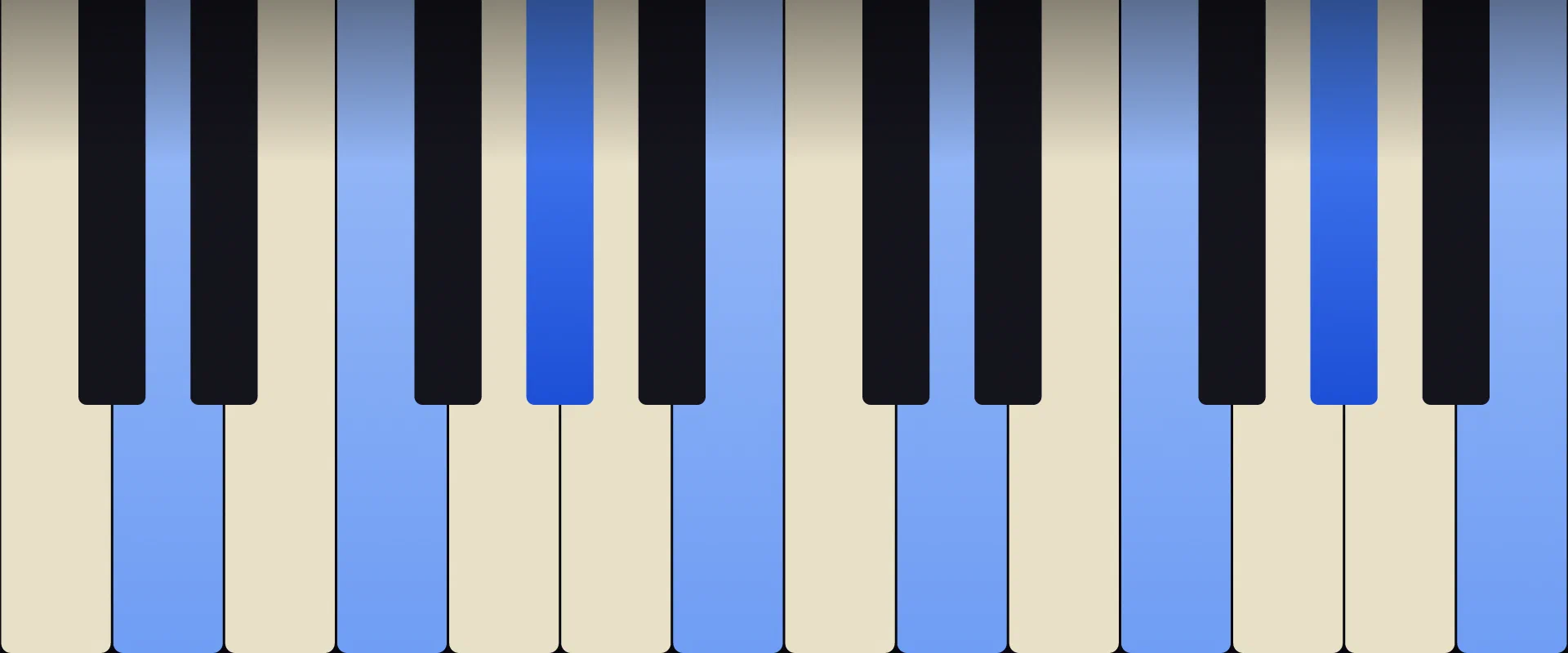
One black key at the bottom and three white keys above it, evenly spread. Right hand root position is 1 on G♯, 2 on B, 3 on D, 5 on F, left hand 5, 3, 2, 1. The thumb rides forward on the black key while the other fingers sit back between the black keys they pass, so nothing reaches for the front edge.
The exercise worth doing is the resolution, which is almost automatic. Both tritones close inwards: G♯ rises a semitone to A while D falls to C, and B rises to C while F falls to E. Play the four notes, move every finger by one semitone, and you are holding A, C, C and E, A minor with a doubled third. Nothing travels further than a key.
The second grip moves the left hand elsewhere. Hold G♯ B D F in the right hand, play a low E underneath, and the sound is a complete E7♭9: root, major 3rd, 5th, minor 7th and flattened 9th from a four note shape and one bass note. Pianists comping in A minor lean on this, because the alternative is voicing five notes in one hand.
G♯dim7 on the Guitar
The chord books offer nothing at the nut for this root, so guitarists assume it lives up the neck. It does not have to. Two of the four notes are open strings: the fourth sounds D, the flattened 5th, and the second sounds B. Fret the third string at the 1st fret for G♯ and the first string at the 1st fret for F, leave the two between them open, and x x 0 1 0 1 is the whole chord in first position with two fingers. Do not barre across, because the second string at the 1st fret is C and does not belong.
Add a root with the sixth string at the 4th fret: 4 x 0 1 0 1, ring finger on the bass, index and middle at the 1st fret, fifth string damped by the underside of the index. That is a wide, ringing version of a chord normally heard as a tight cluster.
The arithmetic explains why. The standard closed grip on the top four strings alternates two frets, here x x 6 7 6 7, root on the fourth string at the 6th fret. Since the shape repeats every three frets it also sits at 3 4 3 4 and 9 10 9 10, and one more step down lands on 0 1 0 1, where the lower fret becomes open strings. Only one of the three diminished sevenths reaches fret zero, and this is it.
The fifth string root form, x 11 12 10 12 x, is where teachers point, but the 11th fret is cramped and no open string can help there.
Inversions
| Inversion | Notes low to high | Bass note |
|---|---|---|
| Root position | G♯ B D F | G♯ |
| 1st inversion | B D F G♯ | B |
| 2nd inversion | D F G♯ B | D |
| 3rd inversion | F G♯ B D | F |
Inversion means less here than anywhere else. All four spacings are identical, so none sounds more settled than another. What the bass changes is where the chord points, and it points a semitone above whichever note is lowest: G♯ underneath leads to A minor, B leads to C minor, D to E♭ minor and F to F♯ minor. Four bass notes, four keys, one sound. The open shape above, x x 0 1 0 1, is second inversion, since the lowest note sounding is D.
Voicings
Nothing can be dropped. On a dominant or minor seventh the fifth is expendable; here it is D, one end of a tritone, and the seventh is F, one end of the other.
What can be added is a bass note from outside. Underneath E the chord becomes E7♭9, underneath G it is G7♭9, underneath B♭ B♭7♭9, underneath D♭ D♭7♭9, since each of those roots sits a semitone below one of the four notes. Only one of the four fits the letters G♯ B D F without respelling: E7♭9, which is E, G♯, B, D and F. The other three want A♭ where this page writes G♯. The spelling of this chord is an E7♭9 with its root taken away.
Which Keys Contain G♯dim7
- VII of A harmonic minor
One entry, and it is not an oversight. The triad G♯ B D belongs to six scale pages here, including A major and F♯ minor, but the moment F joins it all six drop out, because every one of them uses F♯. Adding a note narrows the chord from six keys to one.
A harmonic major (A B C♯ D E F G♯) has it on the same seventh degree but has no page here. Nor does E Phrygian dominant, which is A harmonic minor read from E: flamenco and metal players meet this chord there, on their third degree.
Where G♯dim7 Shows Up
| Progression | In letters | Where it lives |
|---|---|---|
| i, vii°7, i | Am, G♯dim7, Am | A minor, bass walking A, G♯, A |
| iv, vii°7, i | Dm, G♯dim7, Am | Cadence with no dominant root |
| V7♭9, i | E7♭9, Am | Jazz comping, right hand holds G♯dim7 |
| vii°7 respelled | G♯dim7, then E♭m | Pivot out of the key |
Row one is the cheapest way to hear the chord. Hold an A minor triad, drop the bass to G♯ and change the upper notes to B, D and F, then go back. One semitone of bass movement each way, and the key sounds established with no dominant chord anywhere.
Row two is smoother than it looks. D minor is D, F and A, and two of those are already in G♯dim7, so only A moves, a semitone down to G♯. The resolution from the piano section then takes over: a cadence in A minor with no voice travelling further than a semitone.
Row three is the same harmony as a jazz musician writes it. Flatten the ninth of E7 and the upper four notes of the result are this chord, so one diminished seventh shape covers the ♭9 alteration on four different dominants.
Row four is what makes the chord useful to composers rather than only to cadences. Arrive on it from A minor, where the ear expects a rise to A, then treat B♭ as its missing root and resolve it as B♭7♭9 to E♭ minor. Only the intention changes, and the music has moved from a key with no sharps or flats to one with six.
Related Chords
- G♯ Diminished Chord the triad underneath, with one tritone rather than two
- G♯ Half-diminished Chord the same triad with F♯ on top instead of F
- E Dominant 7th Chord the dominant this chord alters, and the one root its spelling belongs to
- A Minor 7th Chord the tonic it resolves into
- A Harmonic Minor Scale the only scale page here that spells all four notes this way
- Secondary Dominants and Borrowed Chords for diminished sevenths used as passing and pivot harmony
Learn More
Practice Chords
Drill chord recognition with a metronome, MIDI support, and score tracking.
Start PracticingRelated Articles
A Diminished 7th Chord: Notes, Voicings, and How to Play It
Sep 1, 2026 · 8 min
A♯ Diminished 7th Chord: Notes, Voicings, and How to Play It
Sep 1, 2026 · 8 min
B Diminished 7th Chord: Notes, Voicings, and How to Play It
Sep 1, 2026 · 8 min