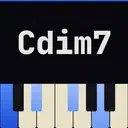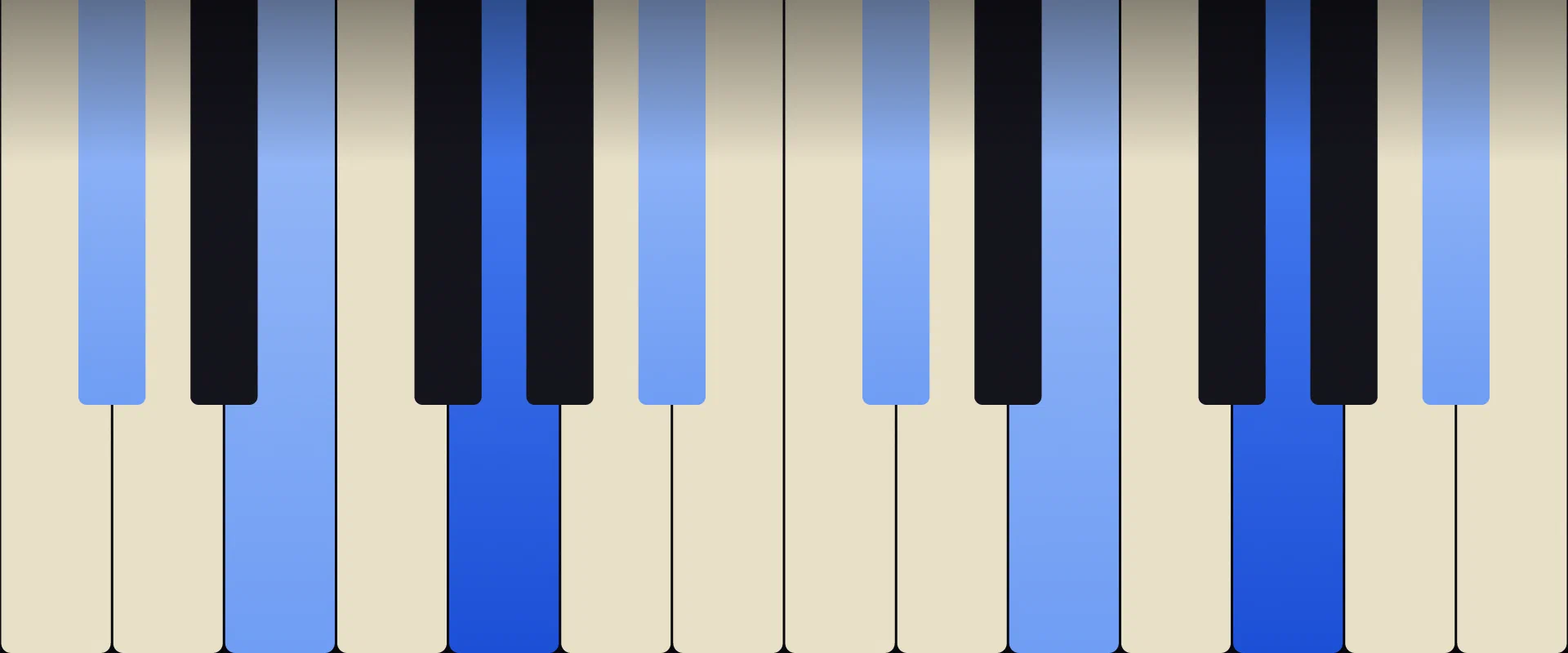
Hold G, B♭, D♭ and F♭ in your right hand and put E♭ underneath with your left. Nothing above has moved, yet the chord has stopped hovering: it is E♭7♭9 now, and it wants A♭ badly enough that your hands will go there on their own. That is the useful truth about Gdim7. It is less a chord in its own right than a dominant seventh with the root taken away, and the fastest way to learn it is to learn which root is missing.
Written Gdim7 or G°7. Two black keys, two white ones, and one accidental that lands where you will not expect it.
Try It: Gdim7 in the Chord Finder
The Notes of Gdim7
| Degree | Note | Interval from Root | Semitones |
|---|---|---|---|
| 1 (Root) | G | Perfect unison | 0 |
| ♭3 | B♭ | Minor 3rd | 3 |
| ♭5 | D♭ | Diminished 5th | 6 |
| ♭♭7 | F♭ | Diminished 7th | 9 |
The seventh is spelled F♭ and played on the white key E. Nothing is wrong with the page: a seventh chord stacks letters in thirds, so above G it must reach a B, then a D, then an F, and the only F nine semitones above G is a flattened one. Play E, write F♭, and the chord stays a G chord on paper.
How Gdim7 Is Built
Every gap here is three semitones: G to B♭, B♭ to D♭, D♭ to F♭, F♭ back up to G. That is why the top note is a diminished seventh and not the minor seventh of Gm7♭5.
Now strip the root off a dominant seventh flattened ninth. Its degrees are 1, 3, 5, ♭7 and ♭9; take away the 1 and the remaining four run 3, 5, ♭7, ♭9, four consecutive minor thirds standing on the dominant’s major third.
The missing root therefore lies a major third below the diminished chord’s root, which here means E♭. Check the letters rather than the rule: E♭7♭9 is E♭, G, B♭, D♭, F♭. Every name matches, the awkward F♭ included, because the ♭9 of E♭ is F♭ and nothing else.
You may have met the shortcut that the dominant lies a semitone below the diminished root. It points at the same sound from another seat: F♯7♭9 is F♯, A♯, C♯, E and G, with G as the flattened ninth. Same four pitches, different letters, and written from F♯ the upper four spell A♯dim7 rather than Gdim7. Both rules work by ear. Only the major third version keeps the spelling.
That is symmetry at work. C♯dim7, Edim7 and A♯dim7 are these four keys under different names, so all twelve roots yield only three distinct diminished sevenths.
Gdim7 on the Piano
Right hand 1 on G, 2 on B♭, 4 on D♭ and 5 on E, which is the F♭. The two black keys sit in the middle of the hand and the two white ones at either end, so the wrist has to stay level while fingers 2 and 4 reach back. Avoid 1, 2, 3, 5: the third finger on D♭ crowds the hand and leaves the little finger to cover a minor third on its own.
Then practise the bass note rather than the shape, because that is where the work happens. Hold the right hand still and walk the left through four notes.
| Left hand | Chord it makes | Resolves to |
|---|---|---|
| E♭ | E♭7♭9 | A♭ |
| F♯ | F♯7♭9 | B |
| A | A7♭9 | D |
| C | C7♭9 | F |
Four altered dominants out of one handful, and their targets, A♭, B, D and F, are themselves a minor third apart. Any chart calling for the altered dominant of those four keys can be answered with this shape, as long as somebody has the bass.
Play the E♭ version and let it land. Under the left hand’s step from E♭ to A♭ the right hand barely travels: G rises a semitone to A♭, B♭ falls to A♭ or climbs to C, D♭ falls to C, F♭ falls to E♭. No voice moves further than a whole tone, which is why the resolution sounds inevitable rather than merely correct.
One caution. With F♯ underneath, your D♭ is functioning as C♯ and your F♭ as E. The fingers do not care. An arranger writing the part out does.
Gdim7 on the Guitar
The chord books list no open form here and they are too cautious. Three open strings are chord tones: both E strings give F♭, the open G gives the root. That buys an easy first inversion at the nut, x 1 2 0 2 0, index at the 1st fret on the 5th string for B♭ and two fingers at the 2nd for F♭ and D♭. Add the 6th string at the 3rd fret and 3 1 2 0 2 0 puts G back underneath.
The workhorse sits further along. Root on the 4th string at the 5th fret, x x 5 6 5 6: four notes, four strings, two frets wide, no doubling and no barre. Since the octave divides into four equal steps, that block gives the identical four pitches at the 2nd, 5th, 8th and 11th frets. Higher up, x 10 11 9 11 x roots it on the 5th string at the 10th, cramped but clean.
Now the payoff. Take that block and add the 6th string at the same fret as its lowest note. At the 5th fret, 5 x 5 6 5 6 puts A in the bass and the chord becomes A7♭9. The same hand gives F♯7♭9 at the 2nd fret, C7♭9 at the 8th and E♭7♭9 at the 11th, and the top four strings never change what they are doing. Its open cousin is x 0 2 3 2 3, the A7♭9 most players already own without knowing a diminished seventh sits inside it.
Inversions
| Inversion | Notes | Bass | Symbol |
|---|---|---|---|
| Root position | G B♭ D♭ F♭ | G | Gdim7 |
| 1st inversion | B♭ D♭ F♭ G | B♭ | Gdim7/B♭ |
| 2nd inversion | D♭ F♭ G B♭ | D♭ | Gdim7/D♭ |
| 3rd inversion | F♭ G B♭ D♭ | F♭ | Gdim7/F♭ |
The table is a formality here in a way it is not for other seventh chords. All four gaps are equal, so every inversion has the same shape and sound, and a publisher would rename the chord after the bass note rather than print a slash. Which note goes underneath still matters: in A♭, B♭ is the classical choice, since it steps down to A♭ while G rises to it.
Voicings
Spread it. Four notes a minor third apart, packed below middle C, read as a smudge; lift the F♭ an octave and the chord opens out. Splitting the two tritones, G against D♭ and B♭ against F♭, between registers is what makes it sound poised rather than merely dissonant.
Nothing here is expendable. Lose G or F♭ and a bare diminished triad is left, which implies no dominant at all; lose B♭ or D♭ and the remaining three no longer stack in thirds. Compare Gm7♭5, where the root is the first thing to go.
If the bass has E♭, add C on top for E♭13♭9, which is the fullest way to colour the arrival on A♭maj7.
Which Keys Contain Gdim7
This chord is not diatonic to any major or natural minor scale, so the usual list of six degrees shrinks to one:
- degree 7 (VII) of G♯ harmonic minor
That page spells the chord F𝄪, A♯, C♯ and E, since naming it from the sharp side forces a double sharp. Identical keys, different letters.
Harmonic minor is the only common scale that grows a fully diminished seventh on its leading tone, and the one giving this exact spelling is A♭ harmonic minor, catalogued here under its enharmonic twin above. In practice you meet the chord as vii of A♭ minor, or borrowed into A♭ major, where the F♭ comes from the parallel minor.
Where Gdim7 Shows Up
| Progression | Chords | Typical use |
|---|---|---|
| vii, i in A♭ minor | Gdim7/B♭, A♭m | Leading tone seventh |
| Rootless V7♭9 in A♭ | Gdim7 over E♭ | Comping without the bass |
| Rootless V7♭9 in D | Gdim7 over A | The same grip, new key |
| ♯iv°7 in D♭ major | D♭, Gdim7, D♭/A♭ | Sharp four passing chord |
| Rootless V7♭9 in F minor | Gdim7 over C, Fm | Minor cadence, altered |
Rows two, three and five are one handful of notes doing three unrelated jobs, which is the practical case for learning this chord instead of three separate altered dominants. In A♭ the bass supplies E♭, in D it supplies A, in F minor it supplies C. Keys sharing no key signature end up sharing a grip.
The D♭ row is the oldest use of the four. Raise the fourth degree of D♭ major to G, stack a diminished seventh on it, and the bass climbs a semitone from G into A♭, the fifth of the key. Ragtime and early musical theatre run on that move, and it is still what most players mean by a passing diminished chord.
The E♭7 relationship is the one to keep. Any bar marked E♭7 on the way to A♭ will take this chord instead, and the flattened ninth it smuggles in is usually an improvement on the plain dominant.
Related Chords
- G Diminished Chord, the triad underneath the F♭
- G Half-diminished Chord, with F natural in place of F♭
- E♭ Dominant 7th Chord, the chord this one is missing the root of
- G Dominant 7th Chord, a dominant on G rather than a fragment of one
- G Minor 7th Chord, the stable seventh on this root
- G Minor 6th Chord, one semitone away on the fifth
- Secondary Dominants and Borrowed Chords
- Guitar Chord Shapes: The CAGED System
Learn More
Practice Chords
Drill chord recognition with a metronome, MIDI support, and score tracking.
Start PracticingRelated Articles
A Diminished 7th Chord: Notes, Voicings, and How to Play It
Sep 1, 2026 · 8 min
A♯ Diminished 7th Chord: Notes, Voicings, and How to Play It
Sep 1, 2026 · 8 min
B Diminished 7th Chord: Notes, Voicings, and How to Play It
Sep 1, 2026 · 8 min