Play F♯, A, C and E♭ to a room of musicians, ask which note is the root, and you will get four answers. All four are defensible, because nothing in the sound favours one over the others. The symbol on the page settles it instead, and what the symbol records is not what the chord sounds like but where the music is about to go.
Written F♯dim7, the claim is that F♯ is the note under pressure, and F♯ under pressure means G is next. That address is what makes this name the useful one: G major and E minor are the keys a guitarist lives in, and this is the sharpest tool either of them owns.
Try It: F♯dim7 in the Chord Finder
Set the root to F♯, then move it up three semitones three times and listen for a change that never comes.
The Notes of F♯dim7
| Degree | Note | Interval from root | Semitones |
|---|---|---|---|
| 1 (root) | F♯ | Perfect unison | 0 |
| ♭3 | A | Minor 3rd | 3 |
| ♭5 | C | Diminished 5th | 6 |
| ♭♭7 | E♭ | Diminished 7th | 9 |
Written out: F♯, A, C, E♭. Two black keys and two white ones, alternating, and the top note sits nine semitones above the bottom. That makes it the narrowest of the seventh chords: F♯7 and F♯m7 span ten semitones, F♯maj7 eleven. A hand that struggles with those will not struggle with this.
The double flat in the degree column is real theory. A minor seventh above F♯ is E, the diminished seventh is one semitone lower, and the letter stays E because F♯, A, C, E is the only stack of thirds available.
How F♯dim7 Is Built
Take the F♯ diminished triad, F♯, A and C, and add a note three semitones above C. Every gap in the finished chord is then a minor third, including the one from E♭ back up to F♯, which is why the shape closes on itself.
The near neighbour is F♯m7♭5, which puts E on top instead of E♭, and that semitone decides everything. F♯m7♭5 belongs to G major outright. F♯dim7 does not, because E♭ is the flattened sixth of G, borrowed from G minor, so a chart printing it in G is already saying the music has darkened.
The second consequence of the even spacing is the one this page is about. Rotate a dominant seventh and you get an inversion of itself. Rotate this chord and you get another root position chord of the same type on a different note. Among seventh chords that happens only here, and the one other common chord with the property is the augmented triad.
F♯dim7 on the Piano
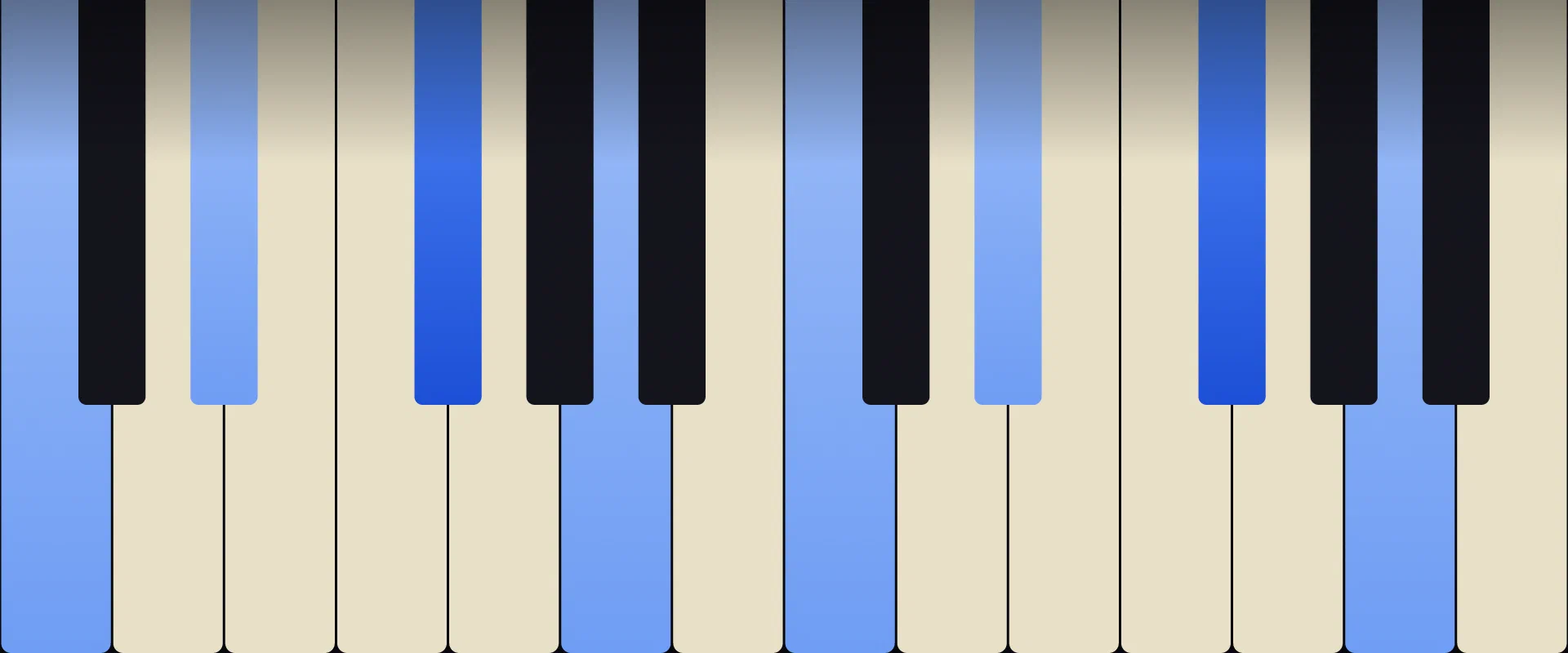
The two black keys come from different groups, which is the whole tactile story. F♯ is the first of the group of three; E♭ is the second of the group of two. Between them lie A and C, flat on the white row. The silhouette runs raised, level, level, raised, so the hand climbs, settles and climbs again.
Right hand 1 on F♯, 2 on A, 3 on C, 5 on E♭. Thumb on a black key is normally worth avoiding, but nine semitones leaves so much room that it never gets crowded. Left hand 5, 4, 2, 1. Split it, F♯ underneath and A, C, E♭ above, and neither hand is holding a tritone on its own.
Play the chord, then move every finger up three semitones, four times, until you are back an octave higher. The sound never changes. The shape under the hand changes at every step:
| Notes | Black and white |
|---|---|
| F♯ A C E♭ | raised, level, level, raised |
| A C E♭ F♯ | level, level, raised, raised |
| C E♭ F♯ A | level, raised, raised, level |
| E♭ F♯ A C | raised, raised, level, level |
Four hand positions, one chord. That is the tax the keyboard charges for laying twelve identical semitones out as seven keys and five.
F♯dim7 on the Guitar
Exactly one of the six open strings is a note of this chord: the fifth, A. That is why the books list no open F♯dim7, and it also points at the one cheap voicing near the nut. x 0 4 5 4 x sounds A, F♯, C and E♭ with the open fifth string in the bass. Middle finger on the fourth string at fret 4, index on the second string at the same fret, little finger on the third string at fret 5.
The workhorse is x x 4 5 4 5, four fingers in a diagonal on the top four strings with F♯ in the bass. Rooted on the fifth string, x 9 10 8 10 x puts the same four notes at the ninth fret, where the frets are narrow enough that reaching back to fret 8 costs nothing. Neither is barred, which is true of every form of this chord.
Now slide the first shape. Three frets is a minor third, so the notes are identical at every stop, but the string carrying the bass changes what the chord is called:
| Shape | Lowest note | Name in root position |
|---|---|---|
| x x 1 2 1 2 | E♭ | D♯dim7 |
| x x 4 5 4 5 | F♯ | F♯dim7 |
| x x 7 8 7 8 | A | Adim7 |
| x x 10 11 10 11 | C | Cdim7 |
Four names, four positions, one sound. And since the pattern repeats every three frets, the shapes at frets 4, 5 and 6 exhaust every diminished seventh there is: only three exist in all twelve keys, and the guitar puts all three inside a single hand position.
Inversions
| Inversion | Notes | Bass | Also a root position chord |
|---|---|---|---|
| Root position | F♯ A C E♭ | F♯ | F♯dim7 |
| 1st inversion | A C E♭ F♯ | A | Adim7 |
| 2nd inversion | C E♭ F♯ A | C | Cdim7 |
| 3rd inversion | E♭ F♯ A C | E♭ | D♯dim7 |
Read the last column carefully. It is not a list of similar chords: those are the same four pitches every time. Written strictly, Adim7 is A, C, E♭ and G♭, and Cdim7 is C, E♭, G♭ and B♭♭, where G♭ sounds as F♯ and B♭♭ sounds as A. The letters shift and the sound does not.
A player who meets any of the four symbols plays the same grip. What the symbol adds is the destination: F♯dim7 leans on G, Adim7 on B♭, Cdim7 on D♭ and D♯dim7 on E. One sound, four errands. Chord Inversions and Voice Leading covers the ordinary case, where the bass note colours a chord. Here it renames it.
Voicings
Nothing here is optional. Drop the E♭ and the F♯ diminished triad is left; drop the F♯ and A, C, E♭ is a diminished triad too. A dominant seventh has a spare fifth to leave out; this one has nothing.
| Voicing | How to play it |
|---|---|
| Piano, two hands | F♯2 in the left, A3, C4 and E♭4 in the right |
| Piano, one hand | F♯3, A3, C4, E♭4 with 1, 2, 3, 5 |
| Piano, as a dominant | D2 in the left hand under all four |
| Guitar, fourth string root | x x 4 5 4 5 |
| Guitar, fifth string root | x 9 10 8 10 x |
| Guitar, near open | x 0 4 5 4 x, open fifth string in the bass |
The third row is the standard trick: put D underneath and the chord becomes D7♭9, with the right hand supplying the whole upper structure. These four notes sit on top of F7♭9, A♭7♭9 and B7♭9 as well, and those dominants target G, B♭, D♭ and E, the same list of destinations the four names gave.
Which Keys Contain F♯dim7
| Degree | Key |
|---|---|
| vii°7 | G harmonic minor |
One scale here produces the chord spelled this way, and the scarcity is honest: diminished sevenths are chromatic events rather than scale chords.
Three other keys sound it under other names, all on their seventh degree. E harmonic minor spells D♯, F♯, A and C, B♭ harmonic minor spells A, C, E♭ and G♭, and C♯ harmonic minor spells B♯, D♯, F♯ and A. The pairing of G with E is the half worth remembering, since those two share a key signature.
Where F♯dim7 Shows Up
Em, F♯dim7, G. The bass rises E, F♯, G while the top voice falls E, E♭, D. Underneath, one voice walks G, A, B and another B, C, D, so every part moves by a tone or a semitone and two of them move against the bass. The F♯ in the bass is doing exactly what the name promises, which is the reason to write this chord as F♯dim7 rather than as any of its aliases.
G, D♯dim7, Em. Identical notes, identical grip, and now the bass falls G, F♯, E while the top voice rises D, D♯, E and the middle steps B, C, B. Spell that rising line D, E♭, E and it looks wrong on the page. Spell it D, D♯, E and the leading note into E minor is visible, which is precisely why the same sound takes a different symbol going this direction.
Anywhere a chart says D7♭9 in G. Play F♯, A, C and E♭ and let the bass supply the D. In a duo that is not a substitution, it is a division of labour.
Its home is fingerstyle guitar and hymnody in G and E minor, and ragtime piano, which leans on diminished sevenths the way later music leans on secondary dominants. Secondary Dominants and Borrowed Chords sets out the wider family.
Related Chords
- F♯ Diminished Chord, the triad this is built on
- F♯ Half-diminished Chord, E in place of E♭, and the symmetry goes
- G♭ Augmented Chord, the triad with the same rootless problem
- G Major Chord, the destination the name F♯dim7 records
- E Minor Chord, the destination the name D♯dim7 records
Learn More
- Seventh Chords: The Complete Guide
- Chord Inversions and Voice Leading
- What Are Intervals and How to Identify Them, for the diminished seventh and the tritone
- The G Harmonic Minor Scale, the one scale here that spells this chord
- The Circle of Fifths Explained
Practice Chords
Drill chord recognition with a metronome, MIDI support, and score tracking.
Start PracticingRelated Articles
A Diminished 7th Chord: Notes, Voicings, and How to Play It
Sep 1, 2026 · 8 min
A♯ Diminished 7th Chord: Notes, Voicings, and How to Play It
Sep 1, 2026 · 8 min
B Diminished 7th Chord: Notes, Voicings, and How to Play It
Sep 1, 2026 · 8 min