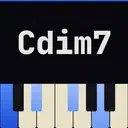
Three accidentals in the name, one black key under the hand. Fdim7 is written F, A♭, C♭ and E𝄫, and the A♭ is the only note that sends a finger anywhere dark. The other two accidentals land on white keys. C♭ is the key everyone calls B, and E𝄫, a doubly flattened E, is the key everyone calls D.
So say that second one plainly. E𝄫 sounds the same as D. Play D. The name is not a warning about some other key, it is a statement about which letter this note occupies in the chord. Of the 240 chords covered here, three keep a double accidental in their correct spelling, and this is one of them.
The letters decide it. A seventh chord is four alternate letters, and on F those are F, A, C and E, so whatever the accidentals do afterwards, the top note stays some kind of E. E♮ is the major 7th, E♭ is the minor 7th, and a diminished 7th is that minor 7th lowered once more, which leaves E♭ carrying a second flat. Write D instead and the letters read F, A, C, D: the chain breaks, and the top interval reads as a 6th, which opens outwards where this chord closes in.
Try It: Fdim7 in the Chord Finder
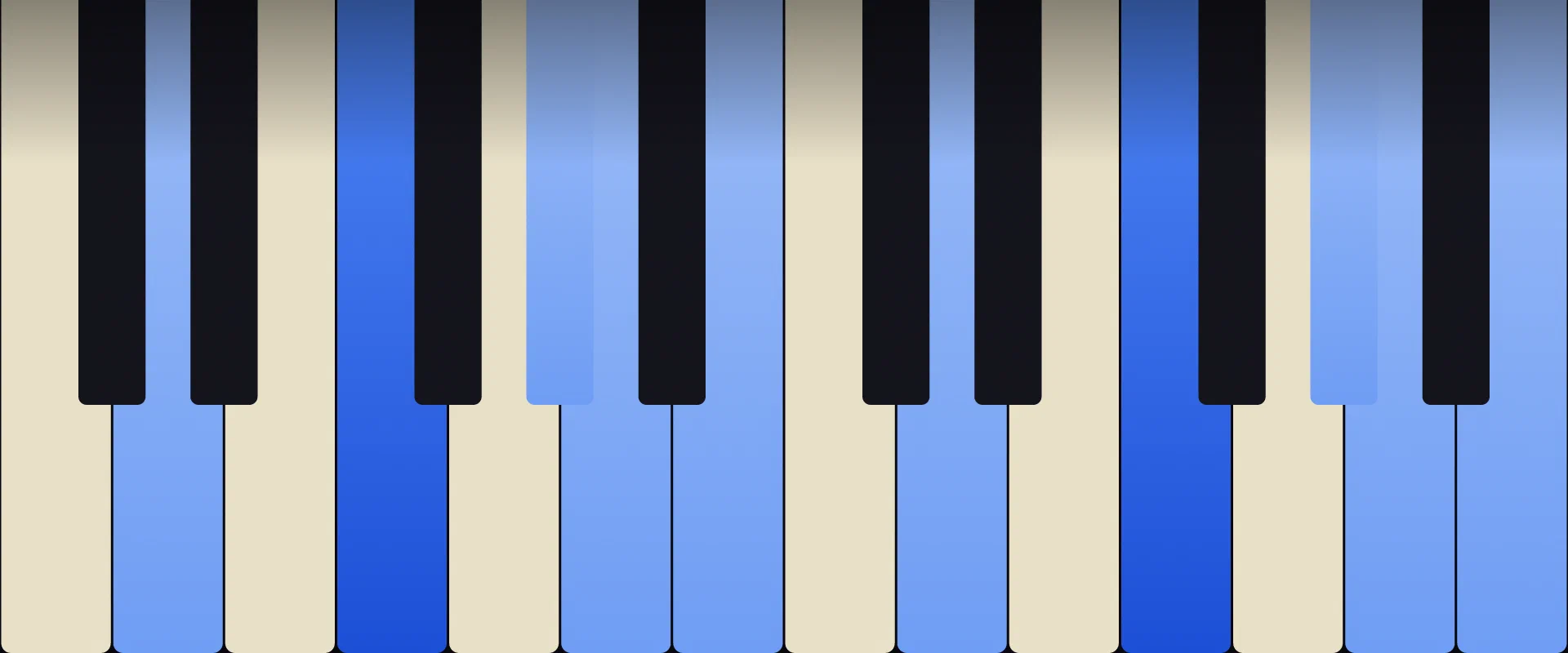
Set F as the root and find the diminished seventh. Two of the four lit keys go by other names.
The Notes of Fdim7
| Degree | Note | Interval from Root | Semitones |
|---|---|---|---|
| 1 (Root) | F | Perfect unison | 0 |
| ♭3 | A♭ | Minor 3rd | 3 |
| ♭5 | C♭ | Diminished 5th | 6 |
| ♭♭7 | E𝄫 | Diminished 7th | 9 |
Three semitones, three, three, and three more would close the octave, so the step from E𝄫 back up to F matches every step below it. Nothing in the spacing marks F out as the root.
How Fdim7 Is Built
Start from the F diminished triad, F A♭ C♭, and carry on stacking: one more minor 3rd gives E𝄫 and the chord is done. Stop a semitone short of that, on E♭, and you have Fm7♭5 instead, which still holds a perfect 5th and still behaves like a chord with a root. Take that semitone and every trace of hierarchy goes.
Four equal intervals give four equal claims on the bottom note, so all twelve roots between them produce only three distinct diminished sevenths. This one is shared with Ddim7, G♯dim7 and Bdim7: not similar chords, the same four pitches under four names. What decides the name is the bass note and the key, and on the flat side of the map the answer is rarely F.
Fdim7 on the Piano
Three white keys and one black, which is peculiar to this collection. The other two diminished sevenths take two black keys and two white. Only this one sits almost entirely on the plain.
Right hand, root position: thumb on F, second finger on A♭, third on B, fifth on D. Nine semitones is a comfortable reach. The two white keys at the top straddle C without touching it, and C is both the note the ear expects and the note that has been flattened away.
Set Fm7♭5 beside it and the little finger comes off the black E♭ onto the white D one key below. Push the whole shape up three semitones and the same four keys return in a new order: across a whole keyboard there are only three sets of keys this chord can sit on.
Fdim7 on the Guitar
The two notes whose names look wrong are the two that arrive free. The open 4th string is D, this chord’s E𝄫, and the open 2nd string is B, its C♭. Fret only A♭ and F, both waiting at the 1st fret, and the chord is complete: x x 0 1 0 1, index on the 3rd string, a second finger on the 1st, the open strings threading between them. Two fingers for a four note chord. Add the middle finger on the 6th string at fret 1 for 1 x 0 1 0 1 and the root is underneath it.
Do not reach for a barre. No diminished seventh can be barred anywhere in standard tuning, and the arithmetic is worth keeping. Neighbouring strings are tuned four or five semitones apart, while every interval inside this chord is three, six or nine, so no two of its notes ever share a fret on adjacent strings. Every grip is a zigzag.
Higher up, the shape rooted on the 5th string is x 8 9 7 9 x, sounding F, C♭, E𝄫 and A♭, thick and slack at fret 8. The 4th string version, x x 3 4 3 4, holds the same four notes in a brighter register. Both repeat every three frets unchanged, so fret 8 is also fret 11 and fret 5.
Inversions
| Inversion | Notes | Bass Note | Symbol |
|---|---|---|---|
| Root position | F, A♭, C♭, E𝄫 | F | Fdim7 |
| 1st inversion | A♭, C♭, E𝄫, F | A♭ | Fdim7/A♭ |
| 2nd inversion | C♭, E𝄫, F, A♭ | C♭ | Fdim7/C♭ |
| 3rd inversion | E𝄫, F, A♭, C♭ | E𝄫 | Fdim7/E𝄫 |
Two of those rows put an accidental in the bass that lands on a white key, and the last asks a bass player to read a double flat. Neither happens on a real part. The third row is printed Fdim7/D, the second Fdim7/B, and more often the chord is renamed after whatever the bass plays.
Inverting a major triad changes its intervals and its sound. Inverting this one changes nothing: every row is the same stack of minor 3rds, so these are relabellings, not rearrangements.
Voicings
The chord holds two interlocked tritones, F to C♭ and A♭ to E𝄫. Split them between the hands, F and C♭ below, A♭ and E𝄫 above, and it opens up. Stack all four below middle C and the minor 3rds turn to mud.
The voicing worth memorising puts D♭ in the bass. F, A♭, C♭ and E𝄫 become the 3rd, 5th, 7th and ♭9 of D♭7♭9, and notice what does not change: the 9th above D♭ has to be a kind of E, so D♭7♭9 needs the double flat for exactly the reason this chord does. It follows the root, not the chord type.
| Shape | Frets, low to high | Sounding notes |
|---|---|---|
| Two fingers, open strings | x x 0 1 0 1 | E𝄫, A♭, C♭, F |
| Root in the bass, fret 1 | 1 x 0 1 0 1 | F, E𝄫, A♭, C♭, F |
| Root on 5th string, fret 8 | x 8 9 7 9 x | F, C♭, E𝄫, A♭ |
| Root on 4th string, fret 3 | x x 3 4 3 4 | F, C♭, E𝄫, A♭ |
Which Keys Contain Fdim7
- degree 7 (VII) of F♯ harmonic minor
One entry, and it does not use these letters: that page spells the chord E♯, G♯, B and D, which is what six sharps force. Same sounds, different names.
The shortness of the list is the point. A diminished seventh is diatonic to almost nothing: the seventh degree of harmonic minor, and essentially nowhere else. The harmonic minor that spells this chord F, A♭, C♭ and E𝄫 is G♭ minor, which takes nine flats, two of them doubles. Nobody writes in it. Everyone uses F♯ minor and spells the chord from E♯ instead. The correct spelling therefore belongs to a key that exists on paper and not in print, which is the shortest explanation of why it looks so strange.
Where Fdim7 Shows Up
| Progression | In letters | Where it lives |
|---|---|---|
| vi7, vii°7, Imaj7 | E♭m7, Fdim7, G♭maj7 | Bass climbing to the tonic in G♭ |
| vii°7, i | Fdim7, G♭m | The cadence this spelling was built for |
| ii7, V7♭9, Imaj7 | A♭m7, D♭7♭9, G♭maj7 | Fdim7 in the right hand |
The F name survives only where F is genuinely in the bass, and in flat keys that means G♭. The first row is the gospel and ragtime move: the bass climbs E♭, F, G♭ and the chord in the middle is a passing diminished seventh named after the note the bassist is standing on. In the second, F rises a semitone into G♭ while E𝄫 falls a semitone onto D♭, which is the sixth degree of G♭ minor stepping down to the fifth. Spell that note D and the step reads as a chromatic accident rather than a scale degree.
The third row is where most players actually meet it. A pianist comping a ii V I in G♭ plays A♭m7, then this exact grip over a D♭ bass, then G♭maj7, and never thinks the word diminished. Three other dominants borrow the same four sounds, E7♭9, G7♭9 and B♭7♭9, but each spells them from a different letter. D♭7♭9 alone matches this page note for note.
Related Chords
- F Half-diminished Chord is one semitone away at the top, E♭ for E𝄫, and it keeps a perfect 5th.
- F Diminished Chord is the triad underneath, and sets out why the 5th of an F chord has to be a kind of C.
- F Minor 6th Chord is F, A♭, C and D, which is what you get by writing that D and leaving the 5th alone. It sounds nothing like this chord.
- F Minor 7th Chord is F, A♭, C and E♭, the same four letters with two of the four flats taken off.
- Chord Inversions and Voice Leading covers the passing bass lines that carry diminished sevenths.
Learn More
For this chord beside the other seventh types, see Seventh Chords: The Complete Guide. D♭7♭9 and the altered dominants it hides inside are covered in Extended Chords and Jazz Harmony. For why G♭ minor takes nine flats where F♯ minor takes three sharps, see the circle of fifths. For every scale on the site containing this chord, see Scales for Piano and Guitar: The Complete Reference Guide.
Practice Chords
Drill chord recognition with a metronome, MIDI support, and score tracking.
Start PracticingRelated Articles
A Diminished 7th Chord: Notes, Voicings, and How to Play It
Sep 1, 2026 · 8 min
A♯ Diminished 7th Chord: Notes, Voicings, and How to Play It
Sep 1, 2026 · 8 min
B Diminished 7th Chord: Notes, Voicings, and How to Play It
Sep 1, 2026 · 8 min