A guitar is tuned to E and B. Three of its six open strings sound one or the other, and the whole beginner repertoire on this root leans on that. Edim7 takes half of it back. The chord is E, G, B♭ and D♭: it keeps the E, and where the B should be it puts a B♭ a semitone lower, on the string in the middle of the strum where a guitarist can least afford to silence anything. The instrument ends up arguing with itself. It is still playable open, better than the books admit, but only if you work it out yourself.
Try It: Edim7 in the Chord Finder
Select F as the root and Harmonic Minor, then look at the seventh degree. Or take E with the whole-half diminished scale under Symmetric, where degrees 1, 3, 5 and 7 all give this chord.
The Notes of Edim7
| Degree | Note | Interval from Root | Semitones |
|---|---|---|---|
| 1 (Root) | E | Perfect unison | 0 |
| ♭3 | G | Minor 3rd | 3 |
| ♭5 | B♭ | Diminished 5th | 6 |
| ♭♭7 | D♭ | Diminished 7th | 9 |
The top note is the black key you would normally call C♯. It has to be written D♭ here: a chord in thirds on E needs the letters E, G, B and D, and C♯ would leave the D line empty. Same key under the finger either way.
How Edim7 Is Built
Every interval is three semitones: E to G, G to B♭, B♭ to D♭, and D♭ back up to E. Four equal steps, twelve semitones, no note with a stronger claim than any other.
Counting tritones shows what the seventh adds. E to B♭ was the only one in the triad; D♭ brings a second, G to D♭, sharing no note with it. Two disjoint tritones is as far from consonance as four pitches reach.
The same pitches also spell C♯dim7, Gdim7 and A♯dim7. Only three distinct diminished sevenths exist in all twelve keys, so the name is a claim about context, not about sound.
One reading keeps the letters intact. Put a C underneath and you have C, E, G, B♭, D♭, which is C7♭9, complete and correctly spelled: Edim7 is that dominant minus its root, note for note. The three other dominants hiding in the same sound, E♭7♭9, G♭7♭9 and A7♭9, need the notes rewritten first. That is the working difference between an enharmonic identity and a spelling you can hand to a copyist.
Edim7 on the Piano
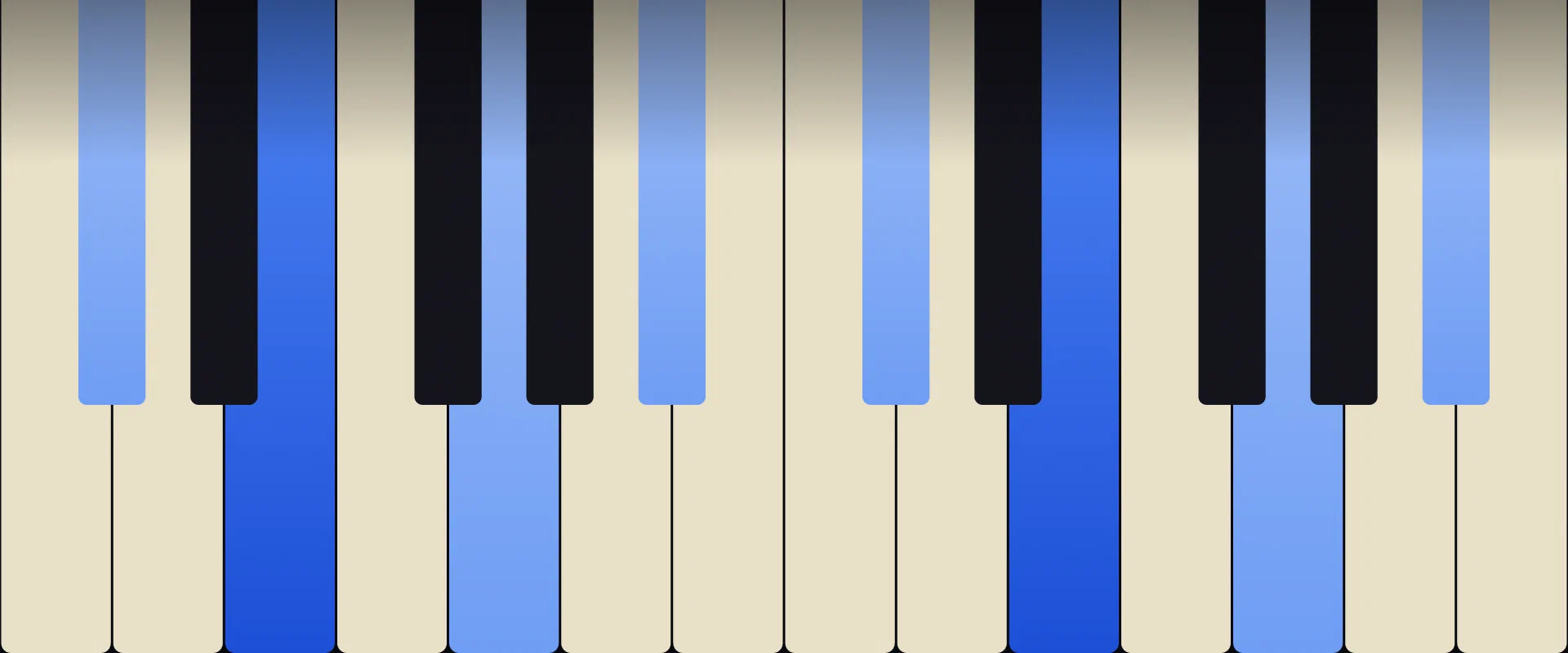
Two white keys and two black, and unusually they do not alternate. E and G are a white pair at the bottom, B♭ and D♭ a black pair above, so the hand climbs out of the keys and stays there instead of weaving.
Right hand: 1 on E, 2 on G, 3 on B♭, 5 on D♭, the fourth finger left hovering over B and C so the black keys sit under fingers that strike evenly.
Left hand: 5 on E, 4 on G, 2 on B♭, 1 on D♭, thumb up on the black key at the top.
Rotating the notes rotates that pairing. Root position and first inversion leave the right thumb on white; second and third push it onto B♭ or D♭ and drive the hand deeper in. Identical intervals, four grips that feel nothing alike.
Worth ten minutes: hold E, G, B♭ and D♭ in the right hand and walk the left through C, E♭, G♭ and A. Each sits a semitone below one chord tone, and each turns the unchanged handful above it into a different dominant seventh flat ninth pulling somewhere new.
Edim7 on the Guitar
The chord books list no open form on this root. The arithmetic says otherwise and takes a minute.
Open strings sound E, A, D, G, B, E. Three are chord tones already: the sixth, third and first. The other three all move, and none moves far. A up one fret is B♭. D up two frets is E. B up two frets is D♭, which is the open B pushed off the one note the chord forbids.
That gives 0 1 2 0 2 0, sounding E, B♭, E, G, D♭, E. Index at the 1st fret on the fifth string, middle and ring at the 2nd on the fourth and second: three fingers, three open strings, all six ringing, nothing to mute, every sounding pitch inside the chord.
There is a reason it never made the books, and difficulty is not it. The voicing contains three E’s. A diminished seventh earns its keep by belonging to nobody, and tripling the root turns a chord that could go four ways into one that sounds like it is about E. Its bottom two notes are a bare tritone on the heaviest strings, too. One cure covers both: drop the sixth string. x 1 2 0 2 0 puts B♭ in the bass and still uses two open strings.
| Form | Frets | Notes sounded |
|---|---|---|
| Open, full | 0 1 2 0 2 0 | E B♭ E G D♭ E |
| Open, B♭ bass | x 1 2 0 2 0 | B♭ E G D♭ E |
| Fourth string root | x x 2 3 2 3 | E B♭ D♭ G |
| Fifth string root | x 7 8 6 8 x | E B♭ D♭ G |
The fourth string form is the one to learn. Index barred at the 2nd fret across the top four strings, ring and little finger at the 3rd on the third and first. It sits close to the nut where tension is highest and the barre bites, and being four equal minor thirds it repeats every three frets: x x 5 6 5 6, x x 8 9 8 9 and x x 11 12 11 12 are the same four notes with G, B♭ and D♭ in the bass in turn. That is the trade the open form asks for. It rings and it is easy, but it goes nowhere.
Inversions
| Inversion | Notes | Bass |
|---|---|---|
| Root position | E G B♭ D♭ | E |
| 1st inversion | G B♭ D♭ E | G |
| 2nd inversion | B♭ D♭ E G | B♭ |
| 3rd inversion | D♭ E G B♭ | D♭ |
Inversion does almost nothing here, and saying so beats pretending otherwise. Four identical minor thirds rearrange into four identical chords, and the three lower rows are better written as diminished sevenths on G, B♭ and D♭ in their own right. Meaning arrives from outside instead: put C under the chord and it leans on F, put A under it and it leans on D, without one note moving.
Voicings
- Open, full, 0 1 2 0 2 0, for the ring; accept that it announces E.
- Open, B♭ bass, x 1 2 0 2 0, the same notes with the doubling thinned.
- Movable grip, x x 2 3 2 3, repeating at frets 5, 8 and 11.
- Fifth string root, x 7 8 6 8 x, when the bass wants E under the fingers.
- Rootless dominant, all four notes in the right hand over a bass C, the standard way to voice C7♭9 with nothing doubled.
Which Keys Contain Edim7
- vii°7 of F harmonic minor
One entry, and that is the honest answer rather than a gap. Among the seven note scales here only F harmonic minor stacks into these four notes. F major will not: its seventh degree gives E, G, B♭ and D, the half-diminished chord, so Edim7 in F major is borrowed from the parallel minor rather than native to the key.
The eight note whole-half diminished scale on E is the exception. Sevenths on its first, third, fifth and seventh degrees are all this chord.
Where Edim7 Shows Up
| Progression | Chords | Typical use |
|---|---|---|
| vii°7, i in F minor | Edim7, Fm | The classical resolution |
| V7♭9, i in F minor | Edim7 over C, Fm | Rootless comping |
| iiø7, V7♭9, i | Gm7♭5, C7♭9, Fm | Minor ii V i in F |
| I, ♯I°7, ii7 in E♭ | E♭, Edim7, Fm7 | Rising chromatic bass |
Row one is why the chord exists. Move it to F minor and three of the four notes travel a single semitone, E up to F, G up to A♭ and D♭ down to C, with only the B♭ taking a whole step.
Row four is where a working player meets it. E♭ major, then a diminished seventh on the E natural just above the tonic, then the ii chord, the bass walking E♭, E, F. Ragtime, gospel and a hundred standards run on that, and it is spelled from E because the note genuinely is a raised tonic in a flat key.
Notice who is playing in all four rows. F minor and E♭ major are keyboard and horn keys, so most of the time these notes sound, nobody is thinking about open strings. A guitarist arrives from the other end, sliding x x 2 3 2 3 along the neck as an approach chord: one player is resolving a leading tone, the other is filling a gap between two frets.
Related Chords
- E Diminished Chord, the same idea with one tritone instead of two.
- E Half-diminished Chord, D natural on top instead of D♭, the one consonance this chord does without.
- E Dominant 7th Chord, the other seventh on this root a guitarist can play open, and a lesson in what the open B is worth.
- C Dominant 7th Chord, since adding C below these notes and dropping the D♭ leaves precisely that.
- F Minor Chord, the destination.
- Guitar Chord Shapes: The CAGED System
Its three other names, C♯dim7, Gdim7 and A♯dim7, publish alongside this page.
Learn More
Practice Chords
Drill chord recognition with a metronome, MIDI support, and score tracking.
Start PracticingRelated Articles
A Diminished 7th Chord: Notes, Voicings, and How to Play It
Sep 1, 2026 · 8 min
A♯ Diminished 7th Chord: Notes, Voicings, and How to Play It
Sep 1, 2026 · 8 min
B Diminished 7th Chord: Notes, Voicings, and How to Play It
Sep 1, 2026 · 8 min