Count the tritones. D up to A♭ is one, six semitones. F up to C♭ is a second, also six. Ddim7 carries both at once inside four notes, and no dominant seventh manages that. B♭7, the chord this one usually stands in for, has one tritone and a perfect fifth from B♭ to F holding the rest steady. Replace that fifth with another tritone and nothing is left to lean on.
That is the real difference between Ddim7 and the Ddim triad inside it. The triad has one tritone. The seventh has two, and neither will hold still.
Try It: Ddim7 in the Chord Finder
The Notes of Ddim7
Ddim7 is four notes: D, F, A♭ and C♭.
| Degree | Note | Interval from Root | Semitones |
|---|---|---|---|
| 1 (Root) | D | Perfect unison | 0 |
| ♭3 | F | Minor 3rd | 3 |
| ♭5 | A♭ | Diminished 5th | 6 |
| ♭♭7 | C♭ | Diminished 7th | 9 |
Charts write it Ddim7 or D°7. Read the last row slowly: a diminished 7th is nine semitones, not ten, so it sits a whole tone below the D above it rather than a semitone.
How Ddim7 Is Built
Take Dm7♭5, D, F, A♭ and C, and lower the C to C♭. That single alteration is everything that separates a half diminished chord from a fully diminished one, and the D half-diminished page works the same pair from the other side.
Stacked upwards the chord reads D to F, F to A♭, A♭ to C♭, three semitones every time. Because the gaps are equal, the two tritones lie one above the other a minor third apart, and each pulls its own way.
D and A♭. D is the leading note of E♭ and rises to it. A♭ is a flattened note and falls to G. Together they give E♭ and G.
F and C♭. F rises a tone to G. C♭ falls a semitone to B♭. Together they give G and B♭.
Sum the two and you land on E♭, G, G and B♭. Every voice moves, none by more than a tone, and both tritones close inwards onto the same G from opposite sides. That doubled G is not sloppy voice leading. It is what two tritones a minor third apart do when they resolve together.
Ddim7 on the Piano
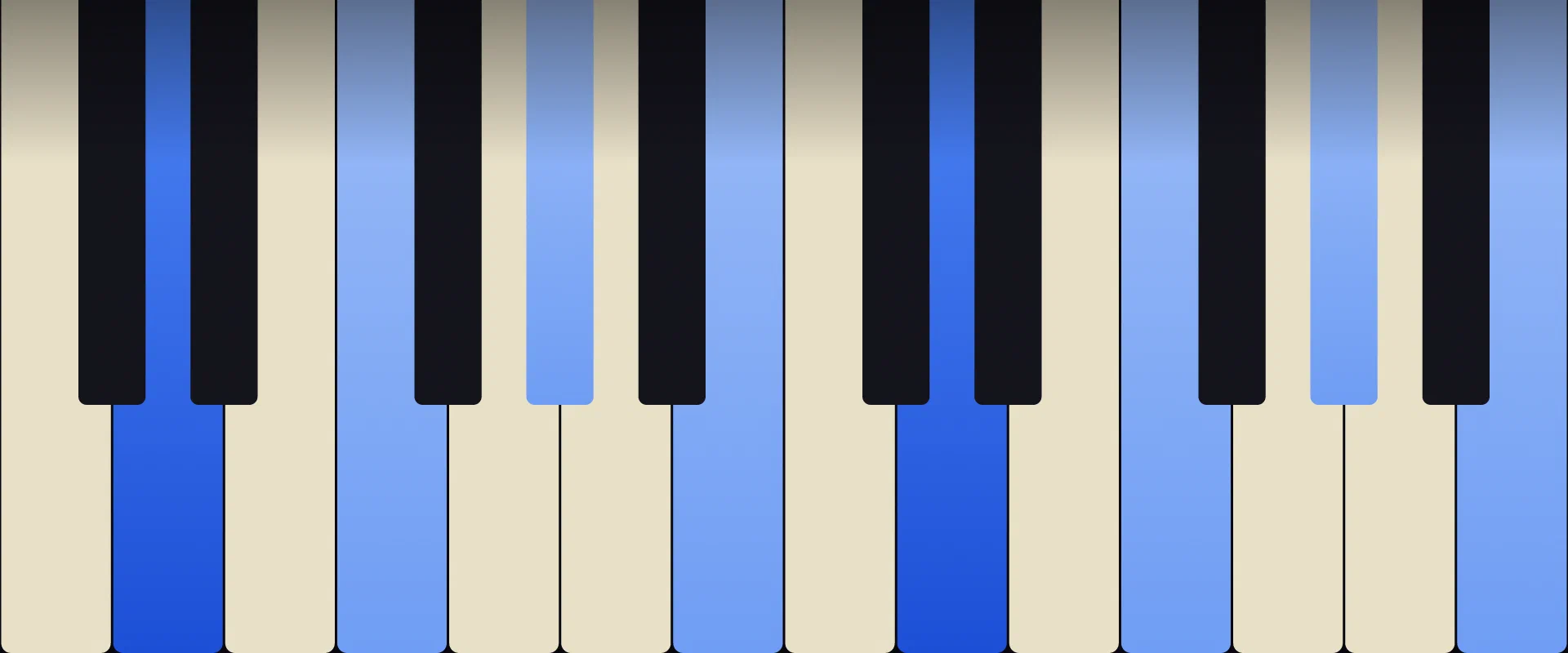
Right hand 1, 2, 3, 5: thumb on D, index on F, middle finger on A♭, little finger on C♭. Left hand 5, 4, 2, 1. Only one of the four keys is black.
Now the note that makes readers doubt the page. C♭ is played on the white key you would normally call B. No black key is involved. A chord built by stacking thirds from D has to put some kind of 7th on the letter C, and a plain C is a semitone too high, so it is flattened onto its neighbour. Write B instead and the chord has two notes on the letter A, none on C, and an interval from D that reads as a sixth. Nor is the name invented for the occasion: in E♭ minor, C♭ belongs to the key signature and takes no accidental at all.
The reward is the easiest hand shape in the four note repertoire. Every interval is three semitones, so the chord spans nine semitones in root position and nine in each inversion. Play F, A♭, C♭, D, then A♭, C♭, D, F, and the fingers keep identical spacing. A dominant seventh changes shape in every inversion. This one never does.
What changes is where the black key lands. A♭ sits under the middle finger in root position, the index in first, the thumb in second, the little finger in third. Constant shape, shifting terrain, and that is the whole difficulty of playing these chords at speed.
Ddim7 on the Guitar
x x 0 1 0 1. Open 4th string for D, 3rd string 1st fret for A♭, open 2nd string for C♭, 1st string 1st fret for F. Two fingers, four notes, nothing doubled, root in the bass. The fully diminished seventh has a reputation as a chord for other people, and on this root the guitar hands it over for an index and a middle finger.
It sits one note from the open Dm7♭5 grip, x x 0 1 1 1. Lift the finger off the 2nd string and let it ring: C drops to C♭. Mute the 5th string while you do it, since open A is a semitone above the A♭ the chord depends on.
Then the useful part. The octave divides into four equal minor thirds, so moving that grip up three frets returns the same four notes:
| Frets (D G B e) | Lowest note |
|---|---|
| 0 1 0 1 | D |
| 3 4 3 4 | F |
| 6 7 6 7 | A♭ |
| 9 10 9 10 | C♭ |
| 12 13 12 13 | D |
One grip, five positions, the whole neck. Only the bass note changes, which makes that ladder a set of inversions laid out along the fingerboard. Nothing else with four notes in it relocates this cheaply.
For a fuller voicing, put the root on the 5th string: x 5 6 4 6 x gives D, A♭, C♭, F across three frets with no barre. That is the Dm7♭5 grip x 5 6 5 6 x with the 3rd string pulled back a fret, the same alteration again. Rooted on the 6th string, 10 11 9 10 x x puts a low D underneath.
Inversions
| Inversion | Bass Note | Notes | Symbol |
|---|---|---|---|
| Root position | D | D, F, A♭, C♭ | Ddim7 |
| 1st inversion | F | F, A♭, C♭, D | Ddim7/F |
| 2nd inversion | A♭ | A♭, C♭, D, F | Ddim7/A♭ |
| 3rd inversion | C♭ | C♭, D, F, A♭ | Ddim7/C♭ |
The slash names whatever is underneath, and here that matters more than usual: the bass is the only thing telling the ear which of the four notes is the root. Root position keeps the leading note D at the bottom and resolves most predictably. First inversion is the one that turns up in minor keys, since that F steps up to G♭ under the tonic.
Voicings
Guitar, open (x x 0 1 0 1). Two fingers, 5th and 6th strings muted.
Guitar, 5th string root (x 5 6 4 6 x). Fuller and darker, no barre.
Piano, one tritone per hand (D and A♭ below, F and C♭ above). Both engines audible separately.
Piano over a B♭ bass. The four notes become the 3rd, 5th, ♭7th and ♭9th of B♭7♭9.
Which Keys Contain Ddim7
Exactly one scale on this site contains Ddim7 diatonically:
- vii°7 of E♭ harmonic minor
The short list is the point. Stack a seventh chord on the 7th degree of E♭ major and you get D, F, A♭ and C, which is half diminished. This chord needs the C♭ that E♭ natural minor supplies and the raised D that harmonic minor supplies, and only harmonic minor carries both. Everywhere else Ddim7 is a borrowing, with the C♭ written in by hand.
Where Ddim7 Shows Up
Minor ii, V, i in E♭ minor: Fm7♭5, B♭7♭9, E♭m. Play Fm7♭5 as F, A♭, C♭, E♭, then drop the E♭ to D. You are now holding Ddim7, which over a B♭ bass is B♭7♭9. One semitone turned the ii into the V. Resolve it, D up to E♭, F up to G♭, A♭ down to G♭, C♭ down to B♭, and the whole cadence costs five semitones of movement.
vii°7 to i: Ddim7, E♭m. The same resolution with no bass player, which is how the chord earns its keep. With the root of the dominant missing, nothing commits the harmony until the tonic arrives.
Passing in D♭ major: D♭maj7, Ddim7, E♭m7. The bass walks D♭, D, E♭ by semitone and the diminished chord harmonises the passing note. Charted as ♯i°7, this is the commonest way the chord reaches a pianist working in flat keys.
Four dominants at once. Strip the root from a dominant 7♭9 and a diminished seventh on its 3rd is what remains. D, F, A♭ and C♭ therefore sit on top of B♭7♭9, D♭7♭9, E7♭9 (respelled G♯, B, D, F) and G7♭9, pointing at E♭, G♭, A and C. Whichever of the four you need, the fingers are already on it.
Those same pitches also spell Fdim7, G♯dim7 and Bdim7, with a different member taken as root each time. There are only three distinct fully diminished sevenths in all twelve keys, and this is one of them.
Related Chords
- D Half-diminished Chord, one semitone away at the top.
- D Diminished Chord, the triad with one tritone in it.
- B♭ Dominant 7th Chord, the root that makes this B♭7♭9.
- E♭ Minor Chord, where both tritones are heading.
- F Half-diminished Chord, the ii that precedes it in E♭ minor.
Learn More
Practice Chords
Drill chord recognition with a metronome, MIDI support, and score tracking.
Start PracticingRelated Articles
A Diminished 7th Chord: Notes, Voicings, and How to Play It
Sep 1, 2026 · 8 min
A♯ Diminished 7th Chord: Notes, Voicings, and How to Play It
Sep 1, 2026 · 8 min
B Diminished 7th Chord: Notes, Voicings, and How to Play It
Sep 1, 2026 · 8 min