Between C and D there is one black key, and C♯dim7 is the chord built on it. Much of the time this chord appears in ordinary repertoire its job is to harmonise a bass note passing between those two: in C major between the tonic and the ii chord, in G major between the IV and a second inversion tonic, in F major between the V and the vi. The function changes in each key. The three bass notes do not.
Try It: C♯dim7 in the Chord Finder
The Notes of C♯dim7
| Degree | Note | Interval from root | Semitones |
|---|---|---|---|
| 1 | C♯ | Root | 0 |
| ♭3 | E | Minor 3rd | 3 |
| ♭5 | G | Diminished 5th | 6 |
| ♭♭7 | B♭ | Diminished 7th | 9 |
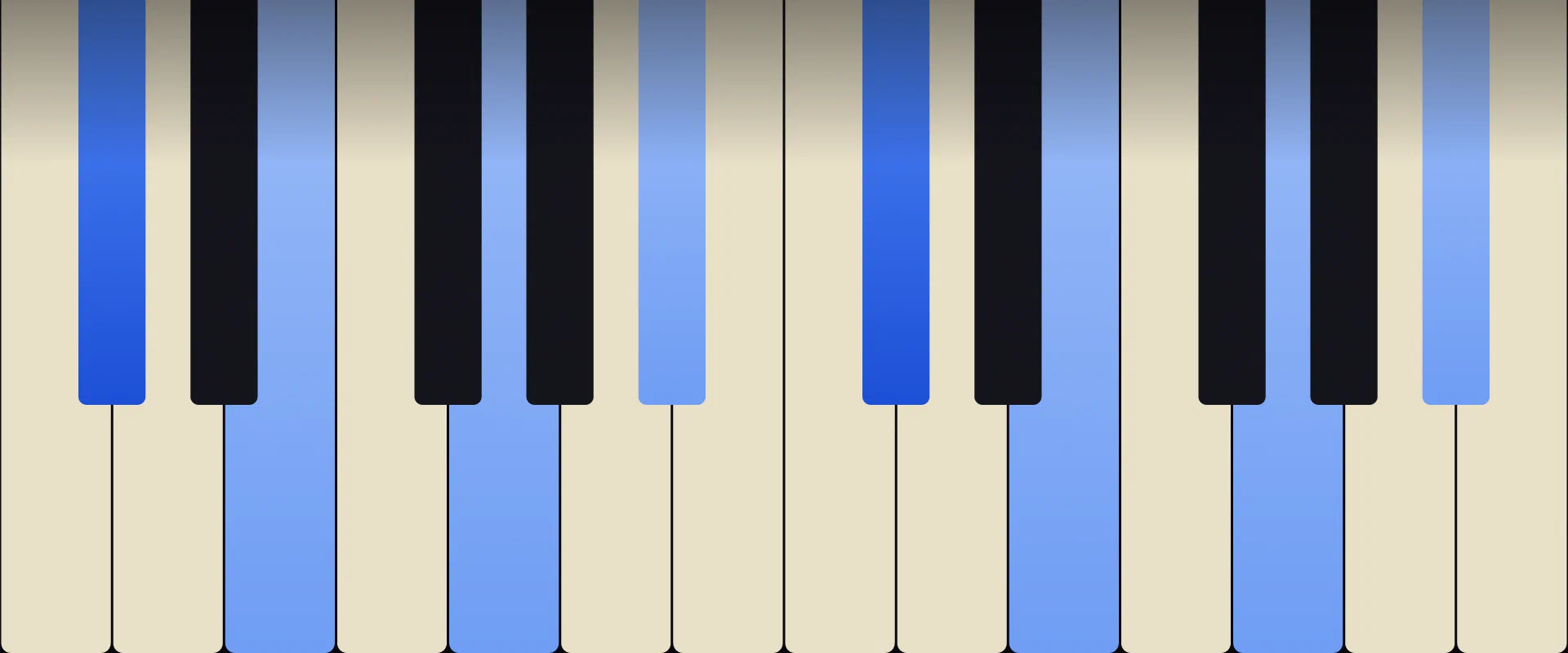
Two black keys, C♯ and B♭, and two white ones, E and G. Nothing lands where the eye would not expect it. The top note is the one to watch: counting letters from C to B gives a seventh, and at nine semitones that seventh is diminished, which in strict notation asks for a B double flat. Printed music writes B♭, it sounds identical, and this page follows the printed music.
How C♯dim7 Is Built
Take the C♯ diminished triad, C♯, E and G, and stack one more minor third on top. B♭ arrives and every gap in the chord is now three semitones.
The consequence that matters is the second tritone. The triad has one, C♯ against G. B♭ creates another, E against B♭, and a four note chord carrying two tritones is rare: no other seventh chord in common use has more than one. That second tritone multiplies the chord’s pull by four. Strip the root from A7♭9 and C♯, E, G and B♭ remain, an identity the triad page works through. Do the same to C7♭9, E♭7♭9 or F♯7♭9 and these four notes are again what is left. One shape, four dominants, four possible tonics a minor third apart.
Even spacing also means the chord answers to four names: read from E, G or A♯ it is Edim7, Gdim7 or A♯dim7, the identical four pitches under a different label. Three sonorities of this type cover all twelve keys.
C♯dim7 on the Piano
Root position runs black, white, white, black. The thumb sits back on C♯, the second and third fingers come forward onto E and G, and the little finger goes back again for B♭. Thumb and little finger on black keys with the middle of the hand on white makes a steadier arch than it sounds. Right hand 1, 2, 3, 5. Left hand 5, 3, 2, 1.
The reach is modest. C♯ up to B♭ is nine semitones, the narrowest four note seventh available on this root: C♯7 stretches ten semitones up to B, C♯maj7 eleven up to C.
Practise all four positions rather than the root one, because the hand shape never changes size while the terrain rotates underneath it. From C♯ the pattern is black, white, white, black. From E it becomes white, white, black, black. From G, white, black, black, white. From B♭, black, black, white, white. Four identical stretches, four different feels, and a fingering learned in one of them is misleading in the next.
C♯dim7 on the Guitar
The chord books list no open form here, which is misleading, because one exists under another name. Play x 1 2 0 2 0: index finger on the fifth string at the 1st fret, middle finger on the fourth string at the 2nd, ring finger on the second string at the 2nd, third and first strings open. It sounds B♭, E, G, C♯ and E, and letting the low open string ring adds a sixth. Guitarists file this grip under Edim7, since E ends up lowest, but the four pitches are the ones on this page.
Cleaner still for first position work is x x 2 3 2 3: E on the fourth string, B♭ on the third, C♯ on the second, G on the first. Four different notes, nothing doubled, nothing above the 3rd fret. Barre the 2nd fret with the index finger and add the 3rd on the third and first strings with the ring and little fingers.
The same grip reappears at x x 11 12 11 12, with C♯ itself on the fourth string. Nine frets separate the two, and nine frets is three minor thirds, which is why the chord comes back as itself. Up there the frets are cramped, though the short barre is easier for it.
For the root in the bass low down, use the movable form at the 4th fret, x 4 5 3 5 x. Between these shapes and the three fret repeat, the neck offers this chord a dozen times over.
Inversions
| Inversion | Notes | Lowest note |
|---|---|---|
| Root position | C♯ E G B♭ | C♯ |
| 1st inversion | E G B♭ C♯ | E |
| 2nd inversion | G B♭ C♯ E | G |
| 3rd inversion | B♭ C♯ E G | B♭ |
Inversion is a weaker idea here than elsewhere, because each of these four is also the root position of one of the other three names. The bass note decides where the chord wants to go. C♯ underneath makes it a leading note chord pointing at D. E underneath is what the open guitar grip gives, sounded by most players without their choosing it. B♭ at the bottom leans downwards instead, since B♭ falls naturally to A.
Voicings
Nothing here is optional. On a dominant seventh you can drop the fifth and keep the sound. Take any note away and the three that remain hold exactly one tritone between them, which is to say they behave like the triad again.
Spread across two hands, keep the tritones stacked rather than interleaved: left hand takes C♯ and G, right hand takes E and B♭ above it. Interleaving them, C♯ and E in the left with G and B♭ in the right, muddies the low register.
What you put underneath decides the chord’s name and its destination:
| Bass note added | Becomes | Wants to reach |
|---|---|---|
| A | A7♭9 | D |
| C | C7♭9 | F |
| E♭ | E♭7♭9 | A♭ |
| F♯ | F♯7♭9 | B |
Four keys a minor third apart, from one grip that never moves. It is why arrangers reach for a diminished seventh when a key change has to happen in half a bar.
Which Keys Contain C♯dim7
- degree 7 (VII) of D harmonic minor
One entry, and the shortness of the list is the point. No major scale contains a diminished seventh chord at all, and this one needs C♯ and B♭ in the same key signature, which almost nothing supplies. Raise the seventh degree of D minor and there it is, built on the note a semitone below the tonic.
The sonority is the seventh degree chord of three other harmonic minor keys, F, A♭ and B, but spelled from a different letter each time: Edim7 in F minor, Gdim7 in A♭ minor, A♯dim7 in B minor. D minor alone calls it C♯dim7. In every other key the chord is a visitor, borrowed for a beat and gone.
Where C♯dim7 Shows Up
| Progression | Chords | Turns up in |
|---|---|---|
| I ♯I°7 ii in C major | C, C♯dim7, Dm7 | Ragtime, early jazz, standards |
| IV ♯IV°7 I in G major | C, C♯dim7, G/D | Hymns, gospel, soul |
| V ♯V°7 vi in F major | C, C♯dim7, Dm | Pop turnarounds, show tunes |
| vii°7 i in D minor | C♯dim7, Dm | Classical cadences, film scoring |
The first row is the one worth drilling. A bass walking C, C♯, D under a change from the tonic to the ii chord is everywhere in music written between roughly 1900 and 1940. On guitar this is the one passing diminished a beginner can play without leaving open position, since C, Dm and the x x 2 3 2 3 grip all live inside the first three frets.
Row two takes the identical bass line somewhere else. Its destination is a second inversion tonic, so the progression lands mid phrase and keeps moving. Organists use it constantly, usually without naming it, to get from the subdominant back home without the bass jumping.
Row four is the chord doing its formal work, and the voice leading is unusually tidy. Resolving into D minor, the outer notes close in on each other: C♯ rises a semitone to D while B♭ falls a semitone to A. A diminished seventh nine semitones wide contracts into a perfect fifth seven semitones wide, and the inner pair, E and G, converge on F between them. Every voice moves, none moves far, nothing crosses.
One test covers all of it. If the bass is stepping from C up to D, this is the diminished seventh you want. If it is not, one of the other two will fit better. The choice between the three is settled by the bass note, not by the key signature.
Related Chords
- C♯ Diminished Chord, the triad underneath, with one tritone instead of two
- C♯ Half-diminished Chord, B natural in place of B♭, which removes the symmetry entirely
- C♯ Dominant 7th Chord, the same root treated as a dominant rather than as a leading note
- Chord Inversions and Voice Leading
- Seventh Chords: The Complete Guide
Learn More
- Secondary Dominants and Borrowed Chords, which covers passing diminished chords in detail
- Diatonic Chords: A Beginner’s Guide
- Extended Chords and Jazz Harmony
- The Circle of Fifths Explained
- D Harmonic Minor Scale, the one key that spells this chord from C♯
- D Natural Minor Scale
Practice Chords
Drill chord recognition with a metronome, MIDI support, and score tracking.
Start PracticingRelated Articles
A Diminished 7th Chord: Notes, Voicings, and How to Play It
Sep 1, 2026 · 8 min
A♯ Diminished 7th Chord: Notes, Voicings, and How to Play It
Sep 1, 2026 · 8 min
B Diminished 7th Chord: Notes, Voicings, and How to Play It
Sep 1, 2026 · 8 min