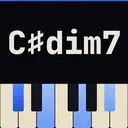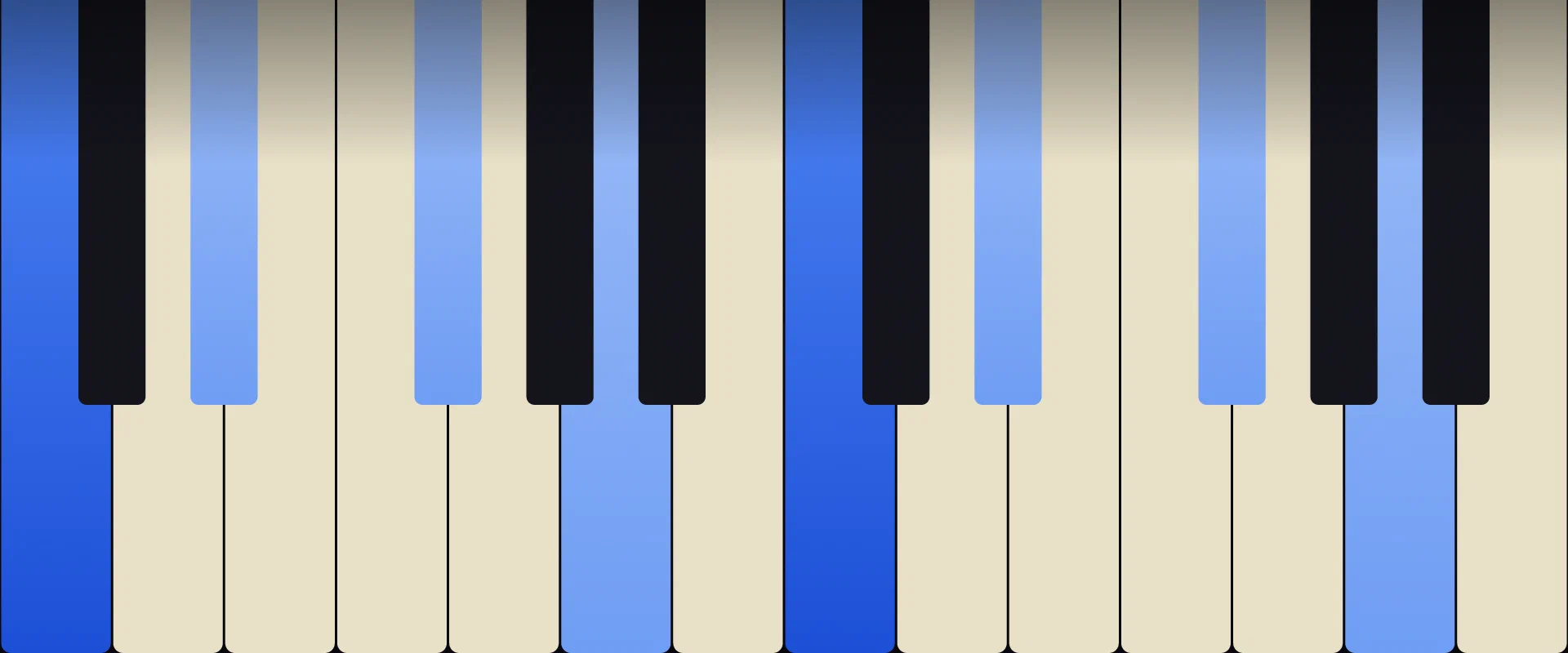
Three of these four notes are unremarkable. The fourth is written B𝄫, a B carrying two flats, and it makes Cdim7 one of only three chords on this site that keeps a double accidental. You play it on the white key A, and it is still not A. Around that glyph sits a practical chord: four notes three semitones apart, belonging to no key on its own, and forever turning up as the top of a dominant seventh whose root somebody else holds.
Try It: Cdim7 in the Chord Finder
Set the root to C♯, choose harmonic minor and look at the seventh degree. Same four keys, printed B♯, D♯, F♯ and A.
The Notes of Cdim7
| Degree | Note | Interval from root | Semitones |
|---|---|---|---|
| 1 (root) | C | Perfect unison | 0 |
| ♭3 | E♭ | Minor 3rd | 3 |
| ♭5 | G♭ | Diminished 5th | 6 |
| 𝄫7 | B𝄫 | Diminished 7th | 9 |
Written out: C, E♭, G♭, B𝄫. Charts abbreviate it to C°7, and plenty of them print plain C° and mean this rather than the three note chord.
Why the top note is B𝄫 and not A
Count letters, not keys. A seventh chord on C is built from alternate letters, C then E then G then B, so the top note has to be a form of B. B natural is the major 7th, the one in Cmaj7. B♭ is the minor 7th, the one in C7 and Cm7. A diminished 7th is a semitone smaller again, that B♭ lowered a second time, and a twice flattened B is written B𝄫. The letter is fixed by the stack and the pitch by the interval; the second flat is what happens where they meet.
That pitch is the white key A, so anyone checking this page against an instrument finds a plain white note under the finger and suspects a misprint. There is none. Call the top note A and the distance from C reads as a major 6th, a consonance, and there is no seventh left in the seventh chord.
The spelling also predicts movement: a diminished 7th falls by step, so B𝄫 resolves down to A♭. Written as A, the same key looks like a note that ought to rise to B♭, an instruction pointing the wrong way.
How Cdim7 Is Built
Start from Cm7♭5, C, E♭, G♭ and B♭, and lower the top note one more semitone. One key on a piano, one fret on a guitar, and the chord stops belonging to B♭ minor and starts belonging nowhere.
Built upwards it is three minor thirds in a row: C to E♭, E♭ to G♭, G♭ to B𝄫. Nothing else in common use is spaced identically all the way, so these four keys are equally well named D♯dim7, F♯dim7 or Adim7, and only three such chords exist in all twelve keys.
Cdim7 on the Piano
Two white keys outside, two black keys in the middle: C at the bottom, E♭ and G♭ raised in the centre, A back on the white plane at the top. Of the four names these keys answer to, only the C spelling arranges them that way: start the same chord from D♯ or F♯ and a black key lands on an outer edge.
Right hand 1, 2, 3, 5: thumb on C, index on E♭, middle on G♭, little finger on A. Left hand, reading upwards, 5, 3, 2, 1. Root to top is nine semitones and every other seventh chord on C reaches further, ten for Cm7 and C7, eleven for Cmaj7, so a small stretch manages this one more easily than the chords it stands in for.
The drill that fixes it moves the hand up three semitones without changing the shape, so C, E♭, G♭, A becomes E♭, G♭, A, C. Four moves lands you an octave higher.
Cdim7 on the Guitar
Exactly one open string belongs to this chord and it is the least helpful member of it: the open 5th string is A, which is to say B𝄫, so the guitar’s one free note puts the oddest member of the chord in the bass. Take it anyway: x 0 1 2 1 2 is a genuine open position Cdim7, index across the 1st fret, middle on the 3rd string and ring on the 1st at the 2nd. Third inversion, and it sounds like a question.
The grip in daily use sits at the 3rd fret, root on the 5th string: x 3 4 2 4 x. Index takes the 3rd string at the 2nd fret, middle the 5th at the 3rd, ring and little finger the 4th and 2nd strings at the 4th. No barre, and the outer strings are damped. Evenly spaced notes mean the same fingering at the 6th, 9th and 12th frets hands back the same four pitches in a new order.
Higher up the root moves to the 4th string at the 10th fret and the chord folds into two frets: x x 10 11 10 11, index flat across the 10th, middle and ring on the 3rd and 1st strings at the 11th. Slide it down three frets at a time to x x 7 8 7 8, x x 4 5 4 5 and x x 1 2 1 2, the lowest of which has E♭ in the bass.
Inversions
| Inversion | Notes | Bass | Symbol |
|---|---|---|---|
| Root position | C E♭ G♭ B𝄫 | C | Cdim7 |
| 1st inversion | E♭ G♭ B𝄫 C | E♭ | Cdim7/E♭ |
| 2nd inversion | G♭ B𝄫 C E♭ | G♭ | Cdim7/G♭ |
| 3rd inversion | B𝄫 C E♭ G♭ | B𝄫 | Cdim7/B𝄫 |
Read any row as its own chord and it is a root position diminished seventh under another name: the bass note does not merely invert this chord, it renames it. The key settles which name is right: the first inversion is Cdim7/E♭ inside D♭ and D♯dim7 in root position inside E minor. See Chord Inversions and Voice Leading.
Voicings
Nothing here is expendable. Drop a note from a major or minor seventh and the chord survives, but remove any one of these four and the three left over form a diminished triad on another of them. There is no shell version of this chord, only a smaller diminished one.
| Shape | Frets | Result |
|---|---|---|
| Cdim7 | x 3 4 2 4 x | 5th string root, no barre |
| Cdim7 | x x 10 11 10 11 | 4th string root, two frets |
| Cdim7 | x 0 1 2 1 2 | Open 5th string, B𝄫 in the bass |
| Cdim7 | x x 1 2 1 2 | Same shape low, E♭ in the bass |
| A♭7♭9 | x 11 10 11 10 x | The chord with its root supplied |
Which Keys Contain Cdim7
- degree 7 (VII) of C♯ harmonic minor
That page spells the chord B♯, D♯, F♯ and A, because C♯ minor is written with sharps and its leading note is B♯. The site’s list stops there, but the seventh degree of three more harmonic minor scales stacks up the same pitches, each spelled from its own leading note:
- D♯ in E harmonic minor
- F♯ in G harmonic minor
- A in B♭ harmonic minor
The chord really is spelled C, E♭, G♭ and B𝄫 in D♭ major, where C is the leading note, and the C diminished triad covers that resolution.
Where Cdim7 Shows Up
| Progression | Chords | Context |
|---|---|---|
| Rootless A♭7♭9 | Cdim7 over an A♭ bass | Comping in D♭ |
| ♯I°7 passing (B major) | B, Cdim7, C♯m7 | Chromatic step up to ii |
| vii°7 i (C♯ minor) | Cdim7, C♯m | Leading note seventh |
| One grip, four dominants | B7♭9, D7♭9, F7♭9, A♭7♭9 | Same four notes on top |
Row one is the identity worth memorising, and the spelling makes it tidy. A♭7♭9 is A♭, C, E♭, G♭ and B𝄫: a flattened ninth above A♭ is still a ninth, so it too must be a form of B, and lowering B♭ once more gives the very same B𝄫. Take the A♭ away and Cdim7 is what remains, note for note and glyph for glyph. The double accidental is not a one-off, it is demanded twice by two different chords for identical reasons.
Even spacing means four dominants rather than one. B underneath and the chord reads B7♭9, aimed at E minor; D gives D7♭9 into G minor, F gives F7♭9 into B♭ minor, A♭ gives A♭7♭9 into D♭. A guitarist holding x 3 4 2 4 x owns the business end of the dominant in four keys and only the bass player needs to know which. See Extended Chords and Jazz Harmony.
Rows two and three are the same keys doing sharp side work, and there the printed letter C matters most. In an engraved B major score the chord between B and C♯m7 is B♯, D♯, F♯ and A, built on a raised tonic. No lead sheet does that. It prints Cdim7, because a player reading symbols at tempo has no use for a B♯ and the grip is identical.
One caution about listening. The chord is symmetrical, so nothing in the sound says which note is the root: heard alone it is not Cdim7, only this set of four pitches. What names it is the bass note before, the chord after and the key signature, so in a chord with no audible root the spelling carries all the information about where it is going.
Related Chords
- C Half-diminished Chord, B♭ on top instead of B𝄫
- C Diminished Chord, the triad underneath these four notes
- Seventh Chords: The Complete Guide
- Guitar Chord Shapes: The CAGED System
Learn More
Practice Chords
Drill chord recognition with a metronome, MIDI support, and score tracking.
Start PracticingRelated Articles
A Diminished 7th Chord: Notes, Voicings, and How to Play It
Sep 1, 2026 · 8 min
A♯ Diminished 7th Chord: Notes, Voicings, and How to Play It
Sep 1, 2026 · 8 min
B Diminished 7th Chord: Notes, Voicings, and How to Play It
Sep 1, 2026 · 8 min