The most forbidding symbol in the seventh chord family sits on the plainest four notes available. Bm7♭5 is B, D, F and A: no sharps, no flats, and no other half diminished chord of the twelve is spelled without an accidental somewhere. Written Bø7 it looks like an import from a jazz manual. Played, it is what the C major scale hands you on its final degree.
Where half diminished chords come from at all has a blunt answer on this root. Stack sevenths on the seven degrees of C major and six are ordinary: Cmaj7 and Fmaj7, Dm7, Em7 and Am7, and G7. The last degree gives a chord that is none of those types. This is it. Half diminished is the leftover in the key with no key signature, not a borrowing.
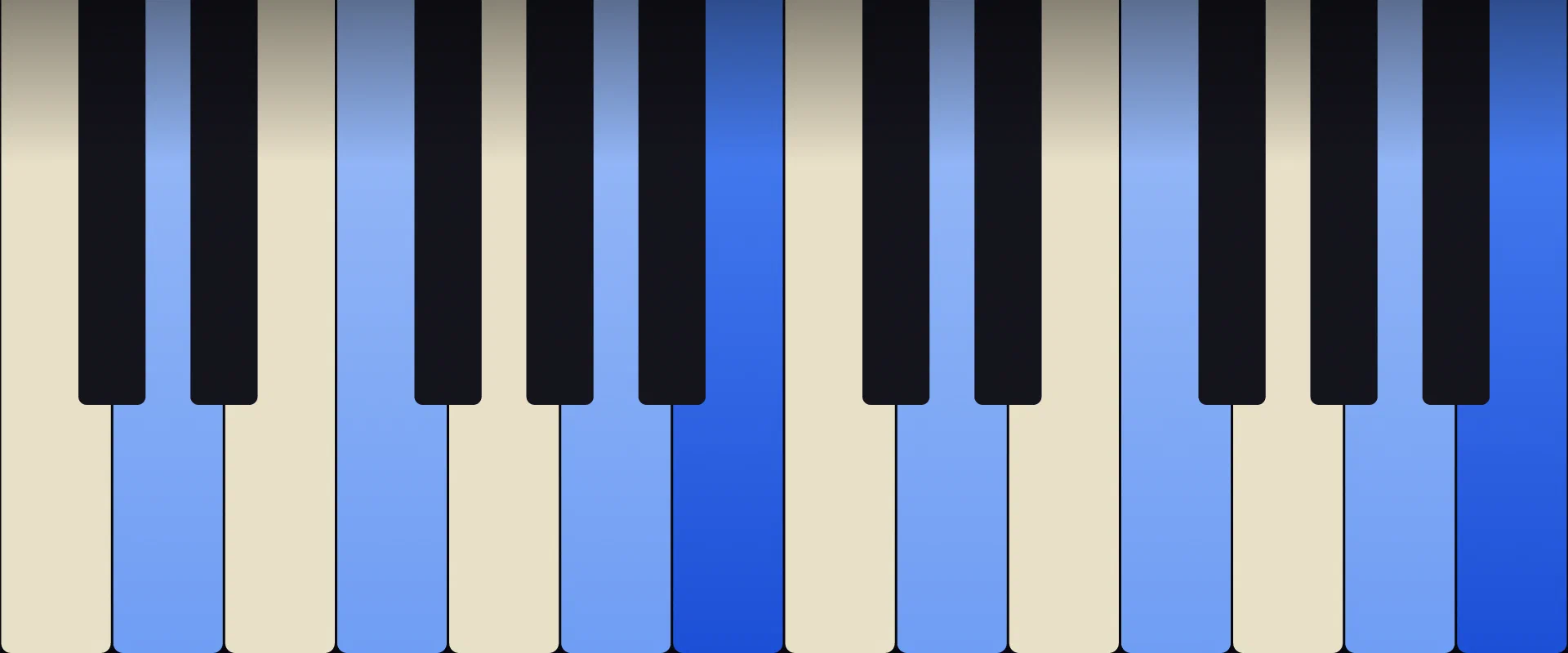
Try It: Bm7♭5 in the Chord Finder
The Notes of Bm7♭5
| Degree | Note | Interval from Root | Semitones |
|---|---|---|---|
| 1 (Root) | B | Perfect unison | 0 |
| ♭3 | D | Minor 3rd | 3 |
| ♭5 | F | Diminished 5th | 6 |
| ♭7 | A | Minor 7th | 10 |
How Bm7♭5 Is Built
Read the gaps rather than the distances from the root: a minor third from B to D, another from D to F, then a major third from F to A. That is a diminished triad with a minor seventh on it, and the choice of A natural for that seventh is the argument the name is making. Lower it to A♭, so the top interval becomes a third minor third, and B D F A♭ is the fully diminished seventh. Half diminished means the fifth got the treatment and the seventh did not.
The tritone sits in an unusual place. B up to F is six semitones, the same two notes that make G7 restless, but in G7 they are the third and the seventh with a G underneath. Here they are the root and the fifth. The bass is itself one of the pair doing the leaning, which is why the chord sounds unresolved without sounding like a dominant in its own right.
That comparison has a practical form. G9 is G, B, D, F and A. Take the G away and exactly this chord remains, so a pianist wanting a dominant ninth in C can play Bm7♭5 above it and leave the root to the bass.
One more identity belongs to the chord a minor third up. Dm6 is D, F, A and B, the same four pitches rearranged, so that page and this one describe one object from opposite ends. Every half diminished chord is the minor 6th chord a minor third above its own root.
Bm7♭5 on the Piano
Four white keys and nothing else. The hand lies flat, no finger arching over a raised key or sliding back between two of them, and no other half diminished chord permits that. Right hand, 1 on B, 2 on D, 3 on F, 5 on A. Left hand, 5, 3, 2,
- The symbol looks harder than the hand ever works.
The exercise that teaches the chord is its resolution, and it stays on white keys until the last moment. Hold B, D, F, A. Move F down to E and A down to G♯, leaving B and D alone: that is E7. Then let G♯ rise to A and D fall to C for A minor. Two voices down, one up, and the minor cadence has happened under a hand that barely moved.
Bm7♭5 on the Guitar
Three of the four notes are open strings. A is the fifth, D the fourth, B the second, and F is the first fret of the top string. Put those together as x00201, with the third string at fret 2 for a second A, and two fingers give the complete chord across five strings. It sounds A, D, A, B, F from the bottom, so the seventh is underneath and the chord reads as an inversion, unfinished. For a chord that never finishes anything, that is not a fault.
For root position without a barre: x2323x. Index across fret 2 covering the fifth and third strings for B and A, middle on the fourth string at fret 3 for F, ring on the second at fret 3 for D, top string muted. It comes out B, F, A, D, with the tritone on the two lowest sounding strings, which is why the grip feels as tense as it sounds.
The shape the chord books leave out is the one that connects this chord to its neighbour. Take the first position Bm7, x20202, and move the top string down a fret to x20201. F♯ becomes F and the chord is Bm7♭5 in root position: B, D, A, B, F, still three fingers, two open strings and no barre. The tritone now sits between the top two strings, so it rings bright and thin where x2323x sounds thick.
The movable form rooted on the sixth string is 7877xx, an Em7♭5 shape barred at fret 7: index across the sixth, fourth and third strings for B, A and D, middle on the fifth at fret 8 for F. The barre has to skip a string another finger holds a fret higher, which is the fussy part.
Inversions
| Inversion | Notes | Bass Note |
|---|---|---|
| Root position | B D F A | B |
| 1st inversion | D F A B | D |
| 2nd inversion | F A B D | F |
| 3rd inversion | A B D F | A |
First inversion is where the name changes hands. D F A B read upwards is Dm6 in root position, so the bass decides: sitting on D it is a minor 6th chord, moving towards E7 it is the half diminished ii.
Voicings
Keep the tritone apart at the keyboard: B low in the left hand, D, F and A stacked in the right. B and F crammed together below middle C growl and swallow the other two notes.
On guitar, drop the root when a bass is playing it: the three sounding strings above it in x2323x give F, A and D, a complete Bm7♭5 in comping register.
Which Keys Contain Bm7♭5
- degree 7 (VII) of C major
- degree 2 (II) of A natural minor
- degree 2 (II) of A harmonic minor
- degree 1 (I) of B locrian
- degree 6 (VI) of D dorian
- degree 3 (III) of G mixolydian
Five of those six are the same seven notes read from different starting points, A harmonic minor being the one that raises its G. B Locrian is the only mode whose tonic seventh chord is half diminished, which is why nobody writes music in it: a key cannot rest on a chord with a tritone between its bass and its fifth. G Mixolydian is the scale of a G dominant chord, and this is its third degree, the rootless ninth stated as a scale instead of as arithmetic.
The B blues scale holds all four notes among its six, and the F is its flattened fifth, the blue note itself. Bending into that note over a B minor chord outlines this harmony without anybody writing the symbol down.
Where Bm7♭5 Shows Up
| Progression | Numerals | Chords |
|---|---|---|
| Minor cadence in A minor | iiø7, V7, i | Bm7♭5, E7, Am |
| Leading note chord in C | viiø7, I | Bm7♭5, C |
| Rootless dominant | V9 in C without its root | G9 becomes Bm7♭5 |
| Sixth chord flip | iv6 or iiø7 | Dm6 or Bm7♭5 |
The first row is the day job, and it explains why this chord turns up far more often than its reputation suggests. Minor key standards open their cadences with a half diminished ii as a matter of course, and in A minor that chord is this one. A minor is the first key most students read fluently, so what looks like advanced harmony is the second chord of the most ordinary minor cadence there is.
The second row is where the chord is diatonic but underemployed. In C major this is the seventh degree, yet composers rarely write it bare: the ear hears B, D, F and A over a silent G, so a G tends to arrive underneath and the chord becomes a dominant ninth. Its home key and its working key are not the same place.
The last row is one shape doing two jobs. In A minor the fourth degree with an added sixth is Dm6, and these are its notes. Put D in the bass and the progression reads iv6, V7, i. Put B there and the identical fingering reads iiø7, V7, i.
One caution at the end. Flattening the A to A♭ gives Bdim7, the fully diminished seventh, and the two get confused, since the symbols look alike and three of their four notes agree. Bdim7 belongs to C harmonic minor and pulls up to C. This one belongs to C major and A minor and steps sideways to E7.
Related Chords
- B Minor 7th Chord
- B Diminished Chord
- D Minor 6th Chord
- B Locrian Scale
- Secondary Dominants and Borrowed Chords
- Guitar Chord Shapes: The CAGED System
Learn More
Practice Chords
Drill chord recognition with a metronome, MIDI support, and score tracking.
Start PracticingRelated Articles
A Half-diminished Chord: Notes, Voicings, and How to Play It
Aug 31, 2026 · 8 min
B♭ Half-diminished Chord: Notes, Voicings, and How to Play It
Aug 31, 2026 · 8 min
C Half-diminished Chord: Notes, Voicings, and How to Play It
Aug 31, 2026 · 9 min