Two four note chords stand on this root and the spelling reference names them from opposite ends of the circle of fifths. This one keeps its B♭. Lower its top note a semitone and the fully diminished seventh that results needs a double flat to stay honest, at which point the reference gives up on B♭ and calls the chord A♯dim7. The half-diminished is the one that survives on the flat side, with every note it owns wearing a flat sign: B♭, D♭, F♭ and A♭.
One of those four flats is played on a white key. F♭ is the key everybody calls E, and it must be written as some kind of F, because the fifth letter up from B♭ is F.
Try It: B♭m7♭5 in the Chord Finder
Find the four notes, then raise the third of them by one key and hear the chord turn ordinary.
The Notes of B♭m7♭5
B♭m7♭5 has four notes: B♭, D♭, F♭ and A♭.
| Degree | Note | Interval from B♭ | Semitones |
|---|---|---|---|
| 1 (root) | B♭ | Perfect unison | 0 |
| ♭3 | D♭ | Minor 3rd | 3 |
| ♭5 | F♭ | Diminished 5th | 6 |
| ♭7 | A♭ | Minor 7th | 10 |
Written B♭m7♭5 or B♭ø7.
How B♭m7♭5 Is Built
Two routes lead here, each one note long. Take the B♭ diminished triad, B♭ D♭ F♭, and add a minor 7th. Or take B♭m7, B♭ D♭ F A♭, and pull the 5th down from F to F♭. The second is the more useful way to think, because it is what happens in the music: the chord usually arrives as a B♭ minor 7th whose 5th has been flattened for one bar.
The 7th is where the spelling turns interesting. Count letters up from the root, B♭ C D E F G A, and the seventh is some form of A. A minor 7th above B♭ is A♭, which is comfortable. A diminished 7th above B♭ is A♭♭, which is not, and that one interval is the whole reason this site writes the fully diminished chord on these keys as A♯dim7 while the half-diminished chord keeps B♭. Same root, same triad underneath, and the name changes according to what sits on top.
These four notes answer to a second name as well. Read them from D♭ upwards and D♭, F♭, A♭, B♭ is a root, a minor 3rd, a 5th and a major 6th: D♭m6. Every half-diminished chord has a minor 6th chord a minor 3rd above it holding the same notes, and only the bass decides which name is in force. The partner is on this site under a different spelling, since the minor 6th set takes C♯ for that pitch class and C♯m6 comes out as C♯, E, G♯ and A♯, with a plain E where D♭m6 needs an F♭.
B♭m7♭5 on the Piano
Set the hand beside B♭m7 and one finger has moved, one white key to the left, from F to E. That short move is more awkward than it looks. F is one of the two white keys with nothing black immediately to its left, so a finger drops onto it freely. E is pinned directly against E♭, with a black key on its left shoulder. The chord that is harder to spell is also harder to reach.
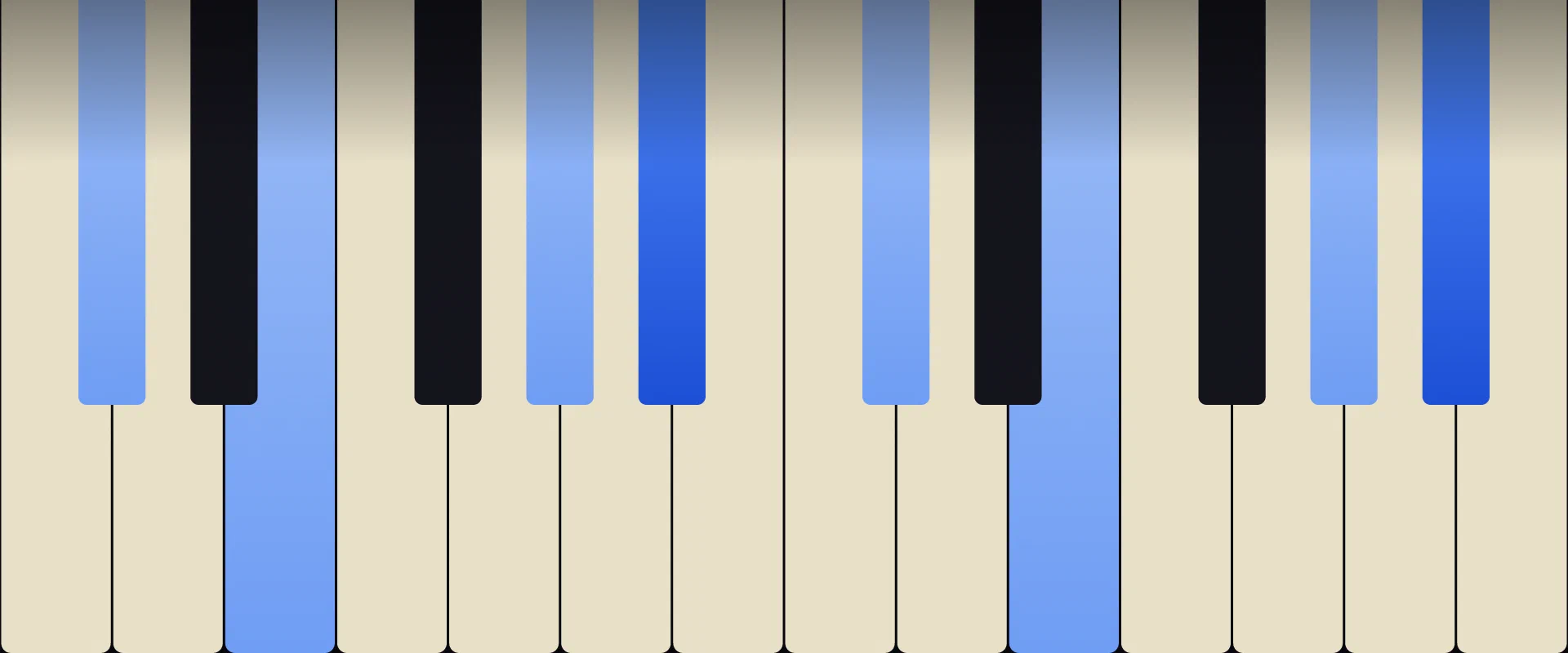
Right hand, 1 on B♭, 2 on D♭, 3 on F♭, 5 on A♭. The gaps are three semitones, three, then four, so the shape is even at the bottom and opens at the top. That uneven top is what stops the chord being symmetrical: stack three minor 3rds instead and every note can claim to be the root, which is precisely the diminished seventh’s problem. Here the major 3rd on top makes B♭ the root and keeps it there.
Lift the root out and D♭, F♭, A♭ is a D♭ minor triad, two black keys with the white key E between them. Play that in the right hand over a single B♭ and the chord is complete. Players who find this one difficult are usually reading four accidentals at once instead of one triad over one bass note.
B♭m7♭5 on the Guitar
Half-diminished chords are not barre chords, and this root shows why. Take the shape rooted on the sixth string, 6 x 6 6 5 x: B♭ at fret 6, A♭ on the D string at fret 6, D♭ on the G string at fret 6, and F♭ on the B string at fret 5. That last note sits behind the barre line. Everything else invites an index finger laid flat across fret 6 and the ♭5 is one fret lower, so the grip takes four separate fingers.
The other home is the 1st fret, x 1 2 1 2 x, one chord tone per string and nothing doubled: B♭ on the A string at fret 1, F♭ on the D string at fret 2, A♭ on the G string at fret 1, D♭ on the B string at fret 2. Lay the index flat across the fifth, fourth and third strings at fret 1, then add the middle finger on the fourth string and the ring finger on the second, both at fret 2. Four strings sound, the outer two stay muted, and for once a chord in this key asks for no real pressure beside the nut.
That grip is also the clearest demonstration of the spelling argument anywhere on the instrument. The third string is stopped at fret 1 for A♭. Let it ring open instead and the note becomes G, which is A♭♭ written properly, and the chord is the fully diminished seventh the reference calls A♯dim7. One string, one fret, and a new root name.
Inversions
| Inversion | Notes | Bass note | Symbol |
|---|---|---|---|
| Root position | B♭ D♭ F♭ A♭ | B♭ | B♭m7♭5 |
| 1st inversion | D♭ F♭ A♭ B♭ | D♭ | B♭m7♭5/D♭, or D♭m6 |
| 2nd inversion | F♭ A♭ B♭ D♭ | F♭ | B♭m7♭5/F♭ |
| 3rd inversion | A♭ B♭ D♭ F♭ | A♭ | B♭m7♭5/A♭ |
First inversion is barely an inversion. A bass player who walks onto D♭ under this chord has handed everybody a D♭m6 in root position, and that is what the ear takes, since D♭ supports a plain stack of thirds and B♭ no longer has to be believed.
Third inversion reads best in a minor key, because A♭ underneath falls a semitone to G, the note the dominant wants next. Second inversion needs care: F♭ at the bottom puts the tritone lowest in the chord, and low tritones lose their pitch. See Chord Inversions and Voice Leading.
Voicings
D♭ F♭ A♭ over a bass B♭ is the everyday version: the three notes that define the chord, with the root left to somebody else.
B♭ D♭ A♭ F♭, with the ♭5 lifted to the top, is for when the chord needs to sound like itself. F♭ above A♭ is bright and unsettled; buried in the middle it just sounds vague.
Add C above that and the chord grows a natural 9th, the colour melodic minor harmony gives it and the reason improvisers treat it as a mode rather than a stack. See Extended Chords and Jazz Harmony.
Which Keys Contain B♭m7♭5
- i of A♯ locrian
- ii of G♯ natural minor
- ii of G♯ harmonic minor
- vii of B major
- vi of C♯ dorian
- entirely contained in B♭ blues
Five of those six spell the chord A♯, C♯, E and G♯, not B♭, D♭, F♭ and A♭, and that proportion is the honest picture. On the flat side this chord belongs to A♭ minor, which carries seven flats, and nobody writes in A♭ minor while G♯ minor with five sharps is available.
The blues entry is the odd one out. B♭ blues is B♭, D♭, E♭, E, F and A♭, and the whole chord fits inside it, with the scale page writing the ♭5 as a plain E, since a blues scale has no reason to care about letters.
Where B♭m7♭5 Shows Up
Its standing job is the ii of a minor cadence in A♭ minor, and the move into the dominant is almost free:
B♭m7♭5 | E♭7♭9 | A♭m
E♭7♭9 is E♭, G, B♭, D♭ and F♭. Three of those, B♭, D♭ and F♭, are already sitting in the chord in front of it, and the ♭9 that gives the dominant its bite is the F♭ this chord has been holding all along. The only note that has to move is A♭, dropping a semitone to G. One voice, and the harmony has gone from resting on a tritone to driving on one.
Set that beside the major key version of the same bar. In A♭ major the ii chord is B♭m7, whose 5th is F natural. Pull that F down to F♭, change nothing else, and the cadence lands on A♭ minor instead of A♭ major. One white key steps left and the destination changes mode, which is why this chord is learned in pairs with the plain minor 7th rather than on its own. The fork is covered in the ii-V-I.
The third use throws the root away. Hold B♭, D♭, F♭ and A♭, put G♭ underneath, and the chord is G♭9. A semitone slide down from there reaches F7:
G♭9 | F7 | B♭m
F7 is the dominant of B♭ minor, so four notes named after B♭ have quietly become the chord leading back to it, without the right hand moving at all. Sliding a whole harmony down one fret is standard borrowed chord writing and easier to hear than to analyse.
Related Chords
- B♭ Diminished Chord, the triad this is built on, and the source of the F♭ argument.
- B♭ Minor 7th Chord, the same chord with a natural 5th, one white key to the right.
- B♭ Minor 6th Chord, which shows the same minor 6th pairing working from the other side.
- Seventh Chords: The Complete Guide, on where the half-diminished sits among the four seventh chord types.
Learn More
Practice Chords
Drill chord recognition with a metronome, MIDI support, and score tracking.
Start PracticingRelated Articles
A Half-diminished Chord: Notes, Voicings, and How to Play It
Aug 31, 2026 · 8 min
B Half-diminished Chord: Notes, Voicings, and How to Play It
Aug 31, 2026 · 8 min
C Half-diminished Chord: Notes, Voicings, and How to Play It
Aug 31, 2026 · 9 min