A guitar in standard tuning has two open E strings, and this is the chord that can use neither. Start from Am7 at x 0 2 0 1 0, move the finger on the fourth string back a fret so E becomes E♭, and the first string is now ringing the note you have just taken out. Kill it. What is left is x 0 1 0 1 x, Am7♭5, spelling A, C, E♭ and G on two fingers. That semitone changes the chord’s employer too: Am7 is the ii chord of G major, Am7♭5 the ii of G minor.
Try It: Am7♭5 in the Chord Finder
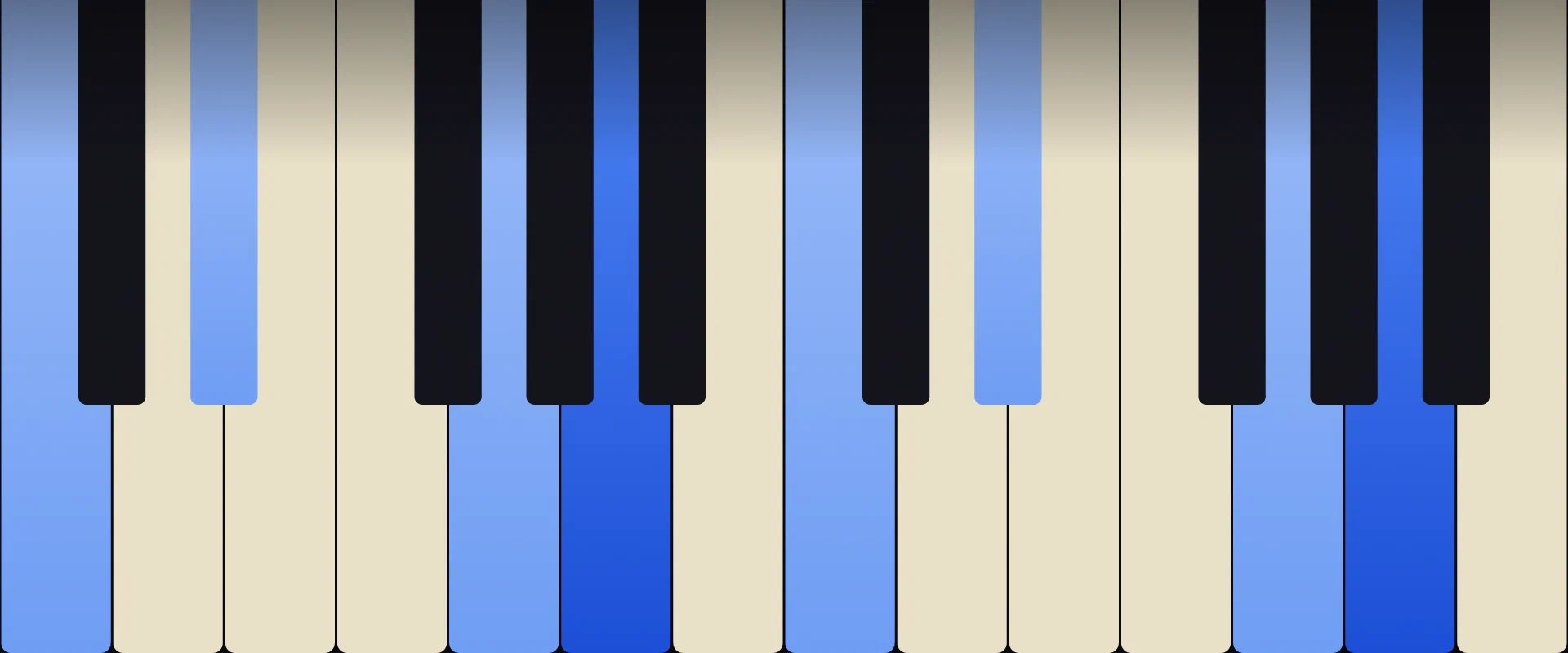
Sound the minor seventh first, then the half diminished, and watch one note step off the white key onto the black key beside it.
The Notes of Am7♭5
| Degree | Note | Interval from root | Semitones |
|---|---|---|---|
| 1 (root) | A | Perfect unison | 0 |
| ♭3 | C | Minor 3rd | 3 |
| ♭5 | E♭ | Diminished 5th | 6 |
| ♭7 | G | Minor 7th | 10 |
Written out: A, C, E♭, G. Three white keys and one black, and the accidental lands where the eye expects to find it. The symbol ø7 means the same thing, so a chart printing Aø7 is asking for these four notes.
How Am7♭5 Is Built
Take A diminished, A, C and E♭, and put a minor 7th above the root. That interval is the whole argument of the chord. Stack a diminished 7th on the same triad instead, G♭ rather than G, and the result is A diminished 7th: equal minor 3rds all the way up, symmetrical, readable from any of its four notes. A half diminished chord refuses that symmetry. Its intervals run three semitones, three, then four, and the major 3rd at the top is what gives the chord one name and one right way up.
The tritone from A to E♭ survives from the triad, and the G sits a whole tone below the root, so close position holds a tritone and a second at once. Even so the chord behaves like a minor seventh with one note lowered rather than like a diminished chord with one added.
Read the same four notes upward from C and they spell Cm6, an identity the C Minor 6th Chord page works through from that side. The practical half of it is that every minor 6th grip you own already holds this chord.
Am7♭5 on the Piano
The black key falls in the middle of the hand rather than at either end, which decides the fingering. Right hand 1, 2, 3, 5: thumb on A, index on C, third finger back onto E♭, little finger out to G. The third finger is the longest, so it reaches into the keyboard without dragging the wrist after it. Take E♭ with the fourth instead and the whole hand rotates inward to help.
Start from the minor seventh and change one thing. Play A, C, E and G, then move the third finger back a semitone. The hand tips forward at one point only, since E♭ sits behind the front edge of E, and every other finger stays where it was. The change of employer described at the top of this page is that much work.
Then there is the cadence in G minor, which is why players learn the chord at all. Left hand takes A, then D, then G. Right hand starts on C, E♭ and G, moves to C, D and F♯, and finishes on B♭, D and G. On the first step C is held while E♭ and G each fall a semitone. On the second, D is held while C and F♯ move a semitone in opposite directions. Two voices at a time, never further than a semitone, and the right hand stays inside the width of two keys throughout.
Am7♭5 on the Guitar
x 0 1 0 1 x costs two fingers, and half the chord is open string: the fifth gives the root and the third gives the seventh, so only E♭ and C are held down. Both sit at the first fret, on the fourth and second strings, which are not neighbours, and the string between them has to keep ringing, so a small barre is out of the question. Middle finger on the fourth string, index on the second, leaning forward far enough to deaden the first. The thumb takes care of the sixth. Low to high the shape sounds A2, E♭3, G3, C4, putting the flattened fifth immediately above the bass and the minor 3rd on top.
Few roots give a half diminished chord an open form at all, and this one qualifies only because two of its notes are open string pitches. With both E strings dead it still rings thinner than the minor seventh it came from, and it wants a firmer right hand.
The movable form with the root on the sixth string lands at the fifth fret: 5 x 5 5 4 x, giving A, G, C and E♭. Middle finger on the sixth string, ring and little fingers on the fourth and third at the same fret, index back to the fourth fret on the second, and the fifth string sits in the middle of the grip being damped by the underside of the middle finger. Fewer strings than a barre chord and much fiddlier.
For comping, x x 5 5 4 5 takes the top four strings inside two frets and gives G, C, E♭ and A, the seventh at the bottom. It is the shape most jazz guitarists reach for here, since the root is the note a bass player least wants doubled.
Inversions
| Inversion | Notes | Bass | Symbol |
|---|---|---|---|
| Root position | A C E♭ G | A | Am7♭5 |
| 1st inversion | C E♭ G A | C | Am7♭5/C |
| 2nd inversion | E♭ G A C | E♭ | Am7♭5/E♭ |
| 3rd inversion | G A C E♭ | G | Am7♭5/G |
A diminished 7th sounds much the same whichever note is underneath, since its inversions are all one shape. Here the four rows are four sounds. First inversion is the mildest, and it is Cm6 in root position. Second puts the tritone in the bass and is the harshest, so it passes through rather than resting. Third is the comping shape above. See Chord Inversions and Voice Leading for what the bass note is doing in each case.
Voicings
| Voicing | How to play it |
|---|---|
| Open form | x 0 1 0 1 x, two fingers, both E strings damped |
| Sixth string root | 5 x 5 5 4 x, root in the bass |
| Top four strings | x x 5 5 4 5, seventh in the bass, easy comping |
| Piano, root position | Right hand 1, 2, 3, 5 on A, C, E♭ and G |
| Piano, split | A2 in the left hand, C4, E♭4 and G4 in the right |
| Guide tones only | C and G, the notes that make the cadence work |
Which Keys Contain Am7♭5
- degree 2 (II) of G natural minor
- degree 2 (II) of G harmonic minor
- degree 7 (VII) of B♭ major
- degree 6 (VI) of C melodic minor
- degree 1 (I) of A locrian
- rooted on degree 1 of, and entirely contained in, A blues
A Locrian is the only entry that treats the chord as a tonic, and it shows why that mode is studied rather than used: a home chord with a tritone measured from its own root has nowhere to settle. The last entry is the surprise. A blues runs A, C, D, E♭, E and G, holding E♭ and E natural at once, so it contains this chord and the plain minor seventh together. A guitarist bending into the flat five and releasing it moves between the two while the harmony underneath never changes.
Where Am7♭5 Shows Up
| Progression | In this key | Chords |
|---|---|---|
| iiø7, V7, i | G minor | Am7♭5, D7, Gm |
| iiø7, V7, I | G major | Am7♭5, D7, G |
| viiø7, Imaj7 | B♭ major | Am7♭5, B♭maj7 |
| Blue note held | A blues | Am7, Am7♭5 |
The G minor cadence is where nearly every player meets the chord, usually in “Autumn Leaves”, whose second half walks into Am7♭5, D7 and Gm and stays there. Something quiet happens in that first bar. Am7♭5 contains a G, the note the whole progression is aimed at, and D7 contains none. The key is announced by the supertonic, taken away by the dominant, and handed back as a root.
Row two is the same chord borrowed. A song in G major has Am7 waiting on its second degree, and flattening one note of it darkens the bar before the dominant without touching the bass. Check the tune first: E is the sixth degree of G major and a common melody note, and this substitution takes it away, so the trick works when the singer is on D or C and fails audibly when they are not.
In B♭ major the chord sits on the seventh degree and looks straight at the tonic. Resolving to B♭maj7 costs almost nothing: A belongs to both chords and never moves, C and E♭ both step to D, and G falls to F. Arrangers use it as a quiet way into a final chord where a dominant would be too loud.
Guitarists meet it less often than horn players do, and the reason is key rather than difficulty. Bands built around guitars put this repertoire in E minor, where the job falls to F♯m7♭5, while the flat keys that suit brass and reeds put it in G minor and hand it to A. Swap the G for a G♭ and you have the fully diminished seventh on this root, a different animal that keeps different company.
Related Chords
- A Minor 7th Chord one semitone away and a different key
- C Minor 6th Chord the same four notes read from C
- A Diminished Chord the triad underneath the seventh
- A Minor Chord the plain triad, one note lowered and one added
- Seventh Chords: The Complete Guide
Learn More
Practice Chords
Drill chord recognition with a metronome, MIDI support, and score tracking.
Start PracticingRelated Articles
B Half-diminished Chord: Notes, Voicings, and How to Play It
Aug 31, 2026 · 8 min
B♭ Half-diminished Chord: Notes, Voicings, and How to Play It
Aug 31, 2026 · 8 min
C Half-diminished Chord: Notes, Voicings, and How to Play It
Aug 31, 2026 · 9 min