The chord that opens a cadence in F♯ minor already contains F♯. G♯m7♭5 is G♯, B, D and F♯, and that last note, the minor seventh, is the tonic of the key the cadence is heading for. Swap it for F and the chord turns fully diminished, the tonic vanishes, and it stops belonging to F♯ minor.
The instrument that gains is the guitar. F♯ minor is the relative minor of A major, a key built out of open strings, and two of these notes are open strings themselves: the fourth string sounds D, the flattened fifth, and the second sounds B, the minor third. The most forbidding looking chord in the key gives half of itself away for nothing.
Try It: G♯m7♭5 in the Chord Finder
The Notes of G♯m7♭5
| Degree | Note | Interval from root |
|---|---|---|
| 1 | G♯ | Perfect unison |
| ♭3 | B | Minor 3rd, 3 semitones |
| ♭5 | D | Diminished 5th, 6 semitones |
| ♭7 | F♯ | Minor 7th, 10 semitones |
Written low to high in root position: G♯ B D F♯, and also written G♯ø7. Two accidentals, both on black keys, with two plain letters between them.
That tidiness is why the root is named G♯ and not A♭. The minor 7th chord on this same key is written A♭m7, because from the flat side it needs only a C♭. Try that here and it falls apart: a chord on A must use the letters A, C, E and G, so the half diminished version comes out A♭ C♭ E𝄫 G♭, where E𝄫 is an E double flat played on the white key D. The G♯ Diminished Chord page met that double flat with only three notes to spell. The chord with a perfect fifth is spelled from A♭, the chord with a diminished fifth from G♯: the fifth decides the name of the root.
How G♯m7♭5 Is Built
Start from G♯dim, G♯ B D, and add a seventh. Which one is the whole question. F sits a diminished 7th above G♯ and piles on a third minor 3rd; F♯ sits a minor 7th above and breaks the pattern, leaving gaps of three semitones, three, then four.
The asymmetry is the useful part. The fully diminished chord holds two tritones, G♯ to D and B to F, which is why it slides up a minor 3rd four times without changing shape. This one holds exactly one, G♯ to D, plus a perfect fifth from B up to F♯, and that fifth is why it can sit still for a bar.
The top three notes alone are B, D and F♯, an ordinary B minor triad, so the chord is B minor with G♯ underneath, which is how it appears in pop and folk sheet music: not G♯m7♭5 but Bm/G♯. Put G♯ on top of that triad instead and you have Bm6. The relation runs upwards: a half diminished chord matches the minor 6th built a minor 3rd above its root.
G♯m7♭5 on the Piano
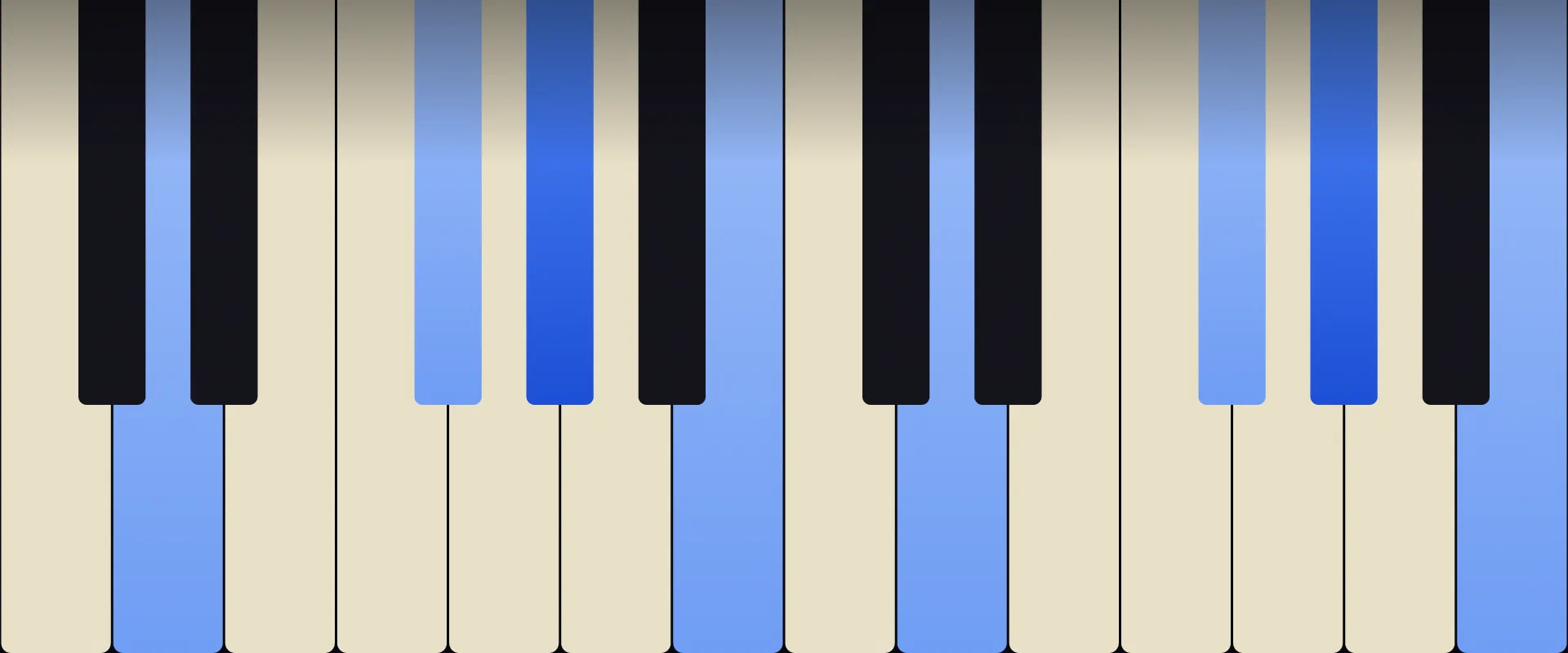
Black, white, white, black, going up. Thumb and little finger take the black keys while the middle fingers come forward on to the white ones, so the strongest fingers are the two pushing back and the hand makes a shallow bowl. Right hand root position is 1 on G♯, 2 on B, 3 on D, 5 on F♯.
The grip that earns its keep is smaller. Hold G♯ and D alone in the left hand, black key then white key, and put B and F♯ in the right, where they form a perfect fifth and move as a block. The cadence is then two semitones of work: keep G♯ and B, drop D to C♯ and F♯ to F, and the chord is C♯7. Keep close root position out of the bass, where the tritone beats rather than colours.
G♯m7♭5 on the Guitar
The chord books have no entry for this, which is not the same as there being nothing to play. Try 4 x 0 4 0 2: sixth string at the 4th fret for G♯, third string at the 4th for B, first string at the 2nd for F♯, fourth and second ringing open, index tip muting the fifth on its way past. Three fingers, and a spread no closed shape here produces.
The movable form is 4 x 4 4 3 x. Middle finger takes the root on the sixth string, ring and little fingers fill the 4th fret on the fourth and third strings, and the index drops back to the 3rd on the second string for D. Two frets of stretch, in the part of the neck where the tension has eased off but the frets are still wide.
In practice a guitarist meets these notes as a slash chord. A bass walking B, A, G♯ under a held B minor lands on this chord at the third step, and the part just says Bm/G♯. Barre B minor at the 2nd fret, let the bass take G♯, and the band plays a supertonic seventh nobody wrote down.
Further up, x 11 12 11 12 x puts the same notes an octave higher on a fifth string root, where the frets are close and nothing rings. To solo, use the G♯ blues scale: it holds all four chord tones, its lowest box starts at the 4th fret, and its blue note is the same D as the chord’s flattened fifth.
Inversions
| Inversion | Notes low to high | Bass note |
|---|---|---|
| Root position | G♯ B D F♯ | G♯ |
| 1st inversion | B D F♯ G♯ | B |
| 2nd inversion | D F♯ G♯ B | D |
| 3rd inversion | F♯ G♯ B D | F♯ |
First inversion is the Bm6 reading in root position, for when the chord is colour rather than function. Second inversion hides it: with D underneath, the first interval a listener meets is D up to F♯, a plain major 3rd, so the ear starts building a D chord.
Third inversion is the useful oddity. It puts F♯, the tonic of the key this chord serves, below a chord whose job is to lead to that tonic: a supertonic on a tonic pedal, which is how a film score holds a scene without moving the bass.
Voicings
Do not drop the fifth. On almost every other seventh chord it goes first; here it is D, and it is the whole identity. Take it out and G♯ B F♯ is a plain minor 7th shell. Drop the root instead, and B D F♯ is a B minor triad, the practical way to comp behind a bass player.
Add A♯ on top for G♯m9♭5. That ninth is natural rather than the flattened one A major would supply, and it comes from B melodic minor, which improvisers know started from G♯ as locrian natural 2.
Which Keys Contain G♯m7♭5
- I of G♯ locrian
- VII of A major
- II of F♯ natural minor
- II of F♯ harmonic minor
- VI of B melodic minor
- IV of D lydian
Four of these six are one set of seven notes, the three sharps of A major, read from four starting points. D lydian repays a look: G♯ is that scale’s raised fourth, so this chord is built on the note that makes the mode Lydian.
The other two are the ones improvisers use. F♯ harmonic minor raises E to E♯, the third of the C♯7 that follows. B melodic minor raises A to A♯, this chord’s own ninth.
Where G♯m7♭5 Shows Up
| Progression | In letters | Where it lives |
|---|---|---|
| iiø7, V7♭9, i7 | G♯m7♭5, C♯7♭9, F♯m7 | The minor ii V i in F♯ minor |
| iv, iv/III, iiø7, V7 | Bm, Bm/A, Bm/G♯, C♯7 | Descending bass under a held B minor |
| iiø7, V7sus♭9, V7, i | G♯m7♭5, C♯7sus♭9, C♯7, F♯m | Minor cadence with the hand held still |
Row one is the cadence this chord exists for, and the voice leading is almost embarrassing. C♯7♭9 is C♯, E♯, G♯, B and D, so it already shares G♯, B and D. One note moves in the whole change: F♯ falls a semitone to F, spelled E♯.
Row two is where songwriters meet the chord without naming it. The upper voices never change and the bass does the work, yet that third step is a full supertonic seventh rather than a passing note, which the next bar proves by carrying on to C♯ and cadencing.
Row three is worth stealing. Hold all four notes still and move the bass from G♯ down to C♯. Over that bass they read as the fifth, seventh, flattened ninth and fourth, which is C♯7sus♭9. Release F♯ to E♯ on the last beat and it becomes a plain C♯7♭9: two bars of dominant harmony out of one motionless hand.
None of it transfers to the fully diminished chord on this root. That one takes F, which does not belong to F♯ minor, and it climbs a semitone like a dominant with its root removed. This chord moves by a fifth like a supertonic. Same triad underneath, opposite jobs, one note apart.
Related Chords
- G♯ Diminished Chord the triad this chord is built on
- B Minor 6th Chord the same four notes named from B
- A♭ Minor 7th Chord the same key on the instrument with a perfect fifth, spelled from the flat side
- C♯ Dominant 7th Chord the chord that follows it in every row above
- G♯ Locrian Scale the one mode whose home chord is this one
- B Melodic Minor Scale the scale improvisers play over it
- The ii, V, I Progression the cadence this chord opens in a minor key
Learn More
Practice Chords
Drill chord recognition with a metronome, MIDI support, and score tracking.
Start PracticingRelated Articles
A Half-diminished Chord: Notes, Voicings, and How to Play It
Aug 31, 2026 · 8 min
B Half-diminished Chord: Notes, Voicings, and How to Play It
Aug 31, 2026 · 8 min
B♭ Half-diminished Chord: Notes, Voicings, and How to Play It
Aug 31, 2026 · 8 min