Drop the fifth. It is the first economy anyone learns about voicing a seventh chord, and on this one it is fatal. Take D♭ out of G, B♭, D♭ and F and you are left with G, B♭ and F, which is the standard shell of plain Gm7 and says nothing whatsoever about a flattened fifth. Everywhere else the fifth is the first note to go. Here it is the note that names the chord.
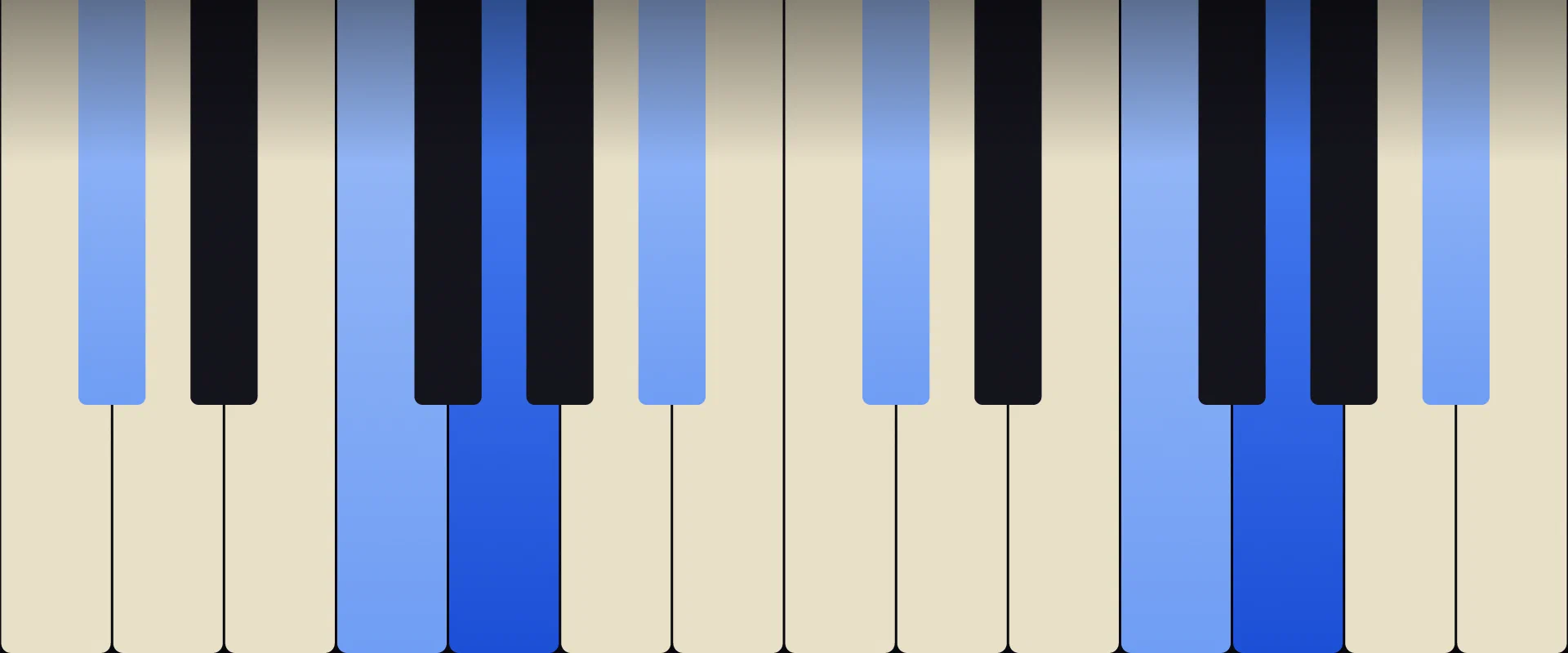
Two black keys and two white ones, written Gm7♭5 or Gø7. Its ordinary employment is as the ii chord of a minor ii V i in F minor, one bar ahead of C7 and two ahead of the tonic, which is where most players meet it: not as a curiosity, but as the bar before the bar before home.
Try It: Gm7♭5 in the Chord Finder
The Notes of Gm7♭5
| Degree | Note | Interval from Root | Semitones |
|---|---|---|---|
| 1 (Root) | G | Perfect unison | 0 |
| ♭3 | B♭ | Minor 3rd | 3 |
| ♭5 | D♭ | Diminished 5th | 6 |
| ♭7 | F | Minor 7th | 10 |
The fifth is spelled D♭ rather than C♯. Both land on the same black key, but a seventh chord stacks letters in thirds, so above G there must be a B, then a D, then an F. Write C♯ and this stops being a G chord on paper.
How Gm7♭5 Is Built
Start from Gm7, G B♭ D F, and pull the D back one semitone. That is the whole alteration, and it changes the chord’s job rather than its colour: Gm7 is somewhere to rest and this is somewhere to leave.
Count the tritones and the name explains itself. G against D♭ is six semitones, the chord’s one unstable interval, while B♭ against F is seven, an ordinary perfect 5th. A chord built on a diminished triad that still keeps a perfect 5th inside it is diminished by halves. Replace the F with F♭, which sounds as E on the keyboard, and you have Gdim7 instead: two tritones, nothing steady anywhere, and a chord that can be renamed from any of its four notes. Gm7♭5 has a root and keeps it.
Read the top three notes alone and there is a neater way to see the alteration. B♭, D♭ and F is a B♭ minor triad, so Gm7♭5 is B♭ minor with a G underneath, where Gm7 is B♭ major with a G underneath. Move that G to the top instead and B♭, D♭, F, G is B♭m6, the minor 6th chord a minor 3rd above the root.
Gm7♭5 on the Piano
Right hand 1 on G, 2 on B♭, 3 on D♭, 5 on F. The two black keys take the second and third fingers and the two white ones the thumb and little finger, so the hand sits pushed back in the middle and forward at both ends: the arch a teacher spends months asking for, handed over by the chord.
Learn it as a move rather than a shape. Play Gm7, hold everything, and slide the third finger back from D to D♭. Nothing else shifts. Play the pair a few times and listen to what that one semitone costs: the chord loses its floor.
Then practise where it goes, since this chord is nothing but an approach. Keep B♭, D♭ and F in the right hand over G in the left, then move the left hand to C. Only one note above it has to shift: F falls a semitone to E. B♭ is now the seventh of C7 and D♭ is its flattened ninth, so the note that made this chord sound wrong is the exact note the dominant wanted. Move the left hand again to F and let the right hand drop, E to F, B♭ to A♭, D♭ to C. Nothing above the bass has travelled further than a whole step.
Gm7♭5 on the Guitar
| Form | Frets | Notes sounded |
|---|---|---|
| Root on the 4th string | x x 5 6 6 6 | G D♭ F B♭ |
| No barre, root on the 6th | 3 x 3 3 2 x | G F B♭ D♭ |
| Root on the 5th, cramped | x 10 11 10 11 x | G D♭ F B♭ |
| Full E shape barre | 3 4 3 3 2 3 | G D♭ F B♭ D♭ G |
The first grip is the one to own. Index on the D string at the 5th fret for the root, then a small barre across the top three at the 6th for D♭, F and B♭. Four notes, four strings, no doubling.
The second is what a guitarist stumbles into while dodging a barre, and it works: G on the 6th string at the 3rd fret, then F, B♭ and D♭ on the 4th, 3rd and 2nd, with the 5th string muted and the top string left out. Three fingers sit at the 3rd fret and the index takes the 2nd. The B♭ minor 6th chord is the same handful under a different name.
The full barre shows why nobody bothers. Compare it with the Gm7 barre at the same fret, 3 5 3 3 3 3. Flattening the fifth means moving two notes rather than one, because that shape doubles the D: the 5th string drops from fret 5 to 4 and the 2nd from 3 to 2. What costs one finger at the piano costs a regrip here.
One trap is worth stating plainly. The three note shell 3 x 3 3 x x is identical for Gm7 and Gm7♭5, since the note that separates them is the one a shell leaves out. Comping a minor ii V, you have to fret the D♭ or the bar is not this chord.
Inversions
| Inversion | Notes | Bass | Symbol |
|---|---|---|---|
| Root position | G B♭ D♭ F | G | Gm7♭5 |
| 1st inversion | B♭ D♭ F G | B♭ | Gm7♭5/B♭ |
| 2nd inversion | D♭ F G B♭ | D♭ | Gm7♭5/D♭ |
| 3rd inversion | F G B♭ D♭ | F | Gm7♭5/F |
Nobody writes the first inversion. With B♭ underneath, those four notes are B♭m6 in root position and that is how they get printed, so the symbol changes although not one pitch has. Third inversion behaves normally, F in the bass falling to E under C7 as any seventh would, and second inversion is the rare one: a bass note a tritone below the symbol’s root sounds unmoored, which is useful only if you want unease.
Voicings
This is the unusual chord with nothing expendable in it. Remove any one note and you are holding a different chord that already exists: without G, a B♭ minor triad; without B♭, three notes that would serve G7♭5 just as well; without D♭, the Gm7 shell; without F, a plain G diminished triad.
The one safe omission is the root, and only when a bass player has it. Play B♭, D♭ and F over their G: your right hand holds B♭ minor while the band holds a half-diminished chord.
Keep G and D♭ in different octaves. The tritone is the entire point and it wants air; crush the two together below middle C and the chord reads as noise rather than tension.
Adding a ninth means choosing between A and A♭. A natural gives Gm9♭5, open and modern; A♭ is what G locrian offers and it grinds against the root.
Which Keys Contain Gm7♭5
- vii of A♭ major
- ii of F natural minor
- ii of F harmonic minor
- vi of B♭ melodic minor
- i of G locrian
- vii of G♯ melodic minor
The two F minor entries are not interchangeable. F harmonic minor also produces C7 on its fifth degree, so that one scale holds the whole cadence. F natural minor gives Cm7 there instead, which will not pull the music home.
B♭ melodic minor is the improviser’s answer. Play it from G and you get G, A, B♭, C, D♭, E♭, F, locrian with a natural second, the standard choice over this chord because it keeps the A.
One warning. On the G♯ melodic minor page these same four sounds are spelled F𝄪, A♯, C♯ and E♯, since the sharp side has to reach a double sharp to name the root. Identical on the keyboard, unrecognisable on the page.
Where Gm7♭5 Shows Up
| Progression | Chords | Typical use |
|---|---|---|
| iiø7, V7♭9, i in F minor | Gm7♭5, C7♭9, Fm | The chord’s day job |
| viiø7, I in A♭ major | Gm7♭5, A♭maj7 | Leading tone seventh |
| Over an E♭ bass | E♭9 | Rootless dominant |
| iv6 named from the bass | B♭m6/G | The same notes in F minor |
| i in G locrian | Gm7♭5 | Modal, and rare for a reason |
The first row does something C7 cannot do alone. A dominant on C leads equally well to F major or F minor, but Gm7♭5 in the bar before has already committed: the D♭ rules out F major before the dominant arrives. Announcing the mode early is this chord’s real function.
The third row hands you a substitution. E♭9 is E♭, G, B♭, D♭ and F, so remove the root and what remains is exactly this chord: any bar calling for the dominant ninth of A♭ can be played as Gm7♭5 over the bass player’s E♭. Its neighbour sharpens the picture, since Gdim7 is G, B♭, D♭ and F♭, and F♭ sounds as E, making that chord the rootless form of E♭7♭9 instead. One note, F or F♭, separates an unaltered dominant from an altered one.
The last row is a warning rather than a suggestion. G locrian takes this chord as its tonic, so the mode’s home chord has a tritone above the root and no perfect fifth. Nothing can settle there, which is exactly the point: half-diminished harmony exists in order to move.
Related Chords
- G Minor 7th Chord, one semitone away on the fifth
- G Diminished Chord, the triad underneath before F is added
- B♭ Minor 6th Chord, these four notes with B♭ in the bass
- G Dominant 7th Chord, whose tritone runs between the third and the seventh instead
- Gdim7, with F♭ in place of F, which is the fully diminished version and behaves quite differently
- G Minor 6th Chord, whose own half-diminished twin is Em7♭5
- Extended Chords and Jazz Harmony for Gm9♭5 and the altered dominants nearby
- The G Locrian Scale
- Guitar Chord Shapes: The CAGED System
Learn More
Practice Chords
Drill chord recognition with a metronome, MIDI support, and score tracking.
Start PracticingRelated Articles
A Half-diminished Chord: Notes, Voicings, and How to Play It
Aug 31, 2026 · 8 min
B Half-diminished Chord: Notes, Voicings, and How to Play It
Aug 31, 2026 · 8 min
B♭ Half-diminished Chord: Notes, Voicings, and How to Play It
Aug 31, 2026 · 8 min