There is a perfect 5th inside this chord. That looks like a contradiction, given that the 5th is the note which has been flattened, but the interval is there: A♭ up to E♭, seven semitones, with the flattened 5th sitting inside it. It is why a half-diminished chord sounds like a minor chord leaning over rather than a mechanism. Lower that E♭ by one more semitone and the perfect 5th vanishes, every interval left is a minor 3rd, and what you are holding is a fully diminished seventh instead.
Then there is the spelling. F, A♭, C♭ and E♭: three flats on four notes, and only two of them send a finger to a black key. C♭ is the white key everyone calls B, for the reason set out on the F diminished page, where the 5th of an F chord has to be some kind of C. The 7th obeys the same rule one letter further along: the top note of a seventh chord on F stays a kind of E, so this one is E♭ and never D♯.
Try It: Fm7♭5 in the Chord Finder
Set F as the root and find the half-diminished seventh. The ♭5 lights up on the key you know as B.
The Notes of Fm7♭5
| Degree | Note | Interval from Root | Semitones |
|---|---|---|---|
| 1 (Root) | F | Perfect unison | 0 |
| ♭3 | A♭ | Minor 3rd | 3 |
| ♭5 | C♭ | Diminished 5th | 6 |
| ♭7 | E♭ | Minor 7th | 10 |
Read the gaps between neighbours rather than the distances from F: three semitones, then three, then four. That major 3rd at the top is the only interval in the chord bigger than a minor 3rd, and it is the whole character of the sound.
How Fm7♭5 Is Built
Take the F diminished triad, F A♭ C♭, and put E♭ a major 3rd above it. The tritone from F to C♭ is untouched, but a note above it softens the effect considerably.
One note separates this chord from Fm7, and it is the 5th, dropped a semitone from C to C♭. Lower the top note instead and the 7th picks up a second flat: written as a doubly flattened E, played on the key called D. That is the fully diminished seventh, and it is a different animal, four notes evenly spaced with no perfect 5th and no clear root. This chord stops one semitone short and keeps its bearings.
Fm7♭5 on the Piano
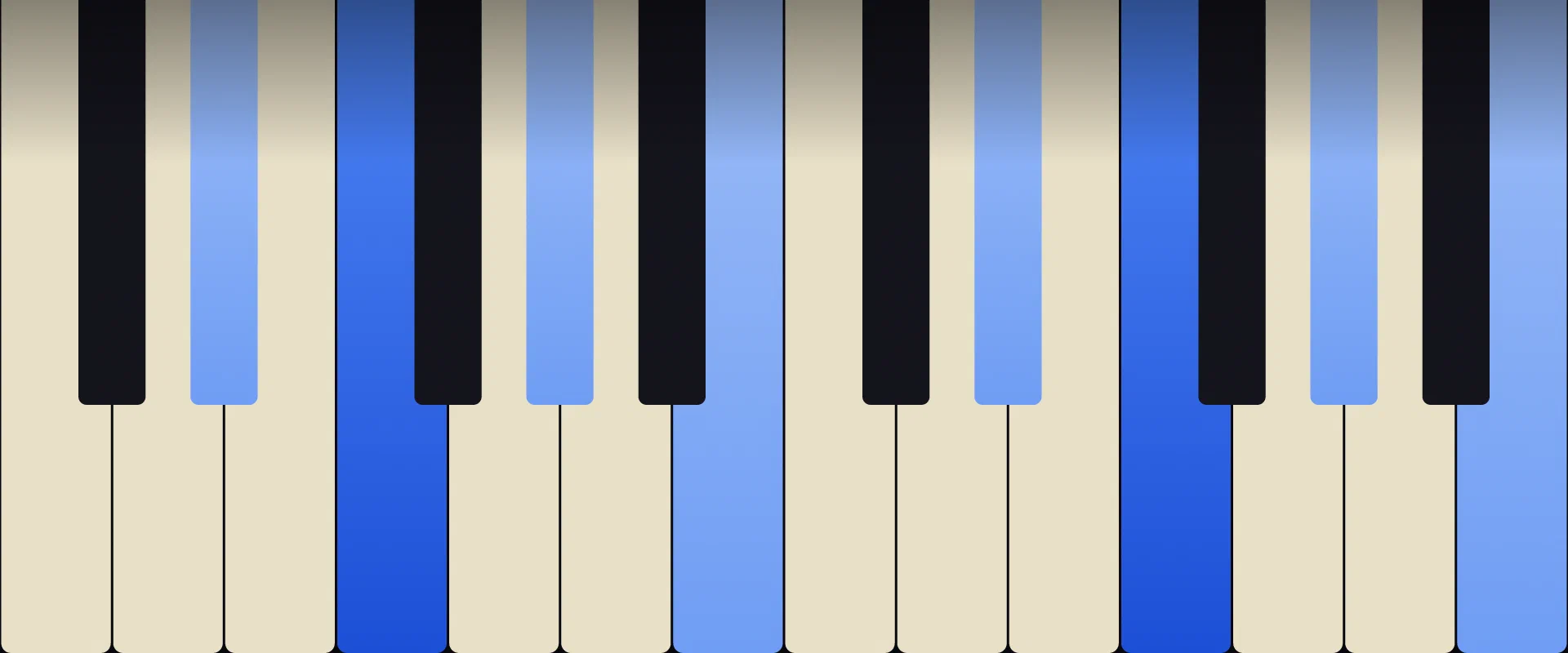
Two white keys and two black ones, but look at where the white ones fall. A keyboard has exactly two seams where neighbouring white keys have no black key between them, B to C and E to F. This chord takes the lower key of one seam and the upper key of the other.
Right hand root position is 1 on F, 2 on A♭, 3 on B, 5 on E♭. Set Fm7 beside it and one finger has moved one key: the middle finger comes back off C onto B, and the hand sits less evenly for it.
The voicing to use is not that one. Play F alone in the left hand and take A♭, C♭ and E♭ with the right, because those three are an A♭ minor triad, and a triad moves far more easily than a four note grip. It also settles the other name in a line: put A♭ in the bass instead of F and the right hand is playing A♭m6.
Fm7♭5 on the Guitar
The guitar gives this chord one note free and then takes away the finger that could have covered it. The open 2nd string is B, which is this chord’s C♭, so at the 1st fret and nowhere else the ♭5 arrives without being fretted.
Start from the Fm7 grip, 1 x 1 1 1 x, played with the middle finger on the 6th string and the index laid flat across the 4th, 3rd and 2nd. Two fingers. Release the 2nd string and the notes are right, F, E♭, A♭ and C♭ from the bottom, but the flat index has to go, because a finger lying across three strings frets the one you now need open. So 1 x 1 1 0 x takes three fingers standing on their tips, middle on the 6th string, ring on the 4th, index on the 3rd, with the open string threading between them. The same trade applies to the four string version, x x 1 1 0 1: one finger covers it for Fm7, three are needed here.
Two frets higher the arithmetic reverses. Middle finger on the 4th string at fret 3, small barre across the top three at fret 4, x x 3 4 4 4, sounding F, C♭, E♭, A♭. Two fingers, where Fm7 in that position needs three, because its C sits at the 5th fret and falls outside the little barre. The chord that was harder at the nut is the easier one here.
The shape rooted on the 5th string at fret 8, x 8 9 8 9 x, cannot be barred either: its strings alternate between two frets, so it takes four fingers in a zigzag.
Inversions
| Inversion | Notes | Bass Note | Symbol |
|---|---|---|---|
| Root position | F, A♭, C♭, E♭ | F | Fm7♭5 |
| 1st inversion | A♭, C♭, E♭, F | A♭ | Fm7♭5/A♭ |
| 2nd inversion | C♭, E♭, F, A♭ | C♭ | Fm7♭5/C♭ |
| 3rd inversion | E♭, F, A♭, C♭ | E♭ | Fm7♭5/E♭ |
First inversion is rarely written as one. Every half-diminished chord has a minor 6th twin a minor 3rd above it, so A♭ C♭ E♭ F over a bass A♭ is read as A♭m6 and nothing on the page will say Fm7♭5.
The second inversion is the one to avoid: with C♭ underneath, the tritone runs upwards from the bass and the ear loses track of the root. Expect that row on a chart as Fm7♭5/B in any case, since bass parts are not written with C♭ in them if an editor can help it.
Voicings
Keep C♭ and E♭ apart. Four semitones is close enough to blur low down, so send E♭ up an octave and let the major 3rd become a minor 6th. If a note has to go, drop the root, not the ♭5: the bass has F covered, and a version without C♭ is just an incomplete Fm7.
| Shape | Frets, low to high | Sounding notes |
|---|---|---|
| Root on 6th string, fret 1 | 1 x 1 1 0 x | F, E♭, A♭, C♭ |
| Top four strings, no barre | x x 1 1 0 1 | E♭, A♭, C♭, F |
| Two finger shape, frets 3 and 4 | x x 3 4 4 4 | F, C♭, E♭, A♭ |
| Root on 5th string, fret 8 | x 8 9 8 9 x | F, C♭, E♭, A♭ |
Which Keys Contain Fm7♭5
- iø7 of F locrian
- iiø7 of E♭ natural minor
- iiø7 of E♭ harmonic minor
- viø7 of A♭ dorian
- vø7 of B♭ phrygian
- viiø7 of F♯ major
The two E♭ minor entries make one point between them. Raising the 7th degree of that key turns D♭ into D natural and rebuilds half its chords, but this one contains no D of any description, so it survives the change untouched. Whichever minor scale a passage draws on, the ii is Fm7♭5.
The last entry is written differently: F♯ major spells the same four sounds as E♯, G♯, B and D♯, which is what six sharps force it to do. F locrian is the opposite case, the one diatonic mode whose tonic chord is half-diminished, and also the reason nobody writes in it for long. The chord is fine. It just cannot be home. It does sit whole inside F blues, where C♭ is the blue note.
Where Fm7♭5 Shows Up
| Progression | In letters | Where it lives |
|---|---|---|
| iiø7, V7♭9, i | Fm7♭5, B♭7♭9, E♭m | Minor ii V i in E♭ minor |
| V9, I | D♭9, G♭maj7 | Dominant cadence in G♭ major |
| iv6, iiø7, V7 | A♭m6, Fm7♭5, B♭7 | Bass walking down under a held chord |
The first row is the chord’s day job, and it hides a detail. Its 7th is E♭, the tonic of the key the progression is heading for, so the chord already holds its own destination while the tension sits underneath. A half-diminished ii sounds like the start of an arrival rather than a departure, which is why players voice it with E♭ on top.
The second row is the same four notes wearing a different hat. Put D♭ underneath and F, A♭, C♭ and E♭ become the 3rd, 5th, 7th and 9th of D♭9, an ordinary dominant heading for G♭ major. The fully diminished seventh over that same bass gives D♭7♭9 instead, a far sharper chord, so one semitone in the top voice decides which the listener gets.
The third row is keyboard economy. A♭m6 and Fm7♭5 are identical notes, so a pianist holds one shape while the bass walks A♭ down to F and the harmony moves from subdominant to supertonic without a finger moving. Guitarists rarely meet the chord under this name, since six flats keeps E♭ minor off most charts, but the grip travels: refret the 2nd string, slide it up the neck, and it is the iiø7 of every minor key a guitar band does play in.
Related Chords
- F Minor 7th Chord restores the 5th to C and removes the tritone.
- F Diminished Chord is the triad underneath, before the 7th arrives.
- A♭ Minor 6th Chord is these four notes with A♭ in the bass.
- A♭ Minor Chord is the triad sitting on top of the root.
- F Minor 6th Chord is the mirror case: a minor 6th chord whose half-diminished twin is rooted on D.
Learn More
For this chord in every key and how it differs from the fully diminished seventh, see Seventh Chords: The Complete Guide. The minor ii V i is worked through in The ii V I Progression, and D♭9 in Extended Chords and Jazz Harmony. E♭ minor and G♭ major share the six flat position on the circle of fifths. For every scale containing this chord, see Scales for Piano and Guitar: The Complete Reference Guide.
Practice Chords
Drill chord recognition with a metronome, MIDI support, and score tracking.
Start PracticingRelated Articles
A Half-diminished Chord: Notes, Voicings, and How to Play It
Aug 31, 2026 · 8 min
B Half-diminished Chord: Notes, Voicings, and How to Play It
Aug 31, 2026 · 8 min
B♭ Half-diminished Chord: Notes, Voicings, and How to Play It
Aug 31, 2026 · 8 min