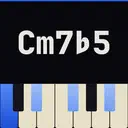
Almost everything on E is easy on a guitar. This is not. The instrument is tuned around the note, the low string is the root, and three of these four notes are open strings: E on the sixth, G on the third, D on the fourth. Then comes B♭, which exists nowhere in the tuning, and the note it displaces sits on the open second string, in the middle of the strum, where it is very hard to keep quiet. Let it ring and a B lands a semitone above the B♭ and the chord turns to gravel.
On a keyboard none of that happens. Three white keys and one black, and the chord is no harder to find than any other. Few chords open so wide a gap between the two instruments, which is why guitarists treat Em7♭5 as exotic and pianists treat it as ordinary furniture.
Try It: Em7♭5 in the Chord Finder
Select E as the root and Locrian to see the chord on the first degree, then move to D harmonic minor and find it on the second.
The Notes of Em7♭5
| Degree | Note | Interval from Root | Semitones |
|---|---|---|---|
| 1 (Root) | E | Perfect unison | 0 |
| ♭3 | G | Minor 3rd | 3 |
| ♭5 | B♭ | Diminished 5th | 6 |
| ♭7 | D | Minor 7th | 10 |
The symbol Eø7 means the same thing and is what you will meet in most jazz charts.
How Em7♭5 Is Built
Take the E diminished triad, E, G and B♭, and put a minor 7th on top. The word minor is doing all the work in that sentence. A minor 7th above E is D. Lower it one further semitone to D♭ and the chord becomes E diminished 7th, a completely different animal that publishes as its own page later in this set, and the single semitone between them is not a shade of colour.
Count the intervals and you can hear why. Inside E, G, B♭ and D there is one perfect 5th, from G up to D, and that consonance is what lets the chord sit still for a bar and be listened to. Lower the D and every interval left in the chord is a minor 3rd or a tritone. Nothing is consonant, no note is more important than any other, and the result cannot be a resting place at all. The half-diminished chord has a key and a home. The fully diminished one is a pure transition, so confusing the two on a chart swaps a chord that belongs somewhere for one that belongs nowhere.
These same four notes read from G rather than from E spell Gm6, and that page works through the identity from the sixth chord side. Here it is enough to note which name is which: the lowest voice decides, and E in the bass gives you the half-diminished reading.
Em7♭5 on the Piano
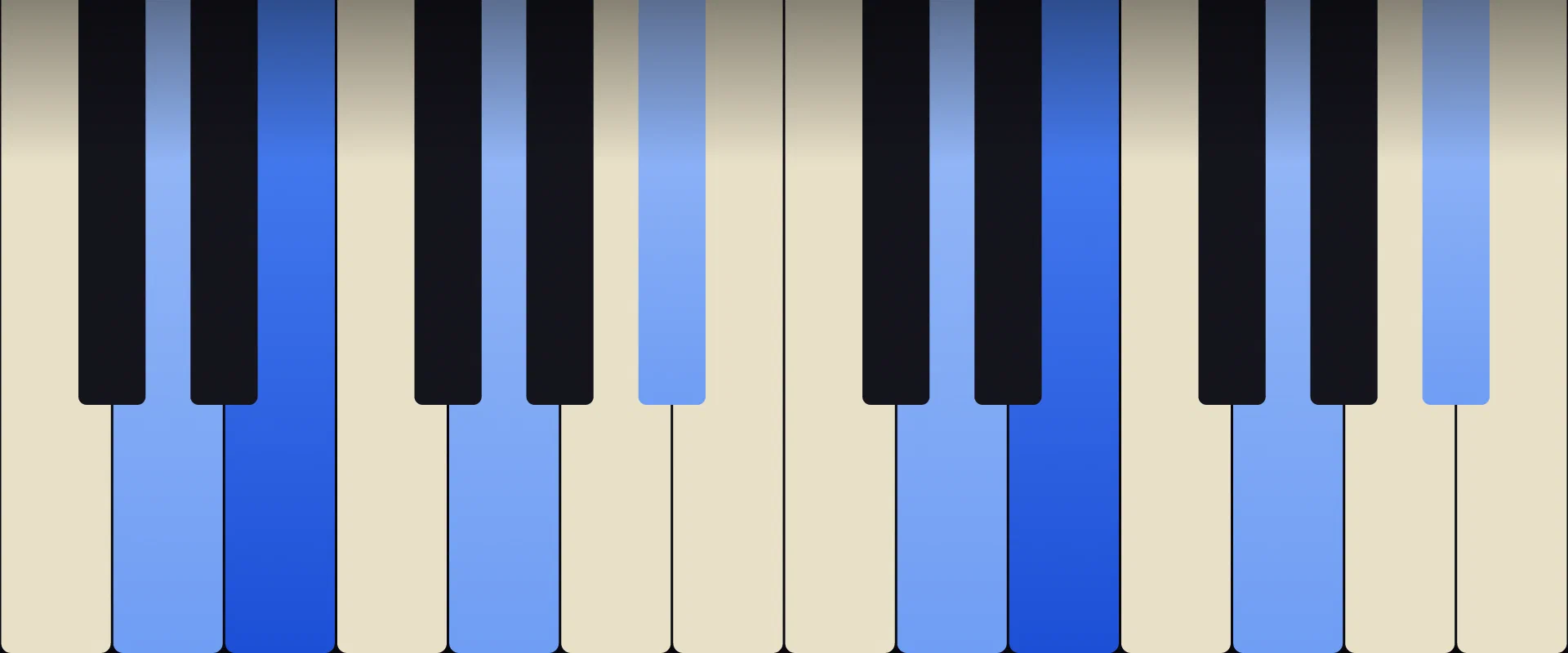
One black key, and it is the one that matters. Right hand 1, 2, 3 and 5 on E, G, B♭ and D, left hand 5, 4, 2 and 1, with the middle finger riding up onto B♭ and the rest of the hand flat on white. The B♭ is a physical landmark, so this is a chord you can find in the dark, which is not true of Em7, whose four white keys give the fingers nothing to feel for.
The comparison is worth making at the keyboard, because it is one finger of difference. Play E in the left hand and a G major triad in the right and you have Em7. Flatten the top note of that triad to B♭, so the right hand is now a G minor triad, and the chord becomes Em7♭5. The hand barely moves. The function changes completely: one chord is a mild minor seventh that can sit anywhere, the other is a chord with somewhere it has to go.
Voice it high. The tritone from E to B♭ is the chord’s identity, and below middle C two notes a tritone apart stop reading as an interval and start reading as noise. Keep E low and alone, put G, B♭ and D above middle C, and the tritone becomes audible as a colour instead of a rumble. The pair to keep apart is D and E: put them next to each other in the same octave and the second buries whatever is above it.
Em7♭5 on the Guitar
Adding the seventh actually improves the guitarist’s position rather than worsening it. The plain diminished triad on E has three open strings among its notes; this chord has four, because the open D string is a chord tone. The whole problem is still the one note, B♭, and the open B that sits a semitone above it.
Work it out string by string from the bottom. Sixth string open gives E. Fifth string at the 1st fret gives B♭, the lowest one the instrument owns and easy ground. Fourth and third strings open give D and G. Second string open would give B, which is exactly the note the chord forbids, so move it to the 3rd fret for a D. First string open gives E. That is 0 1 0 0 3 0, two fingers, six strings, and every note checked.
| Form | Frets | Notes sounded |
|---|---|---|
| Open position | 0 1 0 0 3 0 | E B♭ D G D E |
| Open, thinner | 0 1 0 0 3 x | E B♭ D G D |
| Top four strings | x x 2 3 3 3 | E B♭ D G |
| Fifth string root | x 7 8 7 8 x | E B♭ D G |
| Sixth string root | 12 13 12 12 x x | E B♭ D G |
The open form has a warning attached. Its two lowest notes are E and B♭, a tritone across the bottom two strings, which is heavy going and the main reason it is rarely what a player wants. Drop the sixth string and let a bass player take the root, or use the top four string grip.
x x 2 3 3 3 is the shape actually used. Middle finger on the fourth string at the 2nd fret, index laid flat across the top three at the 3rd: two fingers, four notes, no doublings, and it moves to any root. Most players who meet this chord in a jazz context learn that grip and rarely bother with the rest. The fifth string form, x 7 8 7 8 x, is the same voicing lower down with the root under the fingers, and it needs four separate fingers across two frets rather than a barre.
Inversions
| Inversion | Notes | Bass | Symbol |
|---|---|---|---|
| Root position | E G B♭ D | E | Em7♭5 |
| 1st inversion | G B♭ D E | G | Em7♭5/G, or Gm6 |
| 2nd inversion | B♭ D E G | B♭ | Em7♭5/B♭ |
| 3rd inversion | D E G B♭ | D | Em7♭5/D |
Second inversion is the one to reach for when a line needs to descend. B♭ in the bass is the tritone under the root, so the chord leans downwards hard, and it resolves beautifully onto an A in the bass a semitone below it. That single step, B♭ down to A, is a large part of why this chord and the dominant that follows it feel welded together.
Third inversion suffers from the same problem the root position has at the piano: D with E directly above it puts a whole step at the very bottom of the chord.
Voicings
Most seventh chords let you drop the fifth first. This one does not. B♭ is the fifth and it is also the entire difference between this chord and a plain minor seventh, so removing it does not thin the chord, it renames it. Drop the root instead. G, B♭ and D over somebody else’s E is the standard rootless version, and it is why a pianist comping in a trio plays what looks like a G minor triad and calls it something else.
There is one substitution worth carrying around. E, G, B♭ and D are the top four notes of C9. Give the same four notes to a bass player holding C and the chord is a complete dominant ninth with nothing doubled, which is how this shape ends up doing dominant work in keys that never mention it.
Which Keys Contain Em7♭5
- viiø7 of F major
- iiø7 of D natural minor
- iiø7 of D harmonic minor
- viø7 of G melodic minor
- viø7 of G dorian
- iø7 of E locrian
E Locrian is the only one of those where the chord is the tonic, which is a strange office to hold: a key whose home chord contains a tritone over the root and therefore never sounds finished. That is precisely what the mode is for in film and game music, and this chord is the sound of it.
The surprising entry is the E blues scale, E, G, A, B♭, B and D, which contains all four of these notes. So the B♭ that makes the chord foreign to E minor harmony is the same B♭ that every blues player in E bends towards a hundred times a night. The notes are thoroughly familiar on this root. Only the decision to hold them together as a chord is not.
Where Em7♭5 Shows Up
| Progression | Chords | Typical use |
|---|---|---|
| iiø7, V7, i in D minor | Em7♭5, A7, Dm | The minor ii V i, its main job |
| iiø7, V7♭9, i | Em7♭5, A7♭9, Dm | Three notes held over the change |
| viiø7, I in F major | Em7♭5, F | Leading tone seventh, a C9 with no C |
| I, vii, vi in F major | Fmaj7, Em7♭5, Dm7 | Stepwise descent, F to E to D |
| Vamp on E Locrian | Em7♭5, F, Em7♭5 | Unsettled film and game cues |
The second row is the reason players stop fearing this chord. Em7♭5 is E, G, B♭ and D. A7♭9 is A, C♯, E, G and B♭. Three notes are shared and only one moves, D down a semitone to C♯, so the ii to V in a minor key asks the right hand for almost nothing. Learn the pair as one gesture and the hardest looking change in minor key jazz turns into a fingertip.
The guitar reality behind row one is worth saying plainly. D minor is not a friendly key on the instrument and the ii chord is the awkward one in it, so guitarists mostly play x x 2 3 3 3 and let a bass player supply the E. This chord is heard without its root more often than with it, which is odd for a chord defined by an interval measured from that root.
Row three is the job most listeners have heard without noticing. On the seventh degree of F major it is a dominant with its root missing, so it pulls towards F as C9 does but lightly, without a bass note announcing the cadence. Arrangers use it when a resolution should arrive rather than land.
Related Chords
- E Diminished Chord, the triad this one is built on
- E Minor 7th Chord, B natural where this chord has B♭
- E Minor 6th Chord, which puts its tritone above the third instead of over the root
- G Minor 6th Chord, these four notes with G in the bass
- E Diminished 7th, the same chord with the D lowered to D♭, which removes the last consonance in it
- The E Locrian Scale
- The E Blues Scale
- The D Harmonic Minor Scale
- Guitar Chord Shapes: The CAGED System
Learn More
Practice Chords
Drill chord recognition with a metronome, MIDI support, and score tracking.
Start PracticingRelated Articles
A Half-diminished Chord: Notes, Voicings, and How to Play It
Aug 31, 2026 · 8 min
B Half-diminished Chord: Notes, Voicings, and How to Play It
Aug 31, 2026 · 8 min
B♭ Half-diminished Chord: Notes, Voicings, and How to Play It
Aug 31, 2026 · 8 min