The symbol reads like a warning and the chord is nothing of the kind. D♯, F♯, A and C♯ are the seventh degree of E major and the second degree of C♯ minor, two keys that sit on open strings and between them carry a very large slice of guitar written music. Nothing here is chromatic: every note belongs to a signature of four sharps, and a player who has ever put a D♯ under an E chord to walk the bass down has already sounded most of it.
Try It: D♯m7♭5 in the Chord Finder
The Notes of D♯m7♭5
The chord contains four notes: D♯, F♯, A and C♯.
| Degree | Note | Interval from root | Semitones |
|---|---|---|---|
| 1 | D♯ | Root | 0 |
| ♭3 | F♯ | Minor 3rd | 3 |
| ♭5 | A | Diminished 5th | 6 |
| ♭7 | C♯ | Minor 7th | 10 |
Written D♯m7♭5 on a lead sheet and D♯ø7 in almost any book about harmony.
How D♯m7♭5 Is Built
Start from the D♯ diminished triad, D♯, F♯ and A, and add C♯ ten semitones above the root. That seventh is minor, and the choice is the whole chord: C natural instead would give a diminished seventh and a completely different animal.
Count the tritones and the difference becomes concrete. D♯ to A is one, six semitones, the interval that makes any diminished chord unstable. F♯ up to C♯ is a perfect fifth, a plain consonance sitting quietly in the middle. D♯dim7 has a tritone there as well, F♯ to C, and owning two of them makes it symmetrical and able to resolve almost anywhere. One tritone rather than two is why this chord keeps a clear root and sounds melancholy rather than alarmed.
Why this pitch is D♯ here and E♭ elsewhere
A chord root is a letter as much as a pitch, and the letter is chosen so that every note above it can be counted off by degree without accidentals piling up. From D♯ the count is clean: two letters up is F and F♯ fits the minor third, four letters up is A and A natural is already the diminished fifth, six letters up is C and C♯ is the minor seventh. Three sharps, three ordinary letters.
Try the same sounds on E♭ and the fifth ruins it. The third is G♭ and the seventh D♭, both harmless, but the fifth has to be a B of some kind, and the only B that sounds like A is B double flat. E♭ half-diminished is E♭, G♭, B double flat and D♭: correct, and written by nobody.
Now raise that fifth back to a perfect one and the flats turn effortless. E♭m7 is E♭, G♭, B♭ and D♭, four plain flats, no double accidental anywhere. One pitch sits under both chords, and the letter flips from D♯ to E♭ because a single semitone in the middle decided which side of the notation was cheaper. The spelling follows the chord, not the piano key.
D♯m7♭5 on the Piano
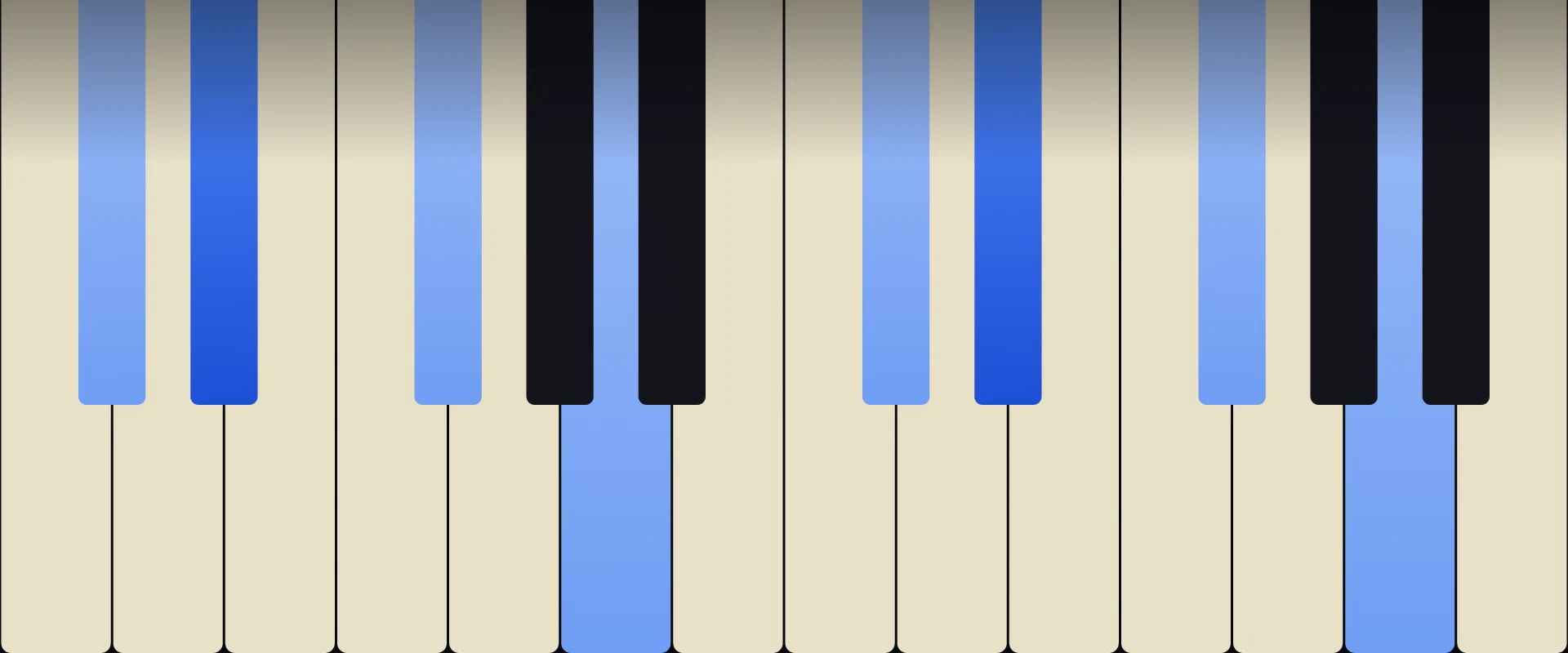
Three black keys and one white. The white one is A, wedged between G♯ and A♯ at the front of the keyboard, and it is also the note that makes the chord half-diminished, so the hand reaches forward for the pitch carrying the identity.
Right hand fingering 1 on D♯, 2 on F♯, 3 on A and 5 on C♯. The shape goes back, back, forward, back, and that in and out motion is the whole difficulty. Let the third finger extend on its own rather than dragging the hand out of the black keys after it, or D♯ and F♯ will slide off their narrow edges.
Set it beside D♯m7, D♯ F♯ A♯ C♯, and you have a demonstration. That chord is four black keys and a perfectly level hand. Lower the A♯ one semitone and the hand tilts, the wrist rotates, and a comfortable shape turns awkward. The theoretical distance is the smallest available. The physical distance is not.
D♯m7♭5 on the Guitar
The grip to learn first is x 6 7 6 7 x, root on the 5th string at the 6th fret. Middle finger on the 5th string, index on the 3rd, ring and little finger on the 4th and 2nd at the 7th fret. No barre, four notes, none doubled, and it lands in the comfortable middle of the neck.
That shape is one fret away from something quite different. Move the index finger on the 3rd string back to the 5th fret, giving x 6 7 5 7 x, and C♯ becomes C natural: the chord is now D♯dim7, the fully diminished seventh. One finger, one fret, and the chord stops being the ii of a minor key and starts behaving like a dominant. Guitarists who confuse the two symbols usually do so because the grips are neighbours.
For a root on the 6th string, 11 x 11 11 10 x puts D♯ at the 11th fret, with C♯ and F♯ above it and A one fret back. Despite the repeated fret number it is no barre, since the 5th string must be muted, and up there muting is the harder half of the job.
Why bother is a question about the key. C♯ minor and E major are what open strings give you, so this chord turns up in guitar written music far more often than its symbol suggests, and a whole minor ii V i sits within three frets: x 6 7 6 7 x for D♯m7♭5, 4 6 4 5 4 4 for G♯7, x 4 6 4 5 4 for C♯m7. The hand walks down the neck as the harmony comes home.
Inversions
| Inversion | Notes | Lowest note |
|---|---|---|
| Root position | D♯ F♯ A C♯ | D♯ |
| 1st inversion | F♯ A C♯ D♯ | F♯ |
| 2nd inversion | A C♯ D♯ F♯ | A |
| 3rd inversion | C♯ D♯ F♯ A | C♯ |
First inversion is a chord with its own name. F♯, A, C♯ and D♯ is F♯m6 in root position, note for note, so the bass alone decides which a listener hears. Every half-diminished chord is the minor 6th chord a minor third below it, and arrangers use that freely: F♯m6 when the music is resting, D♯m7♭5 when it is going somewhere.
Third inversion has one real use, C♯ in the bass holding the tonic note of C♯ minor under a chord that has not yet reached it. Second inversion, with the diminished fifth underneath, is the least stable arrangement and almost never chosen.
Voicings
Put the whole chord over a B in the bass and you have B9, since B, D♯, F♯, A and C♯ is exactly what B9 contains. In E major these four notes are a dominant ninth minus its root, which is why they replace B7 outright and sound lighter doing it. Drop the D♯ too and the remaining F♯, A and C♯ is a plain F♯ minor triad.
In four parts, give the A room: D♯ at the bottom, then A, then C♯, then F♯ on top, so the diminished fifth reads as structure rather than as a colour note added late.
Guitarists can strip it to x 6 7 x 7 x, D♯, A and F♯: root, diminished fifth and third, with the seventh left to the bass or the melody. The A is the one note that may never be dropped.
Which Keys Contain D♯m7♭5
- viiø7 of E major
- iiø7 of C♯ natural minor
- iiø7 of C♯ harmonic minor
- viø7 of F♯ dorian
- iø7 of D♯ locrian
- Contained in E♭ blues
Five of the six are sharp keys, which is the spelling argument arriving from the practical end. The last row is for improvisers, and that page writes the same four notes as E♭, G♭, A and D♭. Only the A survives the translation intact.
Where D♯m7♭5 Shows Up
iiø7, V7, i: D♯m7♭5, G♯7, C♯m. The minor ii V i, and the reason most players ever learn this chord. D♯ and F♯ hold through the first change while A and C♯ each fall a semitone, to G♯ and to the B♯ that is the third of G♯7. C♯ minor is no jazz key by habit, but it is a rock key by geography, and this cadence turns up constantly in music that would never call it a ii V.
I, viiø7, I: E, D♯m7♭5, E. The chord acting as the dominant it very nearly is. D♯ rises to E, A falls to G♯, C♯ steps to B, and the return is softer than a B7 would give, because no root arrives underneath to announce it.
A blues lick, unnamed. Every note lives inside the E♭ blues scale, so a soloist working that scale cannot land outside this harmony. The gap between D♯m7♭5 on a page of theory and the same four pitches under a guitarist’s fingers is a matter of vocabulary, not of sound.
Related Chords
- D♯ Diminished Chord
- E♭ Minor 7th Chord
- F♯ Minor 6th Chord
- C♯ Minor Chord
- Secondary Dominants and Borrowed Chords
Learn More
Practice Chords
Drill chord recognition with a metronome, MIDI support, and score tracking.
Start PracticingRelated Articles
A Half-diminished Chord: Notes, Voicings, and How to Play It
Aug 31, 2026 · 8 min
B Half-diminished Chord: Notes, Voicings, and How to Play It
Aug 31, 2026 · 8 min
B♭ Half-diminished Chord: Notes, Voicings, and How to Play It
Aug 31, 2026 · 8 min