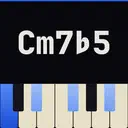
Half-diminished chords have a reputation for living in jazz charts, three ledger lines up. This one takes a single finger on a guitar. Hold the fifth string at the 4th fret, let the third, second and first strings ring, and you have C♯, G, B and E: the whole chord. The three notes you did not have to find are the flattened third, the flattened fifth and the seventh.
That is a fair summary of the chord. As a sound it is nearly free. As a function it depends entirely on the note underneath, because these four pitches also spell a minor sixth chord.
Try It: C♯m7♭5 in the Chord Finder
The Notes of C♯m7♭5
| Degree | Note | Interval from root | Semitones |
|---|---|---|---|
| 1 | C♯ | Root | 0 |
| ♭3 | E | Minor 3rd | 3 |
| ♭5 | G | Diminished 5th | 6 |
| ♭7 | B | Minor 7th | 10 |
One accidental, and it is on the root. The symbol is often written C♯ø7, which looks more forbidding than the three plain letters above it. Watch the seventh: B sits ten semitones up. Lower it one more semitone to B♭ and the chord becomes C♯dim7, a different chord with a different job.
How C♯m7♭5 Is Built
Start from the C♯ diminished triad, C♯, E and G, and add B on top. The stack reads minor third, minor third, major third, and that last interval decides everything. A fully diminished seventh stacks three minor thirds, comes out symmetrical, and can be read from any of its four notes. The major third here breaks the pattern: this chord has one root, one function, and it does not slide.
Read the four notes from E instead. E up to G is a minor third, E up to B a perfect fifth, E up to C♯ nine semitones across six letter names, a major sixth. That is Em6, rooted a minor third above C♯. Every half-diminished chord has a minor sixth twin built that way, and the C♯ minor 6th page works the mechanism through from the other side. What matters here is which twin you got: E minor is the easiest chord on a guitar, so this one arrives at the nut rather than at the 8th fret.
A third reading: A9 is A, C♯, E, G and B, so delete the A and this chord is what remains, a dominant ninth without its root, on the note that dominates D major.
C♯m7♭5 on the Piano
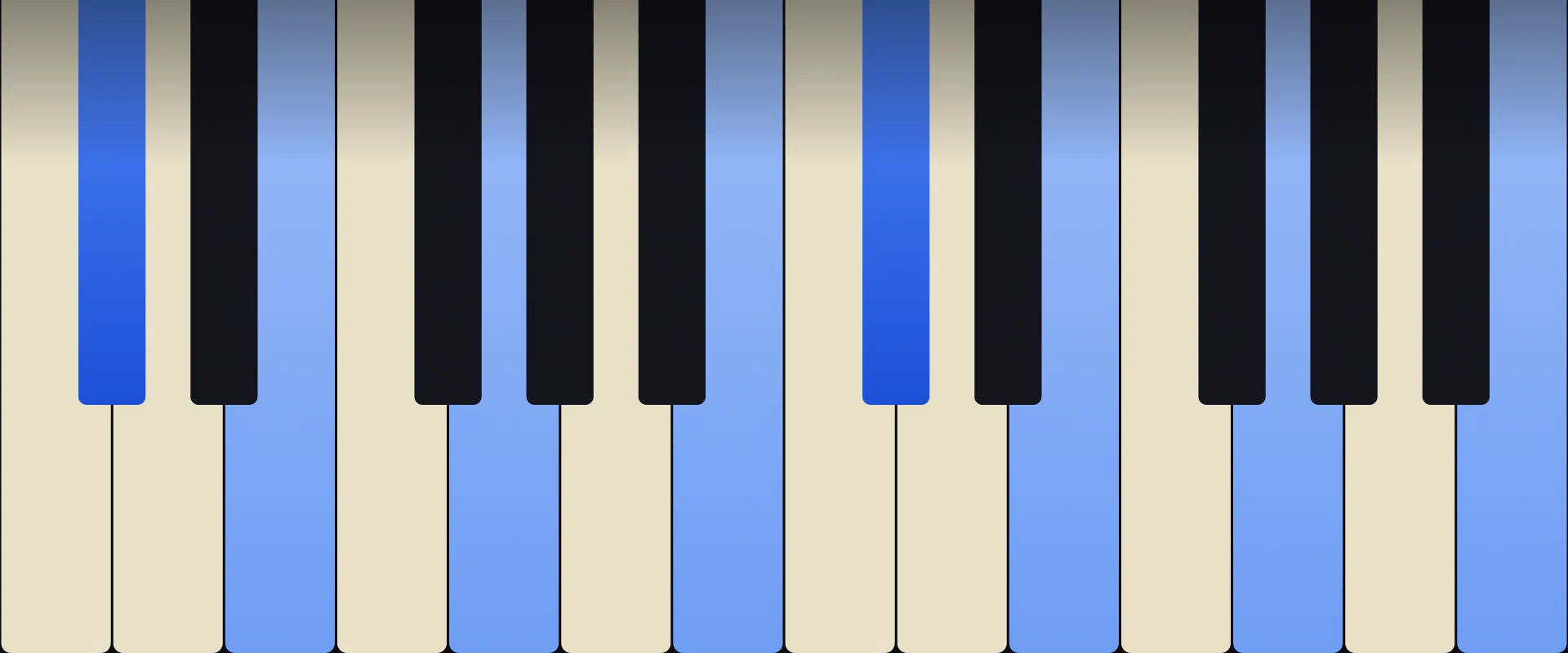
One black key and three white ones, unevenly placed. E sits just past the pair of black keys with none above it, and B does the same at the top of the group of three. G is the awkward one: it is walled in by F♯ and G♯, so the third finger travels forward between two black keys while the thumb stays back on C♯. That diagonal is the entire physical difficulty of the chord.
Right hand, root position: 1 on C♯, 2 on E, 3 on G, 5 on B. Left hand: 5, 4, 2, 1. Compare it with the minor seventh on this root and one key moves, G♯ down to G, black to white. The hand goes from four alternating levels to a thumb hanging behind three white keys, and that is the change fingers get wrong in the dark.
For two hands, split it as a tritone and a fifth. Left hand takes C♯ and G, the six semitones the chord is named for, right hand takes E and B above them. Turn that round and the tritone lands in the middle of the texture, where it goes cloudy.
C♯m7♭5 on the Guitar
The near open voicing is x 4 2 0 0 0: middle finger on the fourth string at the 2nd fret, ring finger on the fifth at the 4th, three open strings above. It sounds C♯, E, G, B, E. Mute the sixth string: letting the low E ring turns it into Em6.
The standard movable grip is x 4 5 4 5 x, sounding C♯, G, B, E: index across the middle strings at the 4th fret, ring finger on the fourth string at the 5th, little finger on the second at the 5th. Jazz guitarists reach for it without thinking: it moves anywhere and never rings on.
With the root on the sixth string the chord sits at the 9th fret, 9 x 9 9 8 x, giving C♯, B, E, G. Narrow frets up there help the stretch and thin the tone. It is the same fret as the minor seventh on this root, with the second string moved down one, which is the whole difference between a perfect fifth and a flattened one.
The lazy route is often the right one. Play an open Em6, 0 2 2 0 2 0, and ask the bass player for C♯. Nobody leaves first position, the chord rings like the open chord it is, and the harmony is identical.
Inversions
| Inversion | Notes | Lowest note |
|---|---|---|
| Root position | C♯ E G B | C♯ |
| 1st inversion | E G B C♯ | E |
| 2nd inversion | G B C♯ E | G |
| 3rd inversion | B C♯ E G | B |
First inversion is barely an inversion. With E underneath, the notes above it make a plain E minor triad and the ear files the chord as Em6, whatever the chart says. Second inversion is the one to avoid: a flattened fifth in the bass removes what stability is left. Third inversion is quietly useful in B minor, where B is the tonic note and the chord becomes a tension resting on a pedal.
Voicings
Drop E if you need three notes. C♯, G and B are the root, the flattened fifth and the seventh, and they carry the identity between them. The opposite economy is just as common: leave the root to a bass player and hold E, G and B, an E minor triad over a note that is not in it.
Add D♯ on top and the chord brightens. That note is not in B minor, whose second degree carries D natural, so it does not come from the key the chord usually serves. It comes from E melodic minor, and using it means treating this as the sixth degree of that scale instead. Charts write C♯ø9 or leave it to the player.
Which Keys Contain C♯m7♭5
- viiø7 of D major
- iiø7 of B natural minor
- iiø7 of B harmonic minor
- viø7 of E melodic minor
- iø7 of C♯ locrian
- inside C♯ blues
The first two do the real work. D major and B minor are relatives, which is why the same four notes are the seventh degree of one and the second degree of the other, and between them they cover a great deal of ordinary guitar and fiddle repertoire. C♯ locrian is the mode built on the chord, useful for improvising over it and little else. The last entry is the surprise: C♯ blues is C♯, E, F♯, G, G♯ and B, so the flattened fifth that makes this chord sound sophisticated is the same G a blues player bends into as a blue note.
Where C♯m7♭5 Shows Up
| Progression | Chords | Turns up in |
|---|---|---|
| iiø7 V7 i in B minor | C♯m7♭5, F♯7, Bm | Minor jazz standards, ballads |
| viiø7 to I in D major | C♯m7♭5, D | Rootless A9, gospel and soul comping |
| Borrowed iiø7 in B major | C♯m7, C♯m7♭5, F♯7, Bmaj7 | Pop and soul turnarounds |
| Em6 over a walking bass | Em6, Em6/C♯, Bm | Folk and pop arrangements |
Row one is the chord’s day job, and the voice leading explains why it is so easy to use. F♯7 is F♯, A♯, C♯ and E. Two of those, C♯ and E, are already here and stay put, while G falls a semitone to F♯ and B falls a semitone to A♯. Two voices held, two dropping by the smallest step available, nobody leaping. B minor is the relative minor of D, so the cadence lives in a key guitarists use constantly, not one that needs a jazz education.
Row two is the version most players use without naming it. In D major the chord sits on the leading note, carries no accidental the key does not already have, and pulls home the way a dominant does because it is one with its root removed. Its near neighbour is C♯dim7, which puts B♭ where this chord puts B. That semitone separates a chord belonging to D major from a chord visiting from outside it, and charts are not always careful about which they print.
Row four is how the chord reaches players who never use the symbol. An arrangement in B minor sits on Em6, the bass walks down from E to C♯ underneath it, and a half-diminished chord happens. The name arrives later, if at all. Row three is the trick in reverse, a major key borrowing the darker second chord for a bar.
Related Chords
- C♯ Diminished Chord, the triad underneath this one, and the page on what the tritone does
- C♯ Minor 7th Chord, the same root with a perfect fifth, and a chord that rests instead of leaning
- E Minor 6th Chord, these four notes with the other bass note
- C♯ Minor 6th Chord, the identity worked through from the minor sixth side
- Seventh Chords: The Complete Guide
- The ii, V, I Progression
Learn More
Practice Chords
Drill chord recognition with a metronome, MIDI support, and score tracking.
Start PracticingRelated Articles
A Half-diminished Chord: Notes, Voicings, and How to Play It
Aug 31, 2026 · 8 min
B Half-diminished Chord: Notes, Voicings, and How to Play It
Aug 31, 2026 · 8 min
B♭ Half-diminished Chord: Notes, Voicings, and How to Play It
Aug 31, 2026 · 8 min