The name points at the wrong note. Everybody reading Cm7♭5 looks at the flattened fifth, because it is in the symbol, and that is the part this chord shares with the one it keeps being confused for. The top note is what decides its job. B♭ is an ordinary minor 7th above C, and that is all that makes this half diminished rather than fully diminished. Cdim7 keeps the same C, E♭ and G♭ and lowers the seventh one more semitone, to the key you play as A, spelled as a doubly flattened B. One key apart, and the two do unrelated work: Cdim7 divides the octave evenly and can be aimed almost anywhere, while Cm7♭5 belongs to B♭ minor and goes to F7.
Try It: Cm7♭5 in the Chord Finder
Set the root to C and the scale to Locrian. This chord is the one on the first degree, and Locrian is the only mode of the major scale where that happens.
The Notes of Cm7♭5
| Degree | Note | Interval from root | Semitones |
|---|---|---|---|
| 1 (root) | C | Perfect unison | 0 |
| ♭3 | E♭ | Minor 3rd | 3 |
| ♭5 | G♭ | Diminished 5th | 6 |
| ♭7 | B♭ | Minor 7th | 10 |
Written out: C, E♭, G♭, B♭. Three black keys and one white one, a lopsided ratio for a chord rooted on C and the first practical thing to know about it. A lead sheet may print the same chord as Cø7, and older editions write Cm7(♭5).
The chord is gentler than its reputation. C to G♭ is a tritone and it is the only one, since E♭ to B♭ is a perfect 5th and G♭ to B♭ a major 3rd. The fully diminished seventh on this root has two tritones and no perfect 5th, which is the real reason it cannot settle and this one can.
How Cm7♭5 Is Built
Start from C diminished, C, E♭ and G♭, and put B♭ on top. Or start from Cm7 and pull the G down a semitone. The second route is the one that matters: the two chords are one key apart on a keyboard and one fret apart on a guitar, and a great deal of minor key writing is the difference between them.
Read the stack upwards and it is a triad over a root. E♭, G♭ and B♭ are an E♭ minor triad, so Cm7♭5 is E♭ minor with a C underneath. That also explains the other name these notes answer to: put E♭ at the bottom and E♭, G♭, B♭, C is E♭m6 in root position. Every half diminished chord is a minor 6th chord rearranged, and the one here is built a minor 3rd above the root, not below it.
Cm7♭5 on the Piano
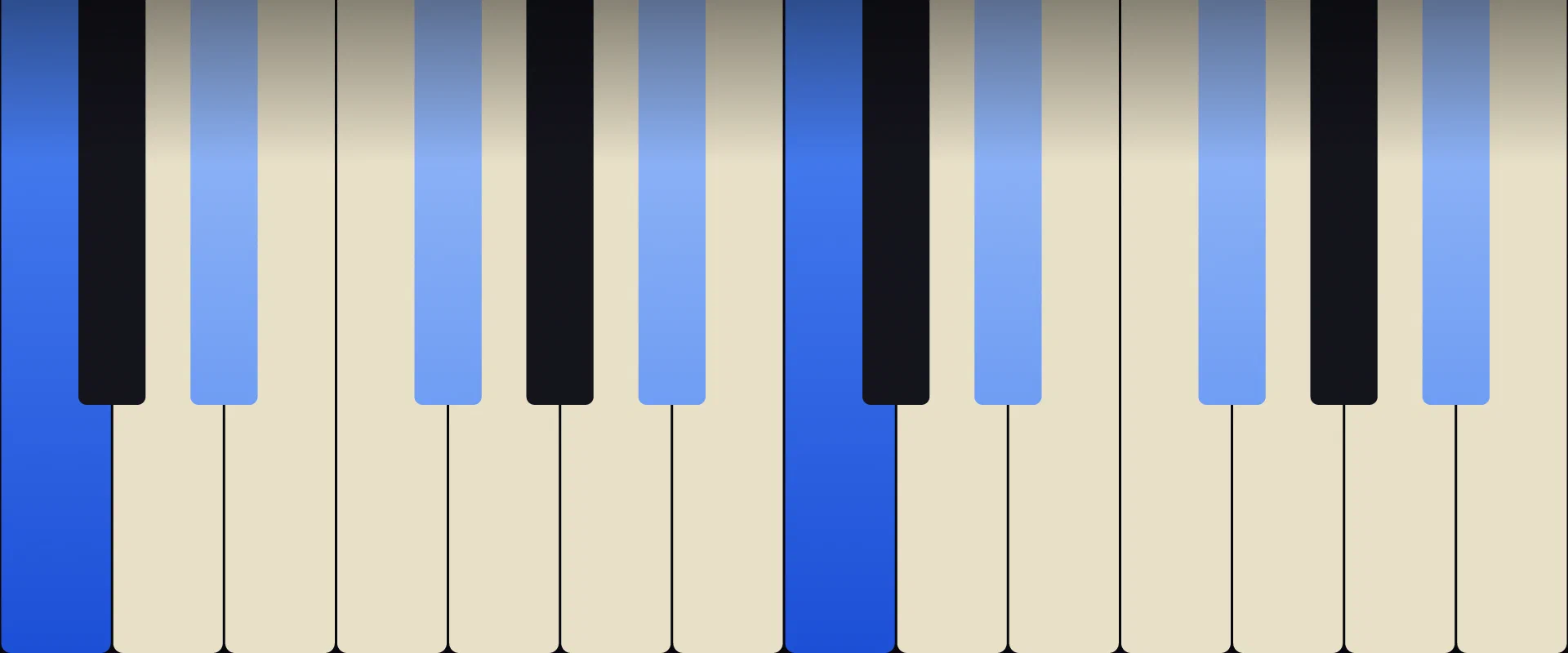
C is the only white key, and the other three are the ones a keyboard is easiest to navigate by. E♭ is the right hand key of the pair; G♭ is the left hand key of the triple and B♭ the right hand key of the same triple, so the chord can be found without looking down.
Right hand 1, 2, 3, 5: thumb on C out on the white plane, index on E♭, middle on G♭, little finger on B♭. Three fingers up on the raised keys with one down at the front is a settled grip, steadier than it sounds, and it is why this chord is often easier to play than Cm7, which differs from it by a single key. Left hand, upwards, is 5, 3, 2, 1.
The exercise that teaches it fastest uses only the left hand. Hold C, E♭, G♭ and B♭ on the right and do not move. C underneath gives Cm7♭5, E♭ underneath gives E♭m6, and A♭ underneath gives a complete A♭9, root, 3rd, 5th, 7th and 9th, nothing missing and nothing spare. Three symbols, one hand shape, and the bass is the only variable.
Cm7♭5 on the Guitar
Not one of the six open strings belongs to this chord. E, A, D, G, B and E: it wants C, E♭, G♭ and B♭ and is offered none of them. Every note is fretted, in every position, with no capo trick that gets round it, which is a short explanation for why guitarists learn this chord late.
What they get in return is that no barre is needed. The 5th string root shape is x 3 4 3 4 x, straight out of the minor seventh next door: Cm7 is x 3 5 3 4 3, so pull the 4th string back one fret and lift the top string off. Four fingers, one each, and the frets alternate 3, 4, 3, 4 across four neighbouring strings, a pattern the hand remembers.
With the root on the 6th string the grip is 8 x 8 8 7 x, C, B♭, E♭ and G♭ from the bottom up: middle finger on the 6th string, ring finger laid flat across the 4th and 3rd at the 8th fret, index on the 2nd at the 7th. On the top four strings alone, x x 10 8 7 6 spells C, E♭, G♭, B♭ in order, the fret numbers falling one at a time so the fingers land in a diagonal.
The reason to know the 8th fret version is the company it keeps. Play Cm7♭5 at 8 x 8 8 7 x, then F7♭9 at x 8 7 8 7 x, then B♭m at 6 8 8 6 6 6. Three frets hold an entire minor cadence and the hand never leaves the position.
Inversions
| Inversion | Notes | Bass | Symbol |
|---|---|---|---|
| Root position | C E♭ G♭ B♭ | C | Cm7♭5 |
| 1st inversion | E♭ G♭ B♭ C | E♭ | Cm7♭5/E♭ |
| 2nd inversion | G♭ B♭ C E♭ | G♭ | Cm7♭5/G♭ |
| 3rd inversion | B♭ C E♭ G♭ | B♭ | Cm7♭5/B♭ |
Read the second row as its own chord and it is E♭m6, which is how arrangers write this sound without the half diminished label. The twinning runs the other way too: the partner of Cm6 is not this chord but Am7♭5.
The bottom row is the odd one. B♭ is the tonic of the key this chord normally serves, so putting it underneath removes the reason to move and the pull towards F7 disappears. For the mechanics, see Chord Inversions and Voice Leading.
Voicings
Spread it out. Packed into one hand below middle C, the minor 3rd at the bottom and the tritone above it blur into one dark smudge.
| Shape | Frets | Result |
|---|---|---|
| Cm7♭5 | x 3 4 3 4 x | 5th string root, no barre |
| Cm7♭5 | 8 x 8 8 7 x | 6th string root, 8th fret |
| Cm7♭5 | x x 10 8 7 6 | Top four strings, diagonal |
| Cm7♭5 | x 3 4 3 x x | Shell: root, ♭5, ♭7 |
| E♭m | x 6 8 8 7 6 | The upper triad, over a C bass |
| F7♭9 | x 8 7 8 7 x | Where the chord goes next |
Which Keys Contain Cm7♭5
- degree 1 (I) of C locrian
- degree 2 (II) of B♭ natural minor
- degree 2 (II) of B♭ harmonic minor
- degree 6 (VI) of E♭ melodic minor
- degree 7 (VII) of D♭ major
- rooted on degree 1 of, and entirely contained in, C blues
The fourth row is the practical one and it hides in the list. Starting E♭ melodic minor from its sixth degree gives C, D, E♭, F, G♭, A♭ and B♭, which is C Locrian with D natural instead of D♭. Both fit the chord, since it contains neither note, and most players take the D: a flattened second a semitone above the root sounds like a complaint. Row one is the textbook answer, row four is what gets played.
The last row overlaps differently. C blues is C, E♭, F, G♭, G and B♭, and four of those six are this chord. One of the two left over is G, a semitone above the chord’s own G♭, so a guitarist bending into the blue note over a C7 passes through this chord on the way.
Where Cm7♭5 Shows Up
| Progression | Chords | Context |
|---|---|---|
| iiø7 V7 i (B♭ minor) | Cm7♭5, F7♭9, B♭m | The minor ii V i |
| Borrowed iiø7 (B♭ major) | B♭maj7, Cm7♭5, F7♭9, B♭m | Turn to the parallel minor |
| viiø7 I (D♭ major) | Cm7♭5, D♭maj7 | Leading note chord |
| Rootless A♭9 | Cm7♭5 over A♭ | Comping under a soloist |
The first row is one of the smoothest moves in harmony and almost nobody notices it. F7♭9 is F, A, C, E♭ and G♭, so three of this chord’s four notes are already in it. Only the B♭ moves, falling a semitone to A, while the G♭ that makes the chord half diminished becomes the flattened ninth of the dominant and does not budge. One voice, one semitone, and the ii V is done. Compare the major version in The ii V I Progression.
Row two is where most listeners have actually met the chord: a song sitting comfortably in B♭ major reaches for Cm7♭5 in the bar before a final chorus, and the flattened fifth is the first sign the key is about to darken. It is a heavier borrowing than plain Cm7, which keeps the G that B♭ major already owns. Row four is the same notes read from below: a pianist who leaves the root to the bass and plays this shape over an A♭ has comped A♭9.
Key signatures explain the rest. Both homes this chord has, B♭ minor and D♭ major, carry five flats, which costs a pianist nothing and is expensive on a guitar with no open string in either key. So Cm7♭5 does its classical job, the leading note seventh of row three, mainly under somebody’s left hand, while guitar led music meets it as a visitor borrowed into B♭ major.
Related Chords
- C Diminished Chord, the triad these four notes are built on
- C Minor 7th Chord, G in place of G♭, one key and a whole change of function
- E♭ Minor 6th Chord, the identical four notes with E♭ underneath
- C Minor 6th Chord, the same twinning seen from the other side
- Seventh Chords: The Complete Guide for where the half diminished sits among the rest
- Guitar Chord Shapes: The CAGED System for moving these grips around the neck
Learn More
Practice Chords
Drill chord recognition with a metronome, MIDI support, and score tracking.
Start PracticingRelated Articles
A Half-diminished Chord: Notes, Voicings, and How to Play It
Aug 31, 2026 · 8 min
B Half-diminished Chord: Notes, Voicings, and How to Play It
Aug 31, 2026 · 8 min
B♭ Half-diminished Chord: Notes, Voicings, and How to Play It
Aug 31, 2026 · 8 min