Take the open B7 that most beginners learn in their first year, x21202, and lift the index finger off the fourth string. What is left is x20202, and that is Bm7: B, D, F♯ and A. One finger fewer. The finger you removed was the one holding the third, so on this root the gesture that turns a chord minor is also the gesture that makes it easier to play.
That matters more here than on most roots, because B minor is the chord this instrument withholds. The plain triad has no open form and the working grip is a full barre at the second fret. Add a note to it and the barre goes away. The seventh is the cheap chord and the triad is the expensive one, which is close to the reverse of how the guitar usually behaves.
Try It: Bm7 in the Chord Finder
The Notes of Bm7
| Degree | Note | Interval from Root | Semitones |
|---|---|---|---|
| 1 (Root) | B | Perfect unison | 0 |
| ♭3 | D | Minor 3rd | 3 |
| 5 | F♯ | Perfect 5th | 7 |
| ♭7 | A | Minor 7th | 10 |
One accidental, and it is neither the note that makes the chord minor nor the note that makes it a seventh. B7 is B, D♯, F♯ and A, so both chords take the same plain A on top. Only the thirds disagree.
How Bm7 Is Built
Stack a minor seventh on the B minor triad. B, D and F♯ stay where they are and A joins them ten semitones above the root.
Now measure the inside of the chord. B to D is three semitones, D to F♯ four, F♯ to A three, and A up to the next B two. There is no semitone anywhere in it and no tritone either. None of the other seventh chords on this root can say that: B7 carries a tritone between D♯ and A, Bmaj7 has the semitone between A♯ and B, the half diminished chord has a tritone from its root up, and the diminished seventh has two. Bm7 holds no interval that wants to move, which is why it sits still and why players get away with putting it where the triad was written.
The four notes have a second home. Set D at the bottom and they read D, F♯, A, B, which is D6 in root position. Not a similar chord, the same pitches, with the bass deciding which name is written. The chord a guitarist in D reaches for instead of the vi is that key’s tonic with its sixth underneath.
Bm7 on the Piano
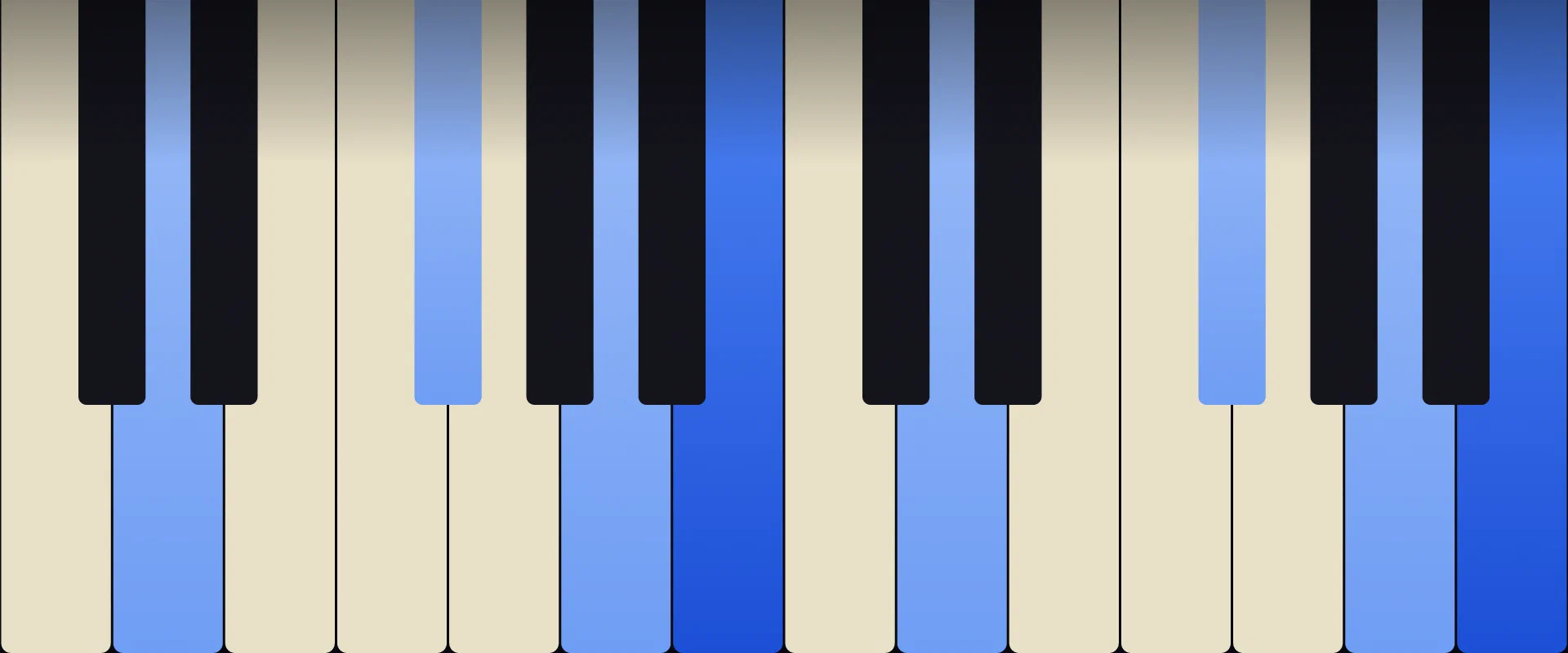
Three white keys and one black, and the black key is third from the bottom, so the hand goes out to F♯ in the middle of the shape and comes back to white for the seventh. Right hand, 1 on B, 2 on D, 3 on F♯, 5 on A: ten semitones of span, wide but flat, with only the middle finger leaving the front of the keyboard. Left hand, 5, 3, 2, 1.
There is a faster way in than counting intervals. Play a D major triad, D F♯ A, in the right hand and put a single B underneath it in the left. That is the whole chord. D major is a shape most players own long before they meet a minor seventh, so Bm7 is available on day one as D over B, and every voicing question afterwards is where to put the B.
Four of the five notes of the B minor pentatonic scale are B, D, F♯ and A. The one it leaves out is E, so a hand improvising on that scale over this chord meets a non chord tone only there, and E over Bm7 reads as a suspension rather than a clash.
Bm7 on the Guitar
x20202, string by string: root B on the fifth string at fret 2, the fourth string open for D, A on the third string at fret 2, the second string open for another B, and F♯ on the first string at fret 2. Three fingers, all at one fret, with an open string between each pair of them.
Low to high it sounds B, D, A, B, F♯. The seventh is buried under a doubled root instead of ringing on top, which is why the shape comes out hollow rather than sweet.
Three other chords sit one finger away. Press the fourth string at fret 1 and D becomes D♯, giving B7. Move the third string finger back a fret and A becomes G♯, giving Bm6. Leave the fifth string out and xx0202 is D6, the same fretting with the root removed from underneath.
Against all that, the triad. B minor is x24432, and the disagreement is on the third string: the triad needs a B there, at fret 4, while the seventh accepts an A at fret 2. Barre both and the accounting is plain. In x24432 the index barre sounds only two strings, the fifth and the first, and three fingers crowd into frets 3 and 4 behind it. In x24232 the third string drops onto the barre, which now earns three strings, and two fingers work above it instead of three.
Higher up, 797777 puts the Em7 shape at the seventh fret: a barre across fret 7 and one finger on the fifth string at fret 9 for F♯. That is the easiest of the three by a distance, and it costs the register, landing an octave clear of the open D, G and A shapes this chord sits between.
Inversions
| Inversion | Notes | Bass Note |
|---|---|---|
| Root position | B D F♯ A | B |
| 1st inversion | D F♯ A B | D |
| 2nd inversion | F♯ A B D | F♯ |
| 3rd inversion | A B D F♯ | A |
First inversion is the one to know. D, F♯, A, B read upwards is D6 in root position, so a bass player walking from B down to D under a held right hand renames the chord without altering a pitch.
Voicings
At the keyboard, put B alone low in the left hand and D, F♯ and A above it in the right. A and B are a whole tone apart and that is the only narrow interval here, so opening the gap between them is what keeps the chord transparent.
On guitar, xx4232 drops the root and leaves a plain D major triad across the top four strings. With a bass on B that is a complete Bm7, and it moves to the open D and G shapes without changing register.
Which Keys Contain Bm7
- degree 6 (VI) of D major
- degree 2 (II) of A major
- degree 3 (III) of G major
- degree 1 (I) of B natural minor
- degree 1 (I) of B dorian
- degree 1 (I) of B phrygian
The last three entries are one fact. B natural minor, B Dorian and B Phrygian disagree about their second and sixth degrees, C♯ against C and G against G♯, and this chord contains neither degree. It is the tonic seventh of all three and cannot tell you which one you are in. Bm6 can, since its G♯ forces Dorian. Bm7 waits for the next chord to settle it.
Where Bm7 Shows Up
| Progression | Numerals | Chords |
|---|---|---|
| Pop loop in D | I, V, vi7, IV | D, A, Bm7, G |
| Cadence in A | ii7, V7, I | Bm7, E7, A |
| Dorian vamp in B | i7, IV | Bm7, E |
| Turnaround in B minor | i7, iv7, ♭VII | Bm7, Em7, A |
The first row is where the substitution earns its keep. D, A and G are open shapes and the vi was the only barre in the loop. The added A is the fifth degree of D, the note the key leans on hardest, so nothing foreign arrives: it works as a pedal tone, ringing the dominant of the key through the vi chord. The limit sits in the same fact. A is also the root of the chord next door, so an arrangement that needs the vi to land as a clear change of harmony wants the plain triad.
The second row is unusual in a way worth noticing. A jazz cadence in A major can be played in first position with no barre anywhere: x20202 for Bm7, 020100 for E7, x02220 for A. Little else in the ii, V, I repertoire is that cheap on this instrument.
Rows three and four are the same chord waiting for different company. Follow it with E major and the G♯ inside that chord puts the passage in B Dorian. Follow it with Em7 and the G natural puts it in B minor. Neither is signalled in advance, and the Dorian version is the one modal players reach for, since both of its chords are easy here.
Related Chords
- B Minor Chord
- D Major 6th Chord
- B Dominant 7th Chord
- B Minor 6th Chord
- B Dorian Scale
- Guitar Chord Shapes: The CAGED System
Learn More
Practice Chords
Drill chord recognition with a metronome, MIDI support, and score tracking.
Start PracticingRelated Articles
A Minor 7th Chord: Notes, Voicings, and How to Play It
Aug 30, 2026 · 8 min
A♭ Minor 7th Chord: Notes, Voicings, and How to Play It
Aug 30, 2026 · 8 min
B♭ Minor 7th Chord: Notes, Voicings, and How to Play It
Aug 30, 2026 · 8 min