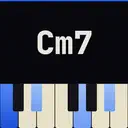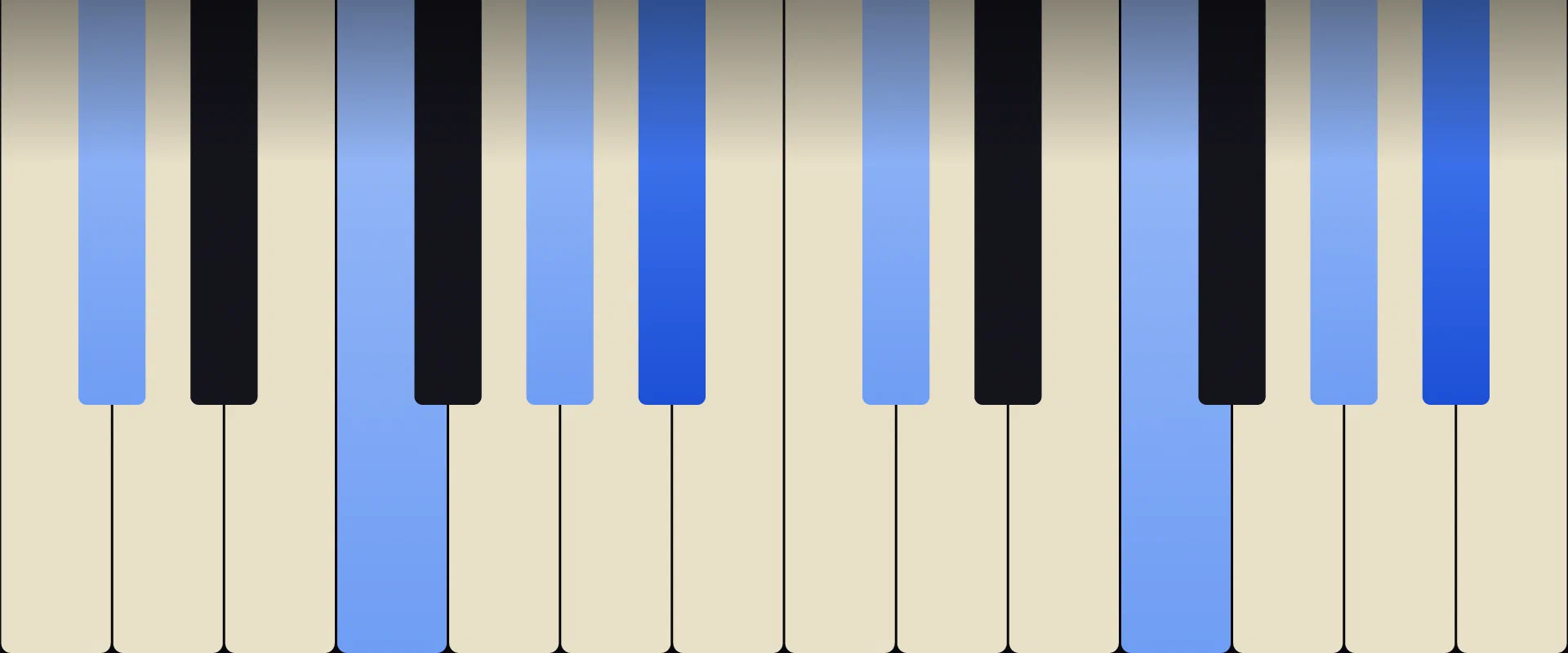
Adding a note to a chord normally costs a finger. At the 1st fret, B♭m7 costs one fewer than B♭m does. The little finger pinning B♭ on the third string at fret 3 lifts, the string falls back onto the barre, and what it sounds there is A♭, exactly the note the seventh chord wanted. The most awkward position on the neck gets easier the moment the harmony gets harder, which is not how this usually goes.
The four notes are B♭, D♭, F and A♭. Three are black keys, and anyone who has met this chord in the wild has almost certainly met it as the ii of A♭ major.
Try It: B♭m7 in the Chord Finder
Sound the minor triad on B♭, then add the 7th and listen to what A♭ does to it.
The Notes of B♭m7
B♭m7 has four notes: B♭, D♭, F and A♭.
| Degree | Note | Interval from B♭ | Semitones |
|---|---|---|---|
| 1 (root) | B♭ | Perfect unison | 0 |
| ♭3 | D♭ | Minor 3rd | 3 |
| 5 | F | Perfect 5th | 7 |
| ♭7 | A♭ | Minor 7th | 10 |
Written B♭m7, and B♭-7 on plenty of big band parts, where the dash saves ink.
How B♭m7 Is Built
Take B♭ minor, B♭ D♭ F, and put A♭ a minor 7th above the root. The key signature of B♭ minor already carries A♭, so this addition costs no accidental: four notes of the chord’s own key, nothing borrowed and nothing cancelled.
Read the same four keys from D♭ upwards and D♭, F, A♭, B♭ is a root, a major 3rd, a 5th and a major 6th: D♭6. Every letter in it is one B♭m7 was using already, so the twin needs no respelling at all. The sharp side is dearer. This site’s twelve roots take C♯ rather than D♭ for that pitch class, so the same keys appear as C♯6, spelled C♯, E♯, G♯ and A♯, with the E♯ on the white key F. The bass decides which name applies and the surrounding key decides the spelling.
B♭m7 on the Piano
Three black keys and one white one, and the white one is the 5th. It is the only note the hand comes forward for, and it is well placed: F and C are the only two white keys with no black key immediately to their left, so the finger taking F drops in beside E♭ rather than threading a gap.
Right hand, 1 on B♭, 2 on D♭, 3 on F, 5 on A♭. The thumb starts on a raised key, which feels wrong for about a week, after which the shape is nearly self-correcting: every finger but the middle one stays back on the same plane. Left hand, 5 on B♭, 3 on D♭, 2 on F, 1 on A♭, which finishes the thumb on a black key.
Root, ♭3 and ♭7 are B♭, D♭ and A♭, all black, so a left hand playing the three notes that carry the chord never touches a white key. Move the bottom note up an octave and you have D♭ F A♭ B♭, D♭6 in root position, with no finger doing a different job than a moment ago. Only the lowest note changed, and with it the name.
B♭m7 on the Guitar
Nothing rings open: not one of E, A, D, G, B and E is B♭, D♭, F or A♭, so every voicing here is stopped from end to end.
The workhorse is the Am7 shape at the 1st fret, x 1 3 1 2 1: index barred across five strings at fret 1, ring finger on the D string at fret 3, middle finger on the B string at fret 2. Set it beside B♭m in the same place, x 1 3 3 2 1, and the saving is the little finger. In the triad it has to hold B♭ on the G string at fret 3; in the seventh chord that string is released onto the barre, where fret 1 gives A♭.
The barre is still the hard part, since frets are widest and strings stiffest beside the nut, but it is now worth more: of the five strings sounding, three come from the barre alone, B♭ on the A string, A♭ on the G string and F on top.
Fret 6 repeats the trick. B♭m as the Em shape is 6 8 8 6 6 6. Lift the ring finger off the D string and the note there falls from B♭ at fret 8 to A♭ at fret 6, giving 6 8 6 6 6 6, root on the sixth string. In both positions the finger that comes off was holding a doubled root, and in both the 7th is what replaces it.
Skip the barre altogether with x 1 x 1 2 x: B♭ on the A string, A♭ on the G string, D♭ on the B string. Root, ♭7 and ♭3, no 5th, no strain, and what most players reach for at tempo. Fret 6 is worth learning for its surroundings too, since the chord’s four notes are B♭ minor pentatonic with E♭ removed, so the hand holding the shape is already standing in the scale a solo would use. The CAGED system fills in what lies between.
Inversions
| Inversion | Notes | Bass note | Symbol |
|---|---|---|---|
| Root position | B♭ D♭ F A♭ | B♭ | B♭m7 |
| 1st inversion | D♭ F A♭ B♭ | D♭ | B♭m7/D♭, or D♭6 |
| 2nd inversion | F A♭ B♭ D♭ | F | B♭m7/F |
| 3rd inversion | A♭ B♭ D♭ F | A♭ | B♭m7/A♭ |
First inversion changes identity rather than colour: put D♭ underneath and most listeners hear a major 6th chord, because the bass has supplied a root the four notes support perfectly well.
Third inversion is the one for movement. A♭ in the bass falls a semitone to G, the 3rd of E♭7, so B♭m7/A♭ into E♭7/G walks the bass down one fret while the harmony turns the corner. Second inversion is the flat one. See Chord Inversions and Voice Leading.
Voicings
B♭ D♭ A♭ is the shell, root, ♭3 and ♭7, and what a left hand should default to.
Take the root out and D♭, F and A♭ is a D♭ major triad. Give that to the right hand over a bass B♭ and the chord sounds as a major triad on top of a minor harmony, which is much of why B♭m7 is warmer than the bare triad.
B♭ D♭ F A♭ C is B♭m9. C is the 2nd degree of B♭ minor and of B♭ dorian alike, so the 9th needs no decision made about it. Further stacking is in Extended Chords and Jazz Harmony.
Which Keys Contain B♭m7
- i of B♭ natural minor
- I of B♭ dorian
- ii of A♭ major
- vi of D♭ major
- iv of F natural minor
- v of E♭ natural minor
The first two differ by exactly one note. B♭ natural minor flattens its 6th degree to G♭, B♭ dorian keeps G natural, and this chord contains neither, so a vamp on it can sit still for eight bars without declaring a mode. The melody rather than the harmony has to say which is in force.
There is a sharp side to be aware of. The same four keys sit on degree 3 of F♯ major, spelled A♯, C♯, E♯ and G♯. Identical sounds, and the note you know as F written as E♯.
Where B♭m7 Shows Up
The chord’s day job is the front half of a cadence in A♭ major:
B♭m7 | E♭7 | A♭maj7
Watch the hand across that first bar line. B♭m7 and E♭7 hold two notes in common, B♭ and D♭, since D♭ is the 7th of E♭7. Only two notes move and both fall, F to E♭ and A♭ to G. The dominant arrives without the pianist lifting more than two fingers, and that economy is why the ii-V-I is voiced this way rather than rebuilt each bar.
A second use sits one semitone from something else entirely. In E♭ major the chord on this root is B♭7, the dominant, B♭ D F A♭. Flatten its 3rd to D♭ and it becomes B♭m7, which stops pointing at E♭ and points at A♭:
E♭maj7 | B♭m7 | E♭7 | A♭maj7
That is the ordinary route to the IV chord in a tune written in E♭: the key’s own dominant turned minor for one bar and spent on a different target. The note doing the work is the D that B♭7 insists on keeping natural.
As a tonic the chord loops rather than cadences:
B♭m7 | G♭maj7 | A♭7 | B♭m7
i, ♭VI and ♭VII, all three out of B♭ natural minor. B♭m7 and G♭maj7 share three notes, B♭, D♭ and F, so the change is one voice sliding from A♭ to G♭ and the loop drifts instead of stepping. On guitar the three roots sit on the sixth string at frets 6, 2 and 4, so the whole thing happens either side of the fret 6 shape and never at the 1st fret.
Under a singer the 7th earns its keep by staying out of the way: B♭m says the thing in three notes and closes it, while B♭m7 leaves the top of the chord open enough to sit beneath a held note without arguing with it.
Related Chords
- B♭ Minor Chord, the triad underneath, and the 1st fret grip before the 7th made it cheaper.
- B♭ Dominant 7th Chord, the same root and the same A♭ with D natural in place of D♭.
- C♯ Major 6th Chord, the same four keys named from the other end and written D♭6 wherever flats are in force.
- Seventh Chords: The Complete Guide, on how a minor 7th differs from the other three seventh chord types.
Learn More
Practice Chords
Drill chord recognition with a metronome, MIDI support, and score tracking.
Start PracticingRelated Articles
A Minor 7th Chord: Notes, Voicings, and How to Play It
Aug 30, 2026 · 8 min
A♭ Minor 7th Chord: Notes, Voicings, and How to Play It
Aug 30, 2026 · 8 min
B Minor 7th Chord: Notes, Voicings, and How to Play It
Aug 30, 2026 · 8 min