Four accidentals, all flats, and one of them lands on a white key. A♭m7 is A♭, C♭, E♭ and G♭, and the C♭ is what sends readers back to the keyboard to check whether the page is broken. Count the chord from the sharp side and it is G♯, B, D♯, F♯: three accidentals, and the awkward note comes out as a plain B. The sharp name wins on tidiness, and the reference still writes A♭m7, because a gospel chart in D♭ or G♭ that suddenly says G♯m7 costs the reader far more than one flat ever will.
Under the hands it is a generous chord. Its top three notes are a complete C♭ major triad, and on a guitar it takes a barre plus one finger. Only the spelling is difficult.
Try It: A♭m7 in the Chord Finder
The Notes of A♭m7
| Degree | Note | Interval from root |
|---|---|---|
| 1 | A♭ | Perfect unison |
| ♭3 | C♭ | Minor 3rd, 3 semitones |
| 5 | E♭ | Perfect 5th, 7 semitones |
| ♭7 | G♭ | Minor 7th, 10 semitones |
Written low to high in root position: A♭ C♭ E♭ G♭.
C♭ is played on the white key B. The letters of a chord rooted on A cannot move, so its third has to be a form of C, and the C three semitones above A♭ is C♭. The full case is on the A♭ Minor Chord page. The seventh adds no new trouble, since G♭ is a black key: the flat spelling still costs exactly one white key accidental.
Keys settle the argument, not counts. The chord is the supertonic of G♭ major, where everything around it carries flats too. That key is filed here under its enharmonic twin, F♯ major, which spells these same four notes G♯m7.
How A♭m7 Is Built
Take A♭m, A♭ C♭ E♭, and put G♭ a minor 7th above the root. Its two neighbours on this root differ by a single note: A♭7 has C where this has C♭, and A♭m6 has F where this has G♭.
Now ignore the root. C♭, E♭ and G♭ on their own are a C♭ major triad, so the chord is a major triad with a bass note a minor 3rd below it. Move C♭ to the bottom and the four notes become C♭6, filed here under B6, the sharp spelling of it. That buried major triad is why the chord sounds warm rather than mournful.
One more note explains why the root keeps two names at all. Lower the fifth a semitone and the chord turns half diminished, which on A♭ has to be spelled A♭ C♭ E𝄫 G♭. That E𝄫 is an E double flat, played on the white key D, so the flat spelling collapses and the reference switches to G♯. On this key, the chord with a perfect fifth is written from A♭ and the chord with a diminished fifth from G♯. The fifth decides the name of the root.
A♭m7 on the Piano
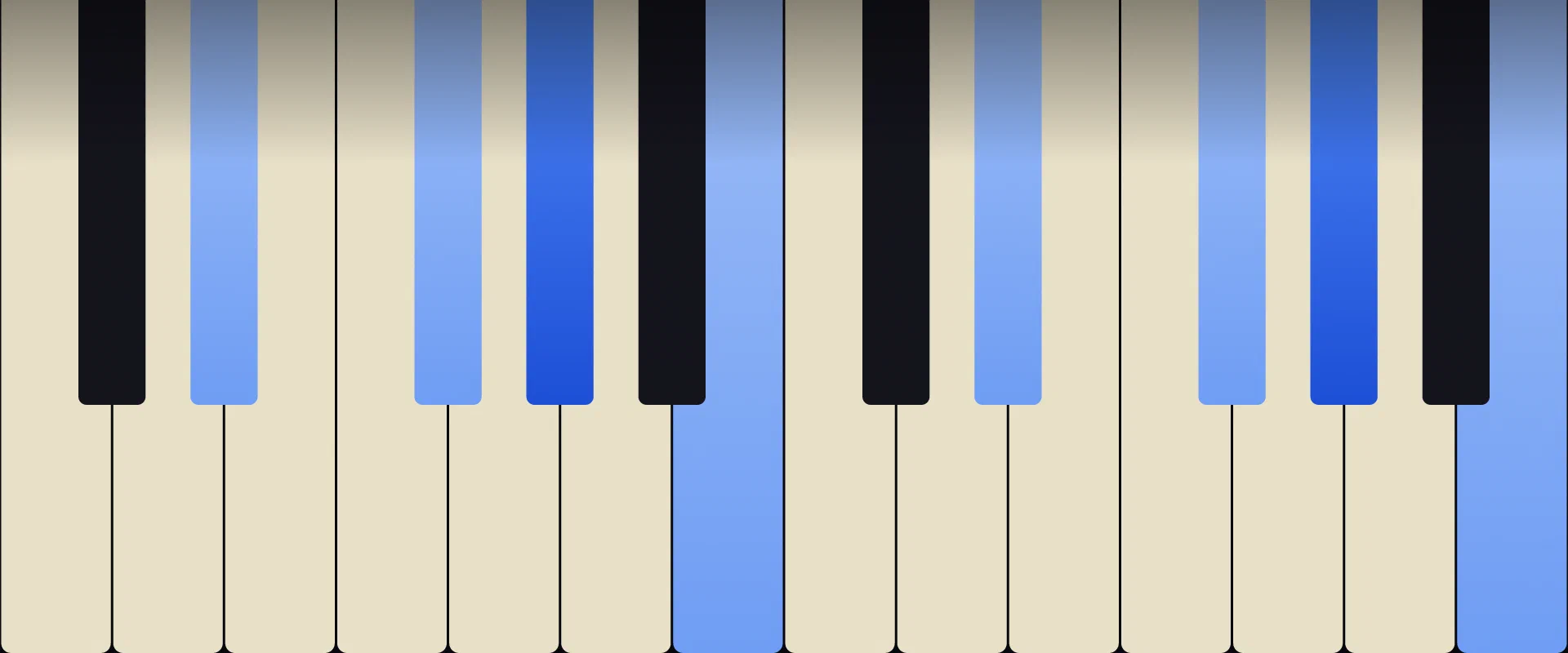
Three black keys and one white, and the way to hold them is not as a four note stack. Put A♭ in the left hand on its own and play C♭ E♭ G♭ with the right, 1 on C♭, 3 on E♭, 5 on G♭. That is a white key with two black ones above it, the most comfortable major triad grip on the instrument. Gospel and soul players voice the chord that way by reflex, which is why something that looks like six flats of trouble is often the first rich chord a young player finds at an organ.
Squeezed into one hand, root position runs 1 on A♭, 2 on C♭, 3 on E♭ and 5 on G♭: thumb deep on a black key, index forward on to a white one, then two fingers back on black keys again, so the hand changes depth once near the bottom and settles. Keep that arrangement out of the bass, where the three semitones from A♭ to C♭ turn any minor 7th into a rumble.
A♭m7 on the Guitar
There is no open form and no need for one. Bar the 4th fret across all six strings, add the ring finger on the fifth string at the 6th, and that is A♭m7: 4 6 4 4 4 4, one finger more than a bare barre. Nothing else on this root is that cheap. The plain triad wants 4 6 6 4 4 4, the dominant 7th 4 6 4 5 4 4 and the major 7th 4 6 5 5 4 4, so adding the minor 7th to A♭m actually takes a finger off the hand.
Lift the ring finger and what is left still has a name. The bare barre sounds A♭, D♭, G♭, C♭, E♭, A♭, every note of the chord plus the fourth, which is A♭m11. Rolling one finger on and off gives two chords without shifting position.
The one open string the chord could have used is the second, which sounds B, its C♭, and the barre lands on top of it. Bar only the top four strings and you get G♭ C♭ E♭ A♭, the whole chord with its seventh in the bass. The B6 page claims that same finger for the other name these notes answer to.
Higher up, the A shape gives x 11 13 11 12 11: the same notes an octave above, in a region where the frets are cramped and an acoustic’s body is in the way.
Soloing costs nothing extra. G♯ minor pentatonic is G♯, B, C♯, D♯, F♯, and its lowest box is rooted on the sixth string at the 4th fret, where the barre sits. Four of those five notes are chord tones.
Inversions
| Inversion | Notes low to high | Bass note |
|---|---|---|
| Root position | A♭ C♭ E♭ G♭ | A♭ |
| 1st inversion | C♭ E♭ G♭ A♭ | C♭ |
| 2nd inversion | E♭ G♭ A♭ C♭ | E♭ |
| 3rd inversion | G♭ A♭ C♭ E♭ | G♭ |
First inversion has a second identity. Read C♭ E♭ G♭ A♭ from the bottom and it is C♭6 in root position, so the bass note alone decides which of the two a listener hears.
Third inversion is what the four string barre gives you, and it leans. With the seventh underneath, G♭ tends to fall a semitone to F, and what arrives is F A♭ C♭ E♭, which is Fm7♭5.
Voicings
Drop the fifth. A♭, C♭ and G♭ fix the name, and E♭ can be left to somebody else.
Add B♭ above for A♭m9, A♭ C♭ E♭ G♭ B♭, which in neo soul is the default sound of the chord rather than a decoration of it. Add D♭ instead for A♭m11, the extension the six string barre hands a guitarist free.
Which Keys Contain A♭m7
- II of F♯ major
- III of E major
- I of G♯ natural minor
- I of A♭ dorian
- IV of E♭ natural minor
- IV of E♭ harmonic minor
The first three pages spell this chord G♯ B D♯ F♯. Same sound, different letters, and the split is not random: E major, F♯ major and G♯ minor are guitar keys, while E♭ minor and A♭ Dorian belong to keyboards, horns and singers.
F♯ major is the entry to look at, because G♭ major has no separate page here. Its supertonic, dominant and tonic in flats are A♭m7, D♭7, G♭maj7; from the sharp side, G♯m7, C♯7, F♯maj7.
Where A♭m7 Shows Up
| Progression | In letters | Where it lives |
|---|---|---|
| ii7, V7, Imaj7 | A♭m7, D♭7, G♭maj7 | The ii V I in G♭ major |
| iv7, ♭VII7, Imaj7 | A♭m7, D♭7, E♭maj7 | The backdoor cadence into E♭ major |
| I, vi7, IV, V | B, G♯m7, E, F♯ | Guitar pop in B major |
Rows one and two open with the same two chords and end somewhere different, which is the most useful thing to know here. Going from A♭m7 to D♭7 only two voices move: G♭ drops to F, E♭ drops to D♭, and A♭ and C♭ stay put. The pair sounds like one chord thickening rather than two chords changing, which is why keyboard players hold the shape and move the bass.
Where it lands is a choice. Down a fifth to G♭maj7 is the plain answer, worth playing once for the layout alone, since G♭ major puts five of its seven notes on black keys. Up a whole tone to E♭maj7 is the back door, and the ear takes it because the C♭ both chords were holding sinks a semitone into B♭, the fifth of the new key.
Row three is the same chord with no flats in sight. B, G♯m, E and F♯ is the four chord loop of a great many guitar records, and the full barre at the 4th fret sounds A♭m11 with one finger and A♭m7 with two. The plain triad is the version that costs extra effort, so those records are full of a seventh nobody wrote down.
Related Chords
- A♭ Minor Chord the triad underneath, and the full case for C♭
- A♭ Minor 6th Chord the same triad with F on top instead of G♭
- B Major 6th Chord these four notes read from the third upwards
- A♭ Dominant 7th Chord C natural instead of C♭, and a chord that has to leave
- A♭ Major 7th Chord C and G in place of C♭ and G♭
- A♭ Dorian Scale the mode this chord is the tonic of
- The ii, V, I Progression the cadence rows one and two are built from
Learn More
Practice Chords
Drill chord recognition with a metronome, MIDI support, and score tracking.
Start PracticingRelated Articles
A Minor 7th Chord: Notes, Voicings, and How to Play It
Aug 30, 2026 · 8 min
B Minor 7th Chord: Notes, Voicings, and How to Play It
Aug 30, 2026 · 8 min
B♭ Minor 7th Chord: Notes, Voicings, and How to Play It
Aug 30, 2026 · 8 min